Review
. 2019 Apr 16;20(8):1872.
doi: 10.3390/ijms20081872.

C-X-C Motif Chemokine Ligand 14 is a Unique Multifunctional Regulator of Tumor Progression

Affiliations
Review

C-X-C Motif Chemokine Ligand 14 is a Unique Multifunctional Regulator of Tumor Progression

Xiao-Yan Yang et al. Int J Mol Sci. .

Abstract

Cancer is a leading cause of death and disease worldwide, with a tremendous financial impact. Thus, the development of cost-effective novel approaches for suppressing tumor growth and progression is essential. In an attempt to identify the mechanisms responsible for tumor suppression, we screened for molecules downregulated in a cancer progression model and found that the chemokine CXCL14, also called BRAK, was the most significantly downregulated. Increasing the production of CXCL14 protein by transfecting tumor cells with a CXCL14 expression vector and transplanting the cells into the back skin of immunodeficient mice suppressed tumor cell growth compared with that of parental tumor cells, suggesting that CXCL14 suppressed tumor growth in vivo. However, some studies have reported that over-expression of CXCL14, especially in stromal cells, stimulated the progression of tumor formation. Transgenic mice expressing 10-fold more CXCL14 protein than wild-type C57BL/6 mice showed reduced rates of chemical carcinogenesis, transplanted tumor growth, and metastasis without apparent side effects. CXCL14 also acts as an antimicrobial molecule. In this review, we highlight recent studies involving the identification and characterization of CXCL14 in cancer progression and discuss the reasons for the context-dependent effects of CXCL14 on tumor formation.

Keywords: C-X-C motif chemokine ligand 14; antimicrobial function; molecular preventive medicine; multifunctional tumor suppressor.


Conflict of interest statement

The authors have no conflicts of interest to declare.

Figures
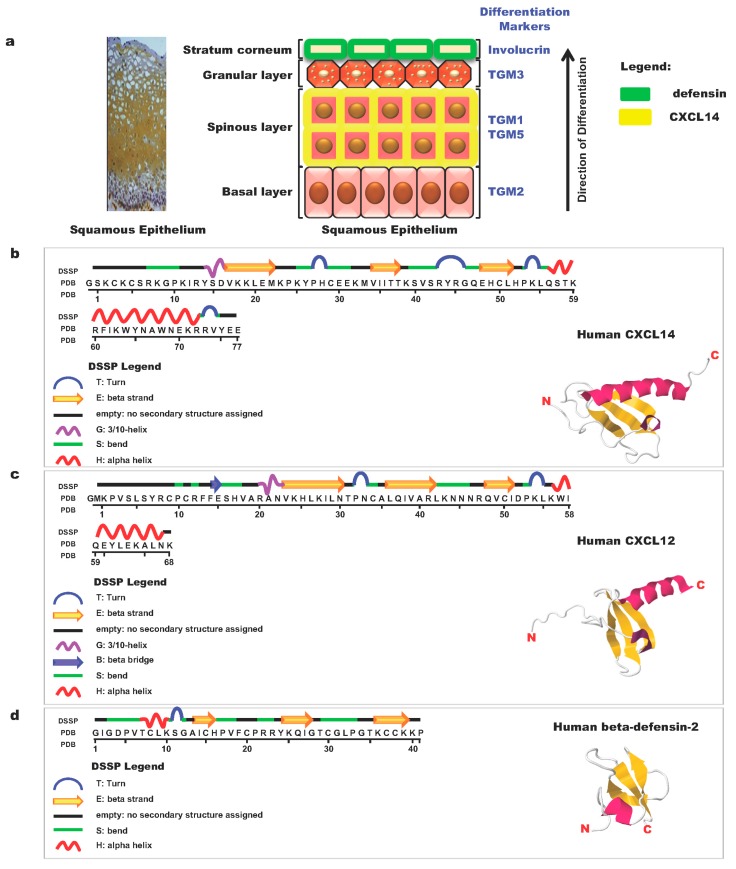
Figure 1
Figure 1
Schematic illustration of the structure of skin epithelial cell layers and representative molecules expressed in these layers [42]. (a) The structure of the squamous epithelial cell layer and localization of differentiation marker proteins, chemokines, and defensin. In the left panel, the tissue was treated with anti-human CXC ligand 14 (CXCL14) antibodies (brown in color). TGM: Transglutaminase. (b) Primary and three-dimensional structures of the human chemokine CXCL14 and its domain structure [43]. (c) Primary and three-dimensional structures of the human chemokine CXCL12 and its domain structure [44]. (d) Primary and three-dimensional structures of human beta-defensin-2 and its domain structure [45]. Structures of molecules were adopted from respective references.
Figure 2
Figure 2
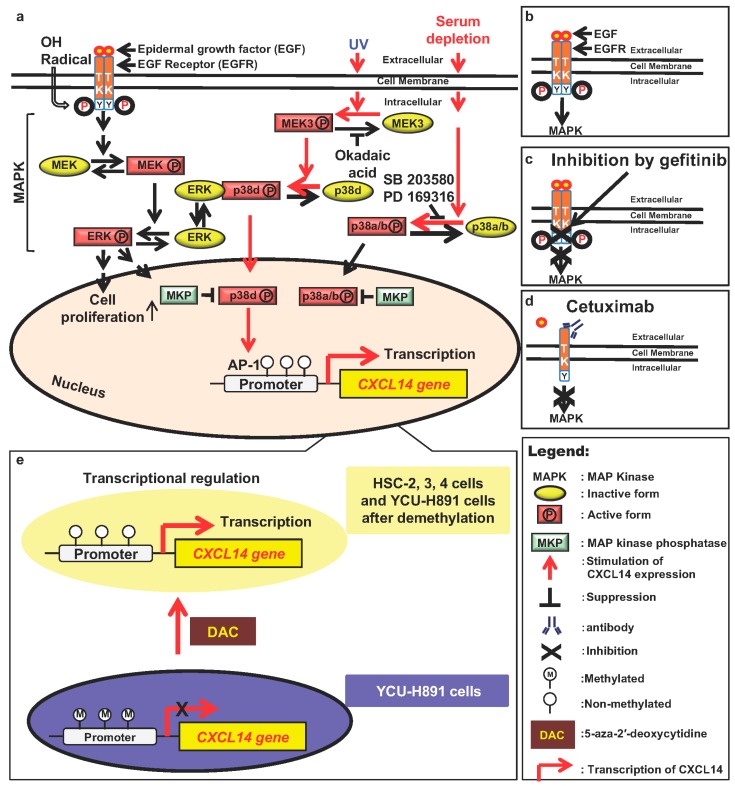
Regulation of CXCL14 expression by mitogen-activated protein kinase (MAPKs) and EGF receptor (EGFR) activators/inhibitors. Red arrows indicate signals that stimulate CXCL14 expression, while black T-bars and crosses indicate suppression of CXCL14 expression. Molecules in yellow ellipses are inactive forms, whereas those molecules in red rectangles are active forms. (a) Regulation of CXCL14 expression by extracellular signals, ERK, and p38 MAPK. (b) EGF binding to EGFR and stimulates MAPK activity [7,9,46]. (c). Gefitinib binds to EGFR and suppresses MAPK stimulation [10]. (d) Cetuximab binds to EGFR and suppresses MAPK activity [14]. (e) DAC suppresses cytidine methylation and stimulates the transcription of CXCL14 [14].

References

    1. Balkwill F. Cancer and the chemokine network. Nat. Rev. Cancer. 2004;4:540–550. doi: 10.1038/nrc1388. - DOI - PubMed
    1. Zlotnik A., Yoshie O., Nomiyama H. The chemokine and chemokine receptor superfamilies and their molecular evolution. Genome. Biol. 2006;7:243. doi: 10.1186/gb-2006-7-12-243. - DOI - PMC - PubMed
    1. Marcuzzi E., Angioni R., Molon B., Calì B. Chemokines and Chemokine Receptors: Orchestrating tumor metastasization. Int. J. Mol. Sci. 2019;20:96. doi: 10.3390/ijms20010096. - DOI - PMC - PubMed
    1. Farber E. The multistep nature of cancer development. Cancer Res. 1984;44:4217–4223. - PubMed
    1. Vogelstein B., Kinzler K.W. The multistep nature of cancer. Trends Genet. 1993;9:138–141. doi: 10.1016/0168-9525(93)90209-Z. - DOI - PubMed

MeSH terms

LinkOut - more resources