


Dexmedetomidine improves cognition after carotid endarterectomy by inhibiting cerebral inflammation and enhancing brain-derived neurotrophic factor expression
- PMID: 31014147
- PMCID: PMC6567697
- DOI: 10.1177/0300060519843738
Dexmedetomidine improves cognition after carotid endarterectomy by inhibiting cerebral inflammation and enhancing brain-derived neurotrophic factor expression
Abstract
Objectives: Carotid endarterectomy (CEA) is efficient in preventing stroke for patients with significant carotid stenosis, but results in mild cognitive dysfunction. Dexmedetomidine is neuroprotective in stroke models. We hypothesized that dexmedetomidine may improve cognition after CEA.
Methods: Forty-nine patients scheduled for elective CEA were randomly assigned to intravenous dexmedetomidine treatment group (n = 25) and control group C (normal saline, n = 24). Mini-Mental State Examination (MMSE) and Montreal Cognitive Assessment (MOCA), as well as lactate, TNF-α, IL-6, and BDNF levels in blood, were assessed before, during, and after surgery.
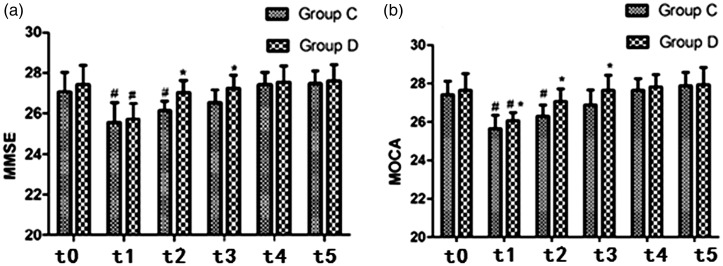
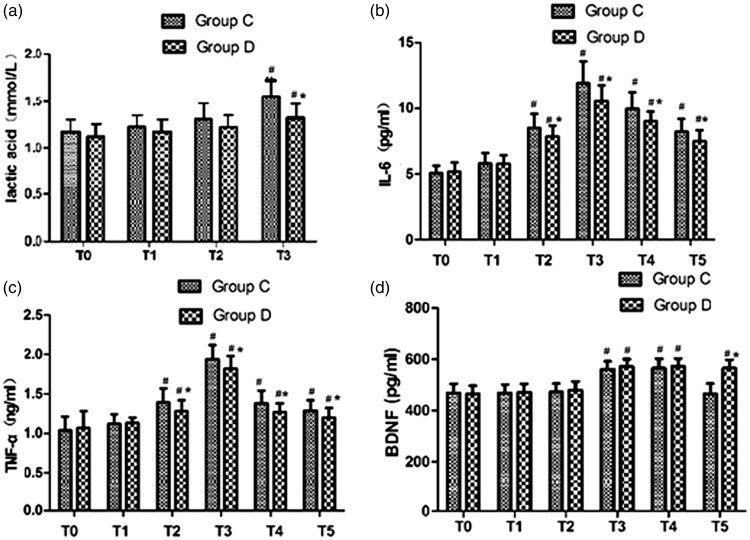
Results: MMSE and MOCA scores showed subtle decline in both groups at 24 hours postoperatively; this decline remained at 48 hours postoperatively in group C. Both scores were higher in group D than in group C at 48 and 72 hours postoperatively. TNF-α and IL-6 were lower from 5 minutes post-clamping through 24 hours postoperatively in group D; lactate was lower at 5 minutes post-clamping in group D. BDNF was higher from 5 minutes post-clamping through 1 hour postoperatively in both groups, and remained high in group D at 24 hours postoperatively.
Conclusions: Dexmedetomidine improved recovery of cognition after CEA, potentially due to reduced inflammation and enhanced BDNF expression.
Keywords: Carotid endarterectomy; Mini-Mental State Examination; Montreal Cognitive Assessment; brain-derived neurotrophic factor; cognitive dysfunction; dexmedetomidine; interleukin 6; lactate; stroke; tumor necrosis factor.
Figures
References
-
- North American Symptomatic Carotid Endarterectomy Trial Collaborators, Barnett HJM, Taylor DW, et al. Beneficial effect of carotid endarterectomy in symptomatic patients with high-grade carotid stenosis. N Engl J Med 1991; 325: 445–453. - PubMed
-
- Halliday A, Mansfield A, Marro J, et al. Prevention of disabling and fatal strokes by successful carotid endarterectomy in patients without recent neurological symptoms: randomised controlled trial. Lancet 2004; 363: 1491–1502. - PubMed
-
- Berman L, Pietrzak RH, Mayes L. Neurocognitive changes after carotid revascularization: a review of the current literature. J Psychosom Res 2007; 63: 599–612. - PubMed
-
- De Rango P, Caso V, Leys D, et al. The role of carotid artery stenting and carotid endarterectomy in cognitive performance: a systematic review. Stroke 2008; 39: 3116–3127. - PubMed
Publication types
MeSH terms
Substances
LinkOut - more resources
Full Text Sources
