


Disentangling the roles of maternal and paternal age on birth prevalence of down syndrome and other chromosomal disorders using a Bayesian modeling approach
- PMID: 31014243
- PMCID: PMC6480500
- DOI: 10.1186/s12874-019-0720-1
Disentangling the roles of maternal and paternal age on birth prevalence of down syndrome and other chromosomal disorders using a Bayesian modeling approach
Abstract
Background: Multiple neonatal and pediatric disorders have been linked to older paternal ages. Combining these findings with the evidence that many men are having children at much later ages generates considerable public health concern. The risk of paternal age has been difficult to estimate and interpret because children often have parents whose ages are similar and likely to be confounded. Epidemiologic studies often model the conditional effects of paternal age using regression models that typically treat maternal age as linear, curvilinear or as age-band categories. Each of these approaches has limitations. As an alternative, the current study measures age to the nearest year, and fits a Bayesian model in which each parent's age is given a conditional autoregressive prior (CAR).
Methods: Data containing approximately 12,000,000 birth records were obtained from the United States Natality database for the years 2014 to 2016. Date were cross-tabulated for maternal ages 15-49 years and for paternal ages 15-65 years. A Bayesian logistic model was implemented using conditional autoregressive priors for both maternal and paternal ages modeled separately and jointly for both Down syndrome and chromosomal disorders other than Down syndrome.
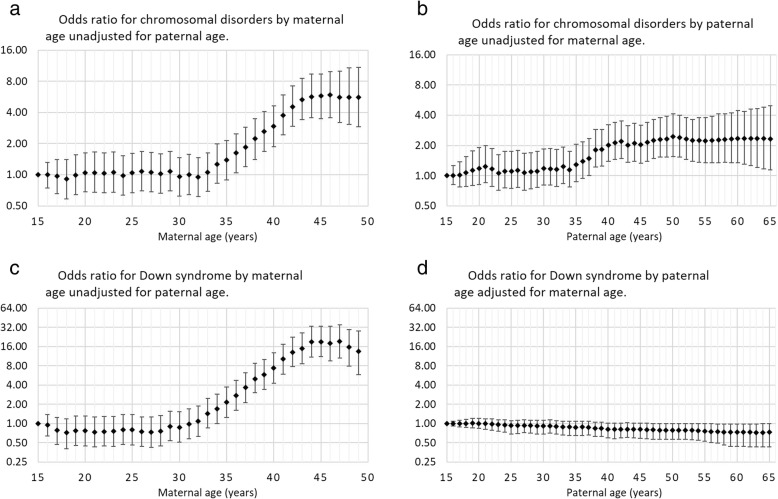
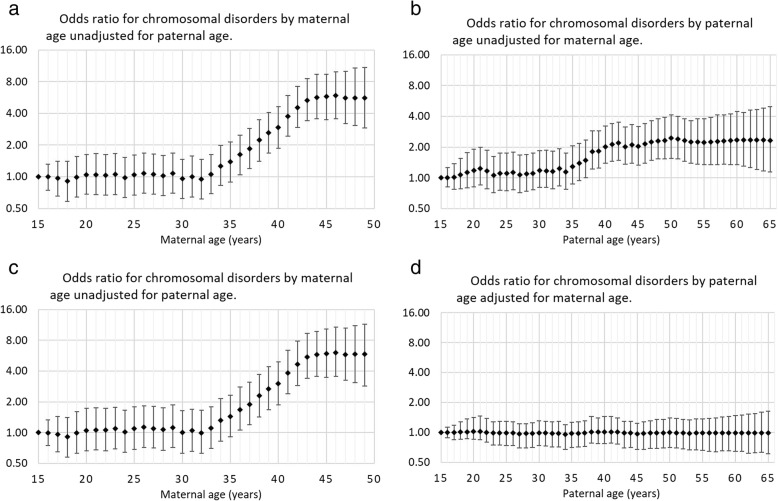
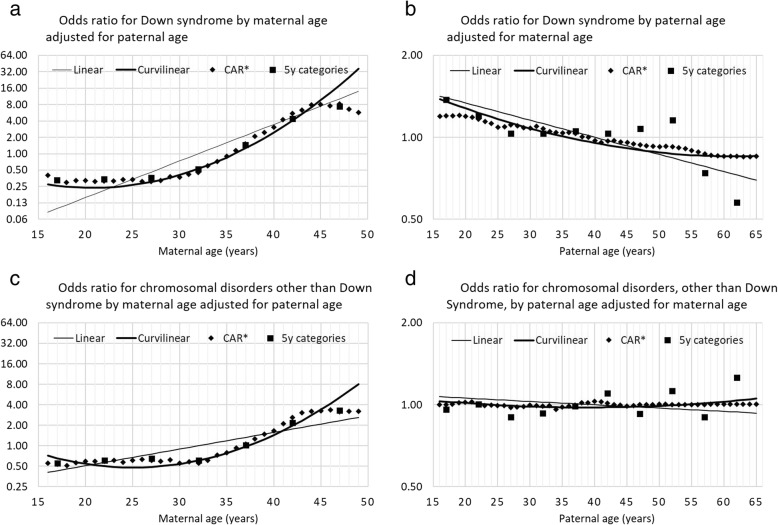
Results: Models with maternal and paternal ages given CAR priors were judged to be better fitting than traditional models. For Down syndrome, the approach attributed a very large risk to advancing maternal age with the effect of advancing paternal age having a very small sparing effect on birth prevalence. Maternal age was also related to the birth prevalence of chromosomal disorders other than Down syndrome while paternal age was not.
Conclusions: Advancing paternal age was not associated with an increase in risk for either Down syndrome or chromosomal disorders other than Down syndrome.
Keywords: Chromosomal disorders; Conditional auto-regressive; Down syndrome; Maternal age; Paternal age.
Conflict of interest statement
Ethics approval and consent to participate
This study was evaluated by the Texas A&M Institutional Review Board (IRB) and determined to be exempt from IRB review.
Consent for publication
Not applicable.
Competing interests
The author declares that he has no competing interests.
Publisher’s Note
Springer Nature remains neutral with regard to jurisdictional claims in published maps and institutional affiliations.
Figures
References
Publication types
MeSH terms
Grants and funding
LinkOut - more resources
Full Text Sources
Medical
Research Materials
