


Acute aerobic exercise effects on cognitive function in breast cancer survivors: a randomized crossover trial
- PMID: 31014267
- PMCID: PMC6480426
- DOI: 10.1186/s12885-019-5589-1
Acute aerobic exercise effects on cognitive function in breast cancer survivors: a randomized crossover trial
Abstract
Background: Many breast cancer survivors (BCS) report deficits in cognitive function. Physical activity (PA) has been associated with better processing speed and memory in healthy adults and thus may be a useful method for improving cognition in BCS. The purpose of this study was to examine the effects of an acute bout of PA on processing speed and spatial working memory in a sample of BCS.
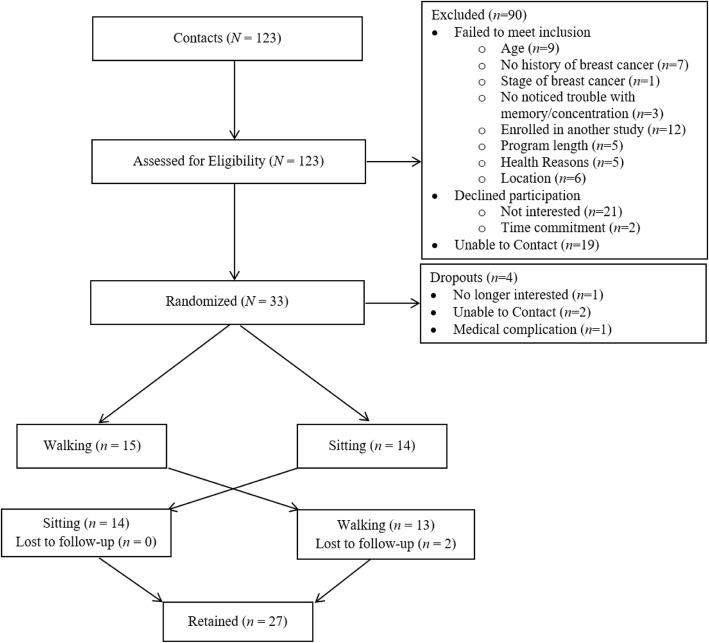
Methods: Using a repeated measures, crossover design, BCS [N = 27; Mage (SD) = 49.11(8.05)] completed two sessions in counterbalanced order: 30 min of moderate-intensity treadmill walking and 30 min of seated rest. Women completed cognitive tasks immediately before and after each session.
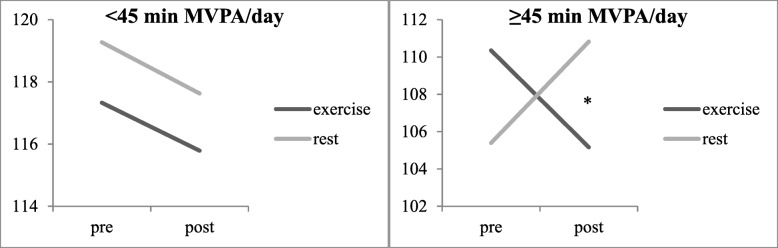
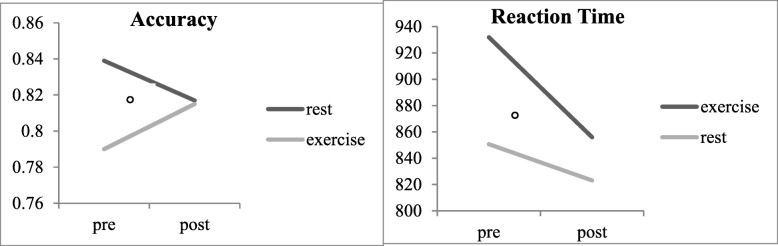
Results: Within-subjects repeated measures analyses of variance revealed a significant time by session effect for processing speed reaction time [F (1,25) = 5.02, p = .03, η2 = 0.17]. This interaction was driven by significantly reduced reaction time (e.g., faster response) post-exercise and no change post-rest. Further between-subjects analyses indicated a significant time by session by moderate to vigorous physical activity (MVPA) split [F (1,25) = 5.23, p = .03, η2 = 0.17], such that women who engaged in ≥45 min of average daily MVPA reduced their reaction time post-exercise (p = .01) and increased RT post-rest (p = .06). Time by session effects for spatial working memory 3-item accuracy and 4-item reaction time trended towards significance, p = 0.08 and p = 0.10, respectively, again driven by better performance post-exercise.
Conclusions: The moderate effect of acute exercise on domains of memory and processing speed in BCS is encouraging. Cancer-related cognitive impairment remains largely misunderstood; however, the results from the present study offer preliminary evidence for the positive relationship between acute exercise and cognition in BCS.
Trial registration: ClinicalTrials.gov NCT02592070 . Registered 30 October 2015. Retroactively registered.
Keywords: Acute exercise; Breast cancer; Cognitive function; Survivorship.
Conflict of interest statement
Ethics approval and consent to participate
All methods and procedures were approved by the institutional review board (IRB; ethics committee) at the University of Illinois at Urbana-Champaign, and written informed consent was obtained from all individual participants included in the study.
Consent for publication
N/A
Competing interests
The authors declare that they have no competing interests.
Publisher’s Note
Springer Nature remains neutral with regard to jurisdictional claims in published maps and institutional affiliations.
Figures

References
-
- DeSantis C, Ma J, Bryan L, Jemal A. Breast cancer statistics, 2013. CA Cancer J Clin. 64(1):52–62. 10.3322/caac.21203. - PubMed
-
- Clarke M, Collins R, Darby S, et al. Effects of radiotherapy and of differences in the extent of surgery for early breast cancer on local recurrence and 15-year survival: an overview of the randomised trials. Lancet (London, England) 2005;366(9503):2087–2106. doi: 10.1016/S0140-6736(05)67887-7. - DOI - PubMed
