


Follow-up care after treatment for prostate cancer: evaluation of a supported self-management and remote surveillance programme
- PMID: 31014282
- PMCID: PMC6480799
- DOI: 10.1186/s12885-019-5561-0
Follow-up care after treatment for prostate cancer: evaluation of a supported self-management and remote surveillance programme
Abstract
Background: Alternative models of cancer follow-up care are needed to ameliorate pressure on services and better meet survivors' long-term needs. This paper reports an evaluation of a service improvement initiative for the follow-up care of prostate cancer patients based on remote monitoring and supported self-management.
Methods: This multi-centred, historically controlled study compared patient reported outcomes of men experiencing the new Programme with men experiencing a traditional clinic appointment model of follow-up care, who were recruited in the period immediately prior to the introduction of the Programme. Data were collected by self-completed questionnaires, with follow up measurement at four and eight months post-baseline. The primary outcome was men's unmet survivorship needs, measured by the Cancer Survivors' Unmet Needs Survey. Secondary outcomes included cancer specific quality of life, psychological wellbeing and satisfaction with care. The analysis was intention to treat. Regression analyses were conducted for outcomes at each time point separately, controlling for pre-defined clinical and demographic variables. All outcome analyses are presented in the paper. Costs were compared between the two groups.
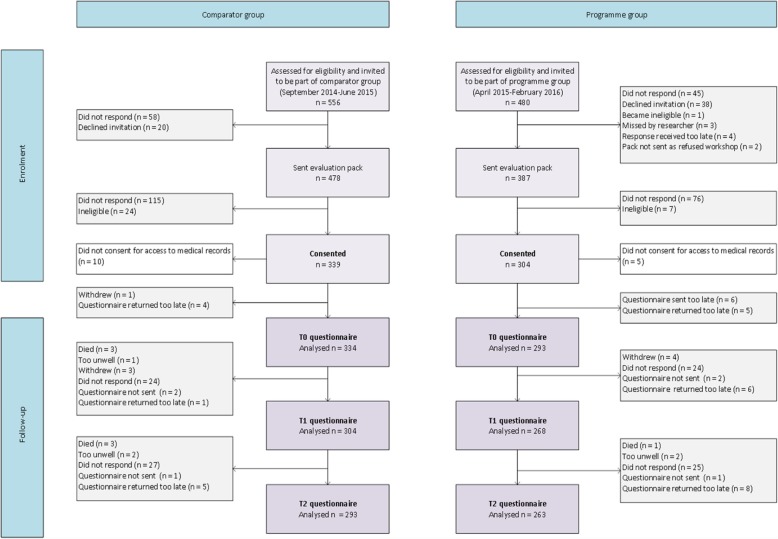
Results: Six hundred and twenty-seven men (61%) were consented to take part in the study (293 in the Programme and 334 in the comparator group.) Regarding the primary measure of unmet survivorship needs, 25 of 26 comparisons favoured the Programme, of which 4 were statistically significant. For the secondary measures of activation for self-management, quality of life, psychological well-being and lifestyle, 20 of 32 comparisons favoured the Programme and 3 were statistically significant. There were 22 items on the satisfaction with care questionnaire and 13 were statistically significant. Per participant costs (British pounds, 2015) in the 8 month follow up period were slightly lower in the programme than in the comparator group (£289 versus £327). The Programme was acceptable to patients.
Conclusion: The Programme is shown to be broadly comparable to traditional follow-up care in all respects, adding to evidence of the viability of such models.
Keywords: Cancer; Cost-effectiveness; Effectiveness; Evaluation; Follow-up care; Patient-led; Patient-triggered; Prostate; Remote surveillance; Supported self-management.
Conflict of interest statement
Ethics approval and consent to participate
The study received ethical approval from the National Research Ethics Service, East of England – Cambridge South (reference number 11/EE/1021.) All participants completed a written consent form, separately for the questionnaire survey and for interview. The study was undertaken in accordance with the Declaration of Helsinki.
Consent for publication
Not applicable.
Competing interests
The authors declare that they have no competing interests.
Publisher’s Note
Springer Nature remains neutral with regard to jurisdictional claims in published maps and institutional affiliations.
References
-
- DeSantis CE, Lin CC, Mariotto AB, Siegel RL, Stein KD, Kramer JL, et al. Cancer treatment and survivorship statistics, 2014. CA Cancer J Clin. 2014;64. - PubMed
-
- Harrison JD, Young JM, Price MA, Butow PN, Solomon MJ. What are the unmet supportive care needs of people with cancer ? A systematic review. Supportive care in cancer : official journal of the Multinational Association of Supportive Care in Cancer. 2009;17. - PubMed
Publication types
MeSH terms
Grants and funding
LinkOut - more resources
Full Text Sources
Medical
