


Combinations of immuno-checkpoint inhibitors predictive biomarkers only marginally improve their individual accuracy
- PMID: 31014354
- PMCID: PMC6480695
- DOI: 10.1186/s12967-019-1865-8
Combinations of immuno-checkpoint inhibitors predictive biomarkers only marginally improve their individual accuracy
Abstract
Background: There are no accepted universal biomarkers capable to accurately predict response to immuno-checkpoint inhibitors (ICI). Although recent literature has been flooded with studies on ICI predictive biomarkers, available data show that currently approved companion diagnostics either leave out many possible responders, as in the case of PD-L1 testing for first-line metastatic lung cancer, or apply to a small subset of patients, such as the recently approved treatment for microsatellite instability-high or mismatch repair deficiency tumors. In this study, we conducted a survey of the available data on ICI trials with matched genomic or transcriptomic datasets in order to cross-validate the proposed biomarkers, to assess whether their prediction power was confirmed and, mainly, to investigate if their combination was able to generate a better predictive tool.
Methods: We extracted clinical information and sequencing data details from publicly available datasets, along with a list of possible biomarkers obtained from the recent literature. After an operation of data harmonization, we validated the performance of all the biomarkers taken individually. Furthermore, we tested two strategies to combine the best performing biomarkers in order to improve their predictive value.
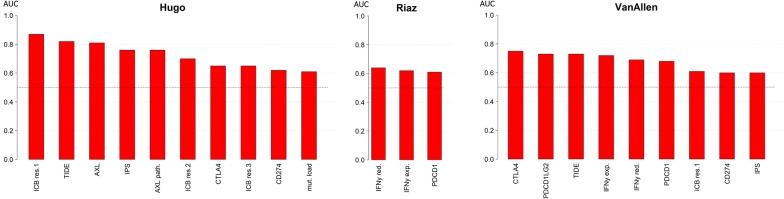
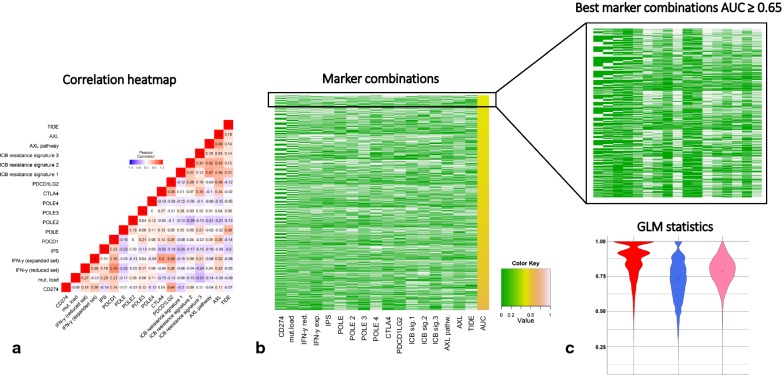
Results: When considered individually, some of the biomarkers, such as the ImmunoPhenoScore, and the IFN-γ signature, did not confirm their originally proposed predictive power. The best absolute scoring biomarkers are TIDE, one of the ICB resistance signatures and CTLA4 with a mean AUC > 0.66. Among the combinations tested, generalized linear models showed the best performance with an AUC of 0.78.
Conclusions: We confirmed that the available biomarkers, taken individually, fail to provide a satisfactory predictive value. Unfortunately, also combination of some of them only provides marginal improvements. Hence, in order to generate a more robust way to predict ICI efficacy it is necessary to analyze and combine additional biomarkers and interrogate a wider set of clinical data.
Keywords: Exome sequencing; Generalized linear models; Genomics; Immuno-checkpoint inhibitors biomarkers; ImmunoPhenoScore; Immunotherapy; Majority voting; RNA-seq; TIDE.
Conflict of interest statement
The authors declare that they have no competing interests.
Figures
References
-
- FDA. FDA approves first cancer treatment for any solid tumor with a specific genetic feature. FDA. 2017. https://www.fda.gov/newsevents/newsroom/pressannouncements/ucm560167.htm.
Publication types
MeSH terms
Substances
LinkOut - more resources
Full Text Sources
Research Materials
