


Little Evidence of Antagonistic Selection in the Evolutionary Strata of Fungal Mating-Type Chromosomes (Microbotryum lychnidis-dioicae)
- PMID: 31015196
- PMCID: PMC6553529
- DOI: 10.1534/g3.119.400242
Little Evidence of Antagonistic Selection in the Evolutionary Strata of Fungal Mating-Type Chromosomes (Microbotryum lychnidis-dioicae)
Abstract
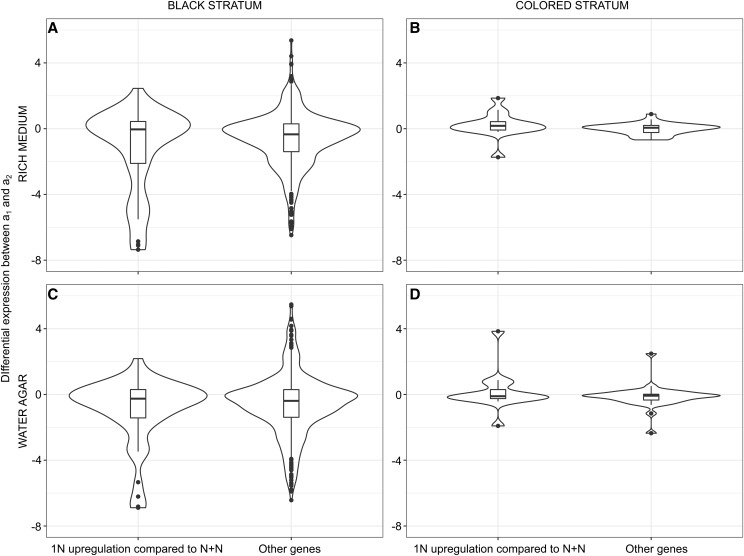
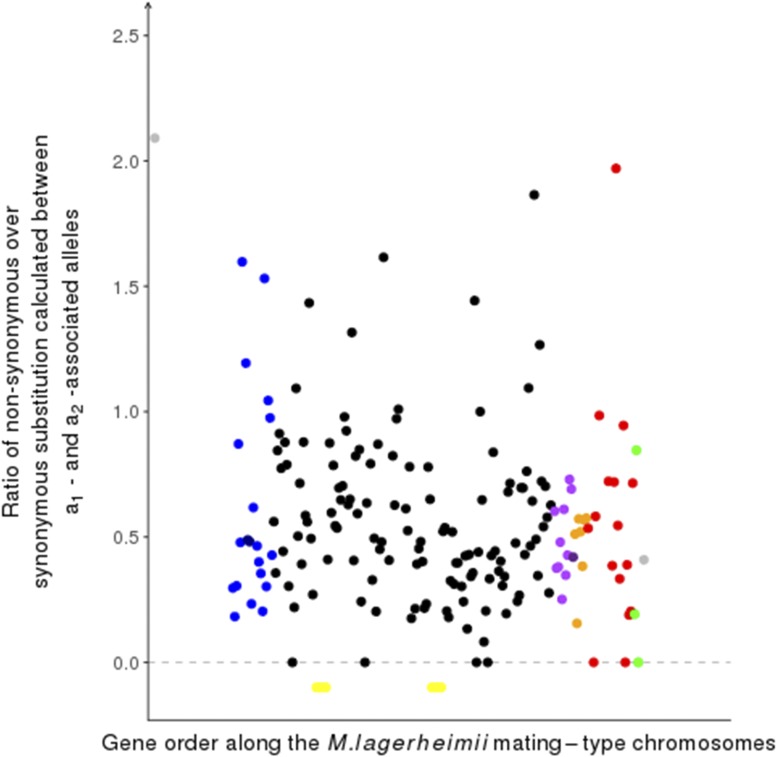
Recombination suppression on sex chromosomes often extends in a stepwise manner, generating evolutionary strata of differentiation between sex chromosomes. Sexual antagonism is a widely accepted explanation for evolutionary strata, postulating that sets of genes beneficial in only one sex are successively linked to the sex-determining locus. The anther-smut fungus Microbotryum lychnidis-dioicae has mating-type chromosomes with evolutionary strata, only some of which link mating-type genes. Male and female roles are non-existent in this fungus, but mating-type antagonistic selection can also generate evolutionary strata, although the life cycle of the fungus suggests it should be restricted to few traits. Here, we tested the hypothesis that mating-type antagonism may have triggered recombination suppression beyond mating-type genes in M. lychnidis-dioicae by searching for footprints of antagonistic selection in evolutionary strata not linking mating-type loci. We found that these evolutionary strata (i) were not enriched in genes upregulated in the haploid phase, where cells are of alternative mating types, (ii) carried no gene differentially expressed between mating types, and (iii) carried no genes displaying footprints of specialization in terms of protein sequences (dN/dS) between mating types after recommended filtering. Without filtering, eleven genes showed signs of positive selection in the strata not linking mating-type genes, which constituted an enrichment compared to autosomes, but their functions were not obviously involved in antagonistic selection. Thus, we found no strong evidence that antagonistic selection has contributed to extending recombination suppression beyond mating-type genes. Alternative hypotheses should therefore be explored to improve our understanding of the sex-related chromosome evolution.
Keywords: Genetics of Sex; antagonistic selection; evolutionary strata; expression; fungi; haploid selection; mating-type chromosomes; sex chromosomes; sexual antagonism.
Copyright © 2019 Bazzicalupo et al.
Figures
References
-
- Alexander H. M., 1989. An experimental field-study of anther-smut disease of Silene alba caused by Ustilago violacea- Genotypic variation and disease incidence. Evolution 43: 835–847. - PubMed
-
- Alexander H. M., 1990. Epidemiology of anther-smut infection of Silene alba caused by Ustilabo violacea - patterns of spore deposition and disease incidence. J. Ecol. 78: 166–179. 10.2307/2261043 - DOI
-
- Alexander H. M., Antonovics J., 1995. Spread of anther-smut disease (Ustilago violacea) and character correlations in a genetically variable population of Silene alba. J. Ecol. 83: 783–794. 10.2307/2261415 - DOI
Publication types
MeSH terms
LinkOut - more resources
Full Text Sources