


Beliefs About Advanced Cancer Curability in Older Patients, Their Caregivers, and Oncologists
- PMID: 31015317
- PMCID: PMC6656513
- DOI: 10.1634/theoncologist.2018-0890
Beliefs About Advanced Cancer Curability in Older Patients, Their Caregivers, and Oncologists
Abstract
Background: Ensuring older patients with advanced cancer and their oncologists have similar beliefs about curability is important. We investigated discordance in beliefs about curability in patient-oncologist and caregiver-oncologist dyads.
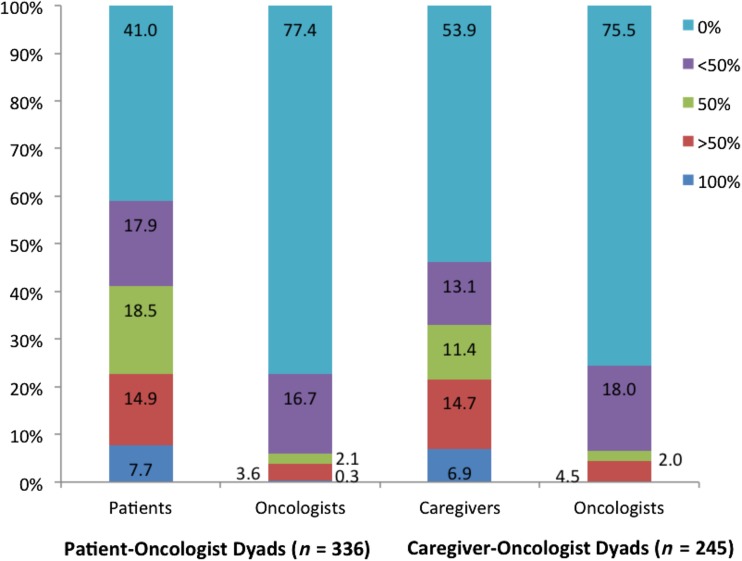
Materials and methods: We used baseline data from a cluster randomized trial assessing whether geriatric assessment improves communication and quality of life in older patients with advanced cancer and their caregivers. Patients were aged ≥70 years with incurable cancer from community oncology practices. Patients, caregivers, and oncologists were asked: "What do you believe are the chances the cancer will go away and never come back with treatment?" Options were 100%, >50%, 50/50, <50%, and 0% (5-point scale). Discordance in beliefs about curability was defined as any difference in scale scores (≥3 points were severe). We used multivariate logistic regressions to describe correlates of discordance.
Results: Discordance was present in 60% (15% severe) of the 336 patient-oncologist dyads and 52% (16% severe) of the 245 caregiver-oncologist dyads. Discordance was less common in patient-oncologist dyads when oncologists practiced longer (adjusted odds ratio [AOR] 0.90, 95% confidence interval [CI] 0.84-0.97) and more common in non-Hispanic white patients (AOR 5.77, CI 1.90-17.50) and when patients had lung (AOR 1.95, CI 1.29-2.94) or gastrointestinal (AOR 1.55, CI 1.09-2.21) compared with breast cancer. Severe discordance was more common when patients were non-Hispanic white, had lower income, and had impaired social support. Caregiver-oncologist discordance was more common when caregivers were non-Hispanic white (AOR 3.32, CI 1.01-10.94) and reported lower physical health (AOR 0.88, CI 0.78-1.00). Severe discordance was more common when caregivers had lower income and lower anxiety level.
Conclusion: Discordance in beliefs about curability is common, occasionally severe, and correlated with patient, caregiver, and oncologist characteristics.
Implications for practice: Ensuring older patients with advanced cancer and their caregivers have similar beliefs about curability as the oncologist is important. This study investigated discordance in beliefs about curability in patient-oncologist (PO) and caregiver-oncologist (CO) dyads. It found that discordance was present in 60% (15% severe) of PO dyads and 52% (16% severe) of CO dyads, raising serious questions about the process by which patients consent to treatment. This study supports the need for interventions targeted at the oncologist, patient, caregiver, and societal levels to improve the delivery of prognostic information and patients'/caregivers' understanding and acceptance of prognosis.
Keywords: Beliefs about cancer curability; Caregivers; Discordance; Older adults; Oncologists.
© AlphaMed Press 2019.
Conflict of interest statement
Disclosures of potential conflicts of interest may be found at the end of this article.
Figures
References
-
- Hirose T, Yamaoka T, Ohnishi T et al. Patient willingness to undergo chemotherapy and thoracic radiotherapy for locally advanced non‐small cell lung cancer. Psychooncology 2009;18:483–489. - PubMed
-
- Yennurajalingam S, Lu Z, Prado B et al. Association between advanced cancer patients' perception of curability and patients' characteristics, decisional control preferences, symptoms, and end‐of‐life quality care outcomes. J Palliat Med 2018;21:1609–1616. - PubMed
-
- Shin DW, Cho J, Kim SY et al. Patients' and family caregivers' understanding of the cancer stage, treatment goal, and chance of cure: A study with patient‐caregiver‐physician triad. Psychooncology 2018;27:106–113. - PubMed
Publication types
MeSH terms
Grants and funding
LinkOut - more resources
Full Text Sources
Medical
