Review
. 2019 Jan;20(1):24-37.
doi: 10.2174/1389202920666190116094736.

An Overview about the Biology of Skeletal Muscle Satellite Cells

Affiliations
Review

An Overview about the Biology of Skeletal Muscle Satellite Cells

Laura Forcina et al. Curr Genomics. 2019 Jan.

Abstract

The peculiar ability of skeletal muscle tissue to operate adaptive changes during post-natal de-velopment and adulthood has been associated with the existence of adult somatic stem cells. Satellite cells, occupying an exclusive niche within the adult muscle tissue, are considered bona fide stem cells with both stem-like properties and myogenic activities. Indeed, satellite cells retain the capability to both maintain the quiescence in uninjured muscles and to be promptly activated in response to growth or re-generative signals, re-engaging the cell cycle. Activated cells can undergo myogenic differentiation or self-renewal moving back to the quiescent state. Satellite cells behavior and their fate decision are finely controlled by mechanisms involving both cell-autonomous and external stimuli. Alterations in these regu-latory networks profoundly affect muscle homeostasis and the dynamic response to tissue damage, con-tributing to the decline of skeletal muscle that occurs under physio-pathologic conditions. Although the clear myogenic activity of satellite cells has been described and their pivotal role in muscle growth and regeneration has been reported, a comprehensive picture of inter-related mechanisms guiding muscle stem cell activity has still to be defined. Here, we reviewed the main regulatory networks determining satellite cell behavior. In particular, we focused on genetic and epigenetic mechanisms underlining satel-lite cell maintenance and commitment. Besides intrinsic regulations, we reported current evidences about the influence of environmental stimuli, derived from other cell populations within muscle tissue, on satel-lite cell biology.

Keywords: Activation; Muscle growth; Myogenic differentiation; Quiescence; Regeneration; Satellite cells; Skeletal muscle; Tissue niche.


Figures
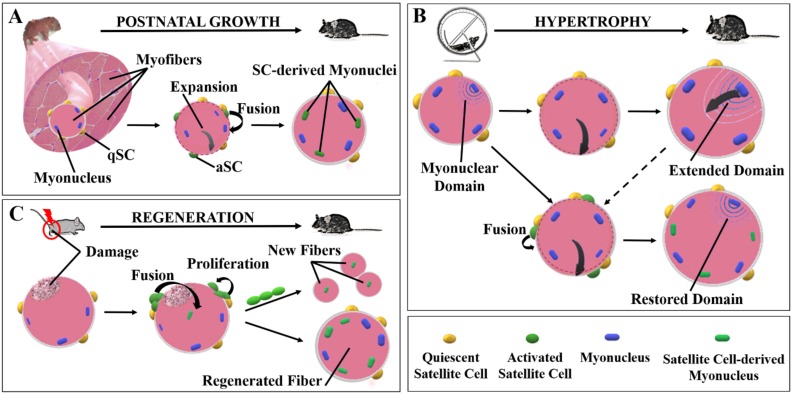
Fig. (1)
Fig. (1)
Satellite cells are involved in muscle growth and regeneration. The adjunction of satellite cell-derived myonuclei occurs during different homeostatic responses underlining muscle plasticity: (A) During post-natal growth early after birth, the physiologic expansion of myofibers results in the activation of quiescent satellite cells, which are able to fuse into growing myofibers contributing to muscle enlargement. (B) In mature myofibers, each myonucleus can govern a specific cytosolic domain. Under hypertrophic conditions, when myofibers undergo physical expansion, the myonuclear domain can be extended allowing myofiber growth without the involvement of myonuclear accretion. However, the enlargement of myofibers can also induce the activation and fusion of satellite cells, leading to the restoration of the original domain. (C) Satellite cells are absolutely necessary to repair injured muscle. During muscle regeneration, activated satellite cells can fuse either to damaged fibers or each other to generate new myofibers driving skeletal muscle healing. qSC: quiescent satellite cell; aSC: activated satellite cell.
Fig. (2)
Fig. (2)
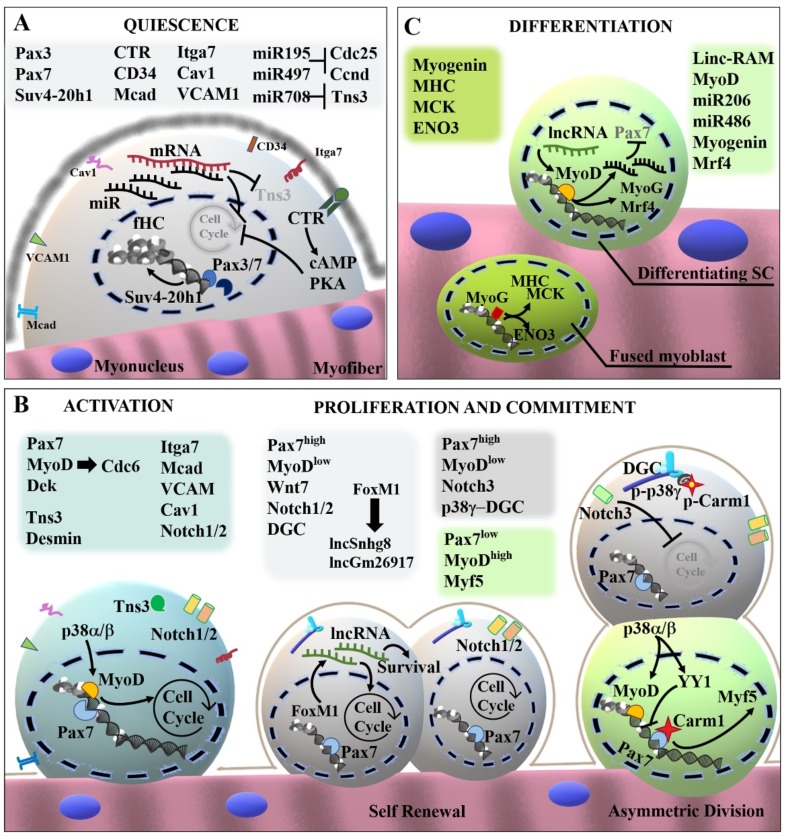
Molecular markers and mechanisms underlining satellite cell behavior. (A) Quiescent satellite cells are characterized by the presence of facultative heterochromatin and thus by a minimal transcriptional activity, being in a dormant state in steady-state muscles. (B) Upon proper stimulation, satellite cells become activated, express MyoD and re-engage the cell cycle. Activated cells can undergo both symmetric and asymmetric division replenishing the stem cell pool and generating committed myoblasts. Daughter cells expressing elevated levels of Pax7 and low levels of MyoD (Pax7high/MyoDlow) maintain the stem-like phenotype, whilst cells highly inducing MyoD and down-modulating Pax7 (Pax7low/MyoDhigh) enter the differentiative program. (C) Differentiating cells express later molecular mediators of the myogenic program as myogenin and Mrf4. Myoblasts can fuse to pre-existing myofibers and express markers of the terminally differentiated phenotype as Myosin heavy chain, muscle creatine kinase and beta enolase.

References

    1. Tajbakhsh S., Cossu G. Establishing myogenic identity during somitogenesis. Curr. Opin. Genet. Dev. 1997;7(5):634–641. - PubMed
    1. Buckingham M., Bajard L., Chang T., Daubas P., Hadchouel J., Meilhac S., Montarras D., Rocancourt D., Relaix F. The formation of skeletal muscle: from somite to limb. J. Anat. 2003;202(1):59–68. - PMC - PubMed
    1. Musumeci G., Castrogiovanni P., Coleman R., Szychlinska M.A., Salvatorelli L., Parenti R., Magro G., Imbesi R. Somitogenesis: From somite to skeletal muscle. Acta Histochem. 2015;117(4-5):313–328. - PubMed
    1. Chargè S.B.P., Rudnicki M.A. Cellular and molecular regulation of muscle regeneration. Physiol. Rev. 2004;84(1):209–238. - PubMed
    1. Kuang S., Kuroda K., Le Grand F., Rudnicki M.A. Asymmetric self-renewal and commitment of satellite stem cells in muscle. Cell. 2007;129(5):999–1010. - PMC - PubMed

LinkOut - more resources