. 2019 Mar 1;9(7):3891-3898.
doi: 10.1002/ece3.5015. eCollection 2019 Apr.

EasyCodeML: A visual tool for analysis of selection using CodeML

Affiliations

EasyCodeML: A visual tool for analysis of selection using CodeML

Fangluan Gao et al. Ecol Evol. .

Abstract

The genomic signatures of positive selection and evolutionary constraints can be detected by analyses of nucleotide sequences. One of the most widely used programs for this purpose is CodeML, part of the PAML package. Although a number of bioinformatics tools have been developed to facilitate the use of CodeML, these have various limitations. Here, we present a wrapper tool named EasyCodeML that provides a user-friendly graphical interface for using CodeML. EasyCodeML has a custom running mode in which parameters can be adjusted to meet different requirements. It also offers a preset running mode in which an evolutionary analysis pipeline and publication-quality tables can be exported by a single click. EasyCodeML allows visualized, interactive tree labelling, which greatly simplifies the use of the branch, branch-site, and clade models of selection. The program allows comparison of major codon-based models for analyses of selection. EasyCodeML is a stand-alone package that is supported in Windows, Mac, and Linux operating systems, and is freely available at https://github.com/BioEasy/EasyCodeML.

Keywords: CodeML; codon‐based models; likelihood‐ratio test; molecular evolution; positive selection.


Conflict of interest statement

None declared.

Figures
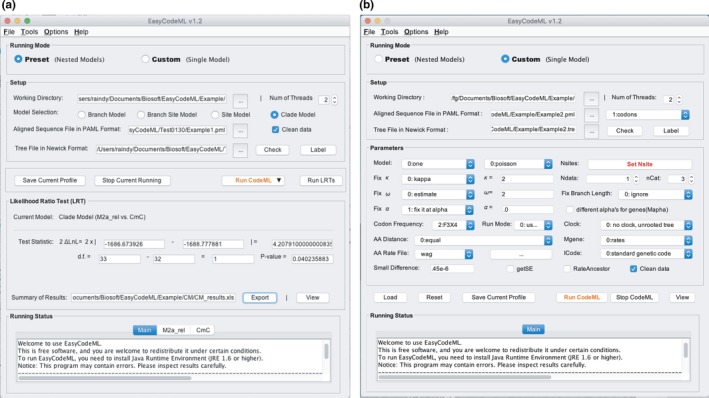
Figure 1
Figure 1
Screenshot of the main interface of EasyCodeML under the (a) preset and (b) custom running modes. In the preset mode, all key parameters of the nested models are built‐in and there is a pipeline from data input to the output of results. In the custom mode, the parameters of any codon‐based model can be modified to meet the requirements of the user
Figure 2
Figure 2
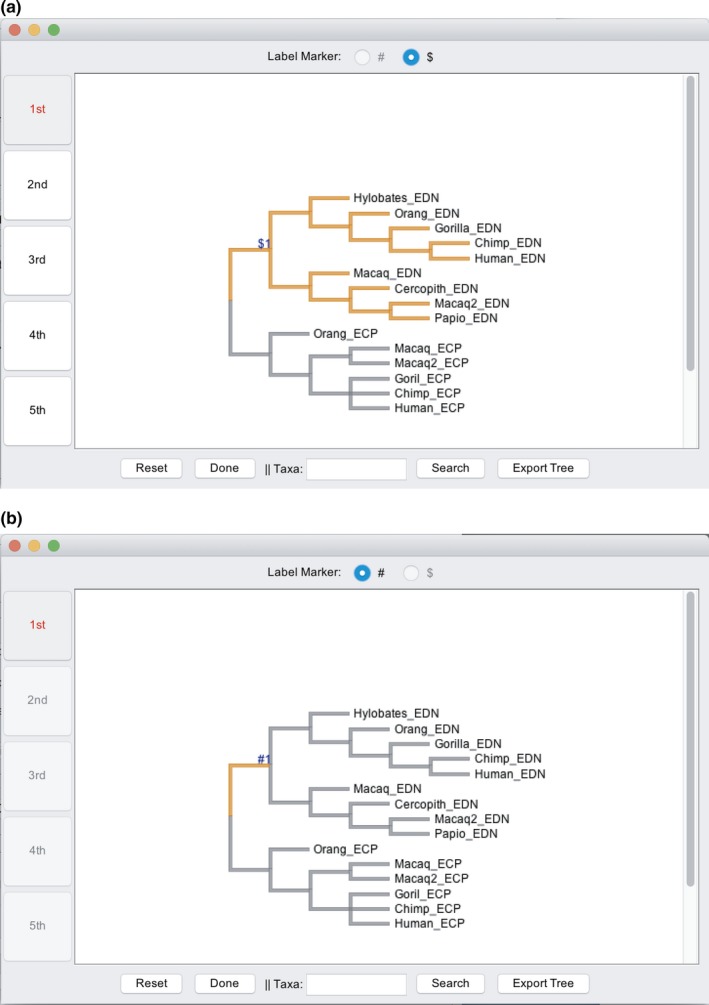
Labelling branches in a tree for the branch‐related models can be done in a simple and intuitive way for the (a) clade models and (b) branch and branch‐site models
Figure 3
Figure 3
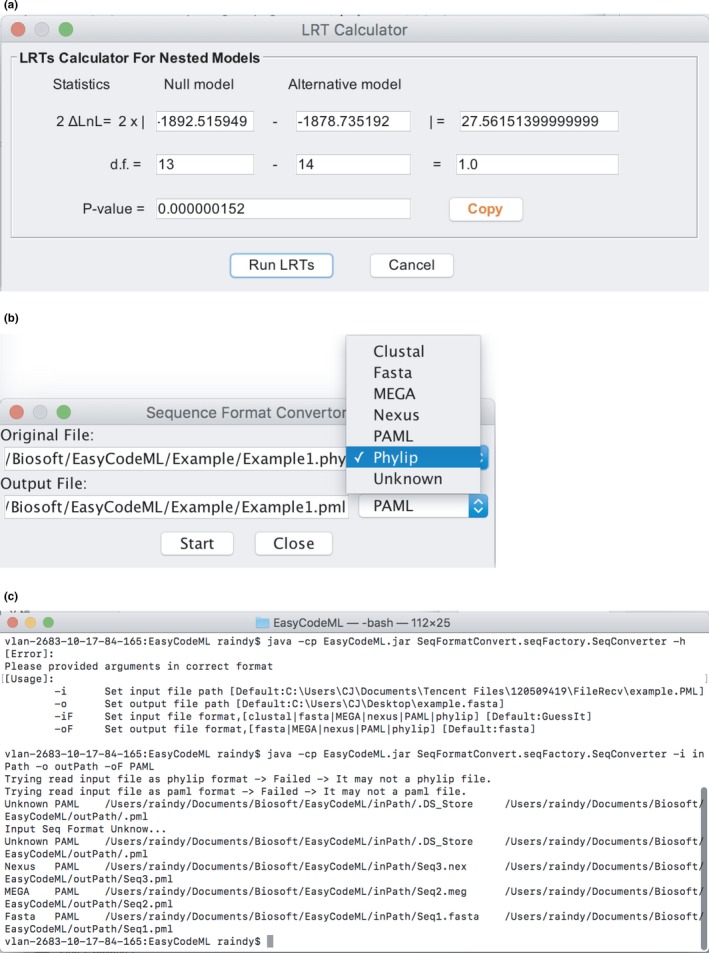
Two utilities available in EasyCodeML: (a) the LRT calculator, and Seqformat convertor in (b) a user‐friendly GUI or (c) command line. Seqformat convertor can convert between diverse types of sequence data formats

References

    1. Anisimova, M. , Bielawski, J. P. , & Yang, Z. (2001). Accuracy and power of the likelihood ratio test in detecting adaptive molecular evolution. Molecular Biology and Evolution, 18, 1585–1592. 10.1093/oxfordjournals.molbev.a003945 - DOI - PubMed
    1. Bielawski, J. P. , & Yang, Z. (2003). Maximum likelihood methods for detecting adaptive evolution after gene duplication. Journal of Structural and Functional Genomics, 3, 201–212. - PubMed
    1. Bielawski, J. P. , & Yang, Z. (2004). A maximum likelihood method for detecting functional divergence at individual codon sites, with application to gene family evolution. Journal of Molecular Evolution, 59, 121–132. 10.1007/s00239-004-2597-8 - DOI - PubMed
    1. Egan, A. , Mahurkar, A. , Crabtree, J. , Badger, J. H. , Carlton, J. M. , & Silva, J. C. (2008). IDEA: Interactive Display for Evolutionary Analyses. BMC Bioinformatics, 9, 524 10.1186/1471-2105-9-524 - DOI - PMC - PubMed
    1. Forsberg, R. , & Christiansen, F. B. (2003). A codon‐based model of host‐specific selection in parasites, with an application to the influenza A virus. Molecular Biology and Evolution, 20, 1252–1259. 10.1093/molbev/msg149 - DOI - PubMed

LinkOut - more resources