


Local transgene expression and whole-body transgenesis to model brain diseases in nonhuman primate
- PMID: 31016282
- PMCID: PMC6431118
- DOI: 10.1002/ame2.12055
Local transgene expression and whole-body transgenesis to model brain diseases in nonhuman primate
Abstract
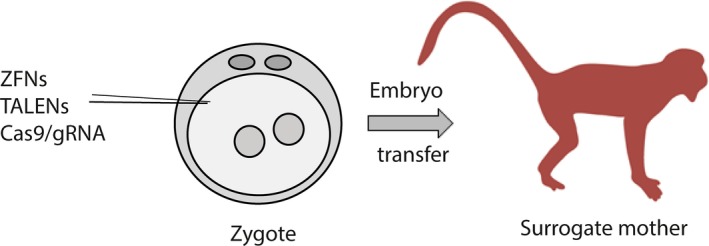
Animal model is an essential tool in the life sciences research, notably in understanding the pathogenesis of the diseases and for further therapeutic intervention success. Rodents have been the most frequently used animals to model human disease since the establishment of gene manipulation technique. However, they remain inadequate to fully mimic the pathophysiology of human brain disease, partially due to huge differences between rodents and humans in terms of anatomy, brain function, and social behaviors. Nonhuman primates are more suitable in translational perspective. Thus, genetically modified animals have been generated to investigate neurologic and psychiatric disorders. The classical transgenesis technique is not efficient in that model; so, viral vector-mediated transgene delivery and the new genome-editing technologies have been promoted. In this review, we summarize some of the technical progress in the generation of an ad hoc animal model of brain diseases by gene delivery and real transgenic nonhuman primate.
Keywords: animal models; neuroscience; nonhuman primates.
Conflict of interest statement
None.
Figures
References
-
- Jennings CG, Landman R, Zhou Y, et al. Opportunities and challenges in modeling human brain disorders in transgenic primates. Nat Neurosci. 2016;19:1123‐1130. - PubMed
-
- Camus S, Ko WK, Pioli E, Bezard E. Why bother using non‐human primate models of cognitive disorders in translational research? Neurobiol Learn Mem. 2015;124:123‐129. - PubMed
-
- Roelfsema PR, Treue S. Basic neuroscience research with nonhuman primates: a small but indispensable component of biomedical research. Neuron. 2014;82:1200‐1204. - PubMed
Publication types
LinkOut - more resources
Full Text Sources
