


Effect of School Services on Academic Performance After Traumatic Brain Injury in Hispanic and Non-Hispanic Students
- PMID: 31016747
- PMCID: PMC6548662
- DOI: 10.1111/josh.12776
Effect of School Services on Academic Performance After Traumatic Brain Injury in Hispanic and Non-Hispanic Students
Abstract
Background: School reintegration after traumatic brain injuries (TBI) requires school support; however, implementation of services is complex. This study evaluates disparities in receipt of school services for Hispanic children and its effect on academic performance.
Methods: Secondary analyses of school data on receipt of pre- and post-TBI school services. A logistic regression compared receipt of services between Hispanic and non-Hispanic white (NHW) children, and a linear regression evaluated services' effect on academic performance.
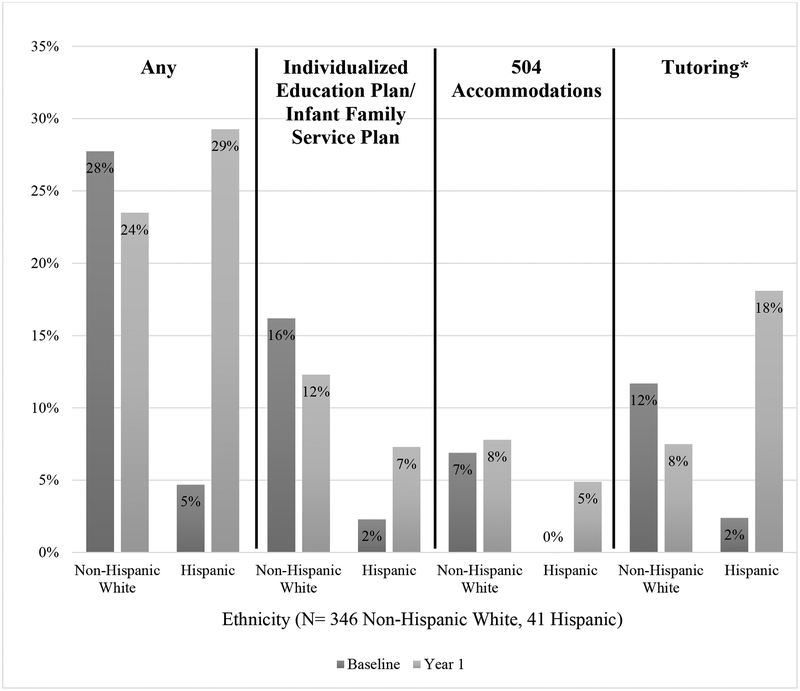
Results: The study includes 419 children; 46 Hispanic, 373 NHW. For NHW children there were no differences in receipt of pre- and post-TBI services; Hispanic children had significant increase in receipt of services from 5% to 27% (p < .001). Compared to NHWs, Hispanics had lower grade point average (GPA) at baseline (2.3 [confidence interval, CI: 1.9-2.7] vs 2.9 [CI: 2.8-3.0]). No differences in GPA were found between groups after injury among students who received post-TBI services.
Conclusions: Students who receive post-TBI school services benefit academically. NHW students maintain their academic performance and Hispanics increase their performance to their NHW peers' level. This highlights the importance of providing post-TBI school services to ensure better outcomes for all children.
Keywords: Hispanic; disability; injury control and prevention; rehabilitation; school services.
© 2019, American School Health Association.
Figures
References
-
- US Centers for Disease Control and Prevention. Traumatic brain injury & concussion. 2017. Available at: https://www.cdc.gov/traumaticbraininjury/index.html. Accessed March 15, 2018.
-
- Glang A, Tyler J, Pearson S, Todis B, Morvant M. Improving educational services for students with TBI through statewide consulting teams. NeuroRehabilitation. 2004;19(3):219–231. - PubMed
-
- Glang A, Todis B, Thomas CW, Hood D, Bedell G, Cockrell J. Return to school following childhood TBI: who gets services? NeuroRehabilitation. 2008;23(6):477–486. - PubMed
Publication types
MeSH terms
Grants and funding
LinkOut - more resources
Full Text Sources
Medical
