Anemia, Iron Deficiency, and Iron Supplementation in Relation to Mortality among HIV-Infected Patients Receiving Highly Active Antiretroviral Therapy in Tanzania
- PMID: 31017077
- PMCID: PMC6553903
- DOI: 10.4269/ajtmh.18-0096
Anemia, Iron Deficiency, and Iron Supplementation in Relation to Mortality among HIV-Infected Patients Receiving Highly Active Antiretroviral Therapy in Tanzania
Abstract
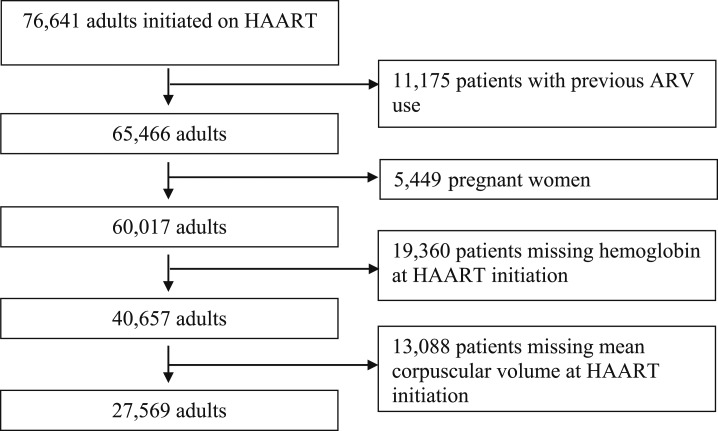
Anemia in HIV-infected patients improves with highly active antiretroviral therapy (HAART); however, it may still be associated with mortality among patients receiving treatment. We examined the associations of anemia severity and iron deficiency anemia (IDA) at HAART initiation and during monthly prospective follow-up with mortality among 40,657 adult HIV-infected patients receiving HAART in Dar es Salaam, Tanzania. Proportional hazards models were used to examine the associations of anemia severity and IDA at HAART initiation and during follow-up with mortality. A total of 6,261 deaths were reported. Anemia severity at HAART initiation and during follow-up was associated with an increasing risk of mortality (trend tests P < 0.001). There was significantly higher mortality risk associated with IDA at HAART initiation and during follow-up versus no anemia or iron deficiency (both P < 0.001). These associations differed significantly by gender, body mass index, and iron supplement use (all interaction test P < 0.001). The magnitude of association was stronger among men. Mortality risk with severe anemia was 13 times greater versus no anemia among obese patients, whereas it was only two times greater among underweight patients. Higher mortality risk was observed among iron supplement users, irrespective of anemia severity. Anemia and IDA were significantly associated with a higher mortality risk in patients receiving HAART. Iron supplementation indicated an increased mortality risk, and its role in HIV infections should be examined in future studies. Given the low cost of assessing anemia, it can be used frequently to identify high-risk patients in resource-limited settings.
Figures
References
-
- Belperio PS, Rhew DC, 2004. Prevalence and outcomes of anemia in individuals with human immunodeficiency virus: a systematic review of the literature. Am J Med 116 (Suppl 7A): 27S–43S. - PubMed
-
- Kupka R, Msamanga GI, Mugusi F, Petraro P, Hunter DJ, Fawzi WW, 2007. Iron status is an important cause of anemia in HIV-infected Tanzanian women but is not related to accelerated HIV disease progression. J Nutr 137: 2317–2323. - PubMed
-
- Liu E, Spiegelman D, Semu H, Hawkins C, Chalamilla G, Aveika A, Nyamsangia S, Mehta S, Mtasiwa D, Fawzi W, 2011. Nutritional status and mortality among HIV-infected patients receiving antiretroviral therapy in Tanzania. J Infect Dis 204: 282–290. - PubMed
-
- Semba RD, Shah N, Klein RS, Mayer KH, Schuman P, Gardner LI, Vlahov D; HER (Human Immunodeficiency Virus Epidemiology Research) Study Group , 2001. Highly active antiretroviral therapy associated with improved anemia among HIV-infected women. AIDS Patient Care STDS 15: 473–480. - PubMed
Publication types
MeSH terms
Substances
Grants and funding
LinkOut - more resources
Full Text Sources
Medical