. 2019 Aug 1;317(2):R289-R300.
doi: 10.1152/ajpregu.00029.2019. Epub 2019 Apr 24.

Acyloxyacyl hydrolase modulates depressive-like behaviors through aryl hydrocarbon receptor

Affiliations

Acyloxyacyl hydrolase modulates depressive-like behaviors through aryl hydrocarbon receptor

Lizath M Aguiniga et al. Am J Physiol Regul Integr Comp Physiol. .

Abstract

Corticotropin-releasing factor (CRF) regulates stress responses, and aberrant CRF signals are associated with depressive disorders. Crf expression is responsive to arachidonic acid (AA), where CRF is released from the hypothalamic paraventricular nucleus (PVN) to initiate the hypothalamic-pituitary-adrenal axis, culminating in glucocorticoid stress hormone release. Despite this biological and clinical significance, Crf regulation is unclear. Here, we report that acyloxyacyl hydrolase, encoded by Aoah, is expressed in the PVN, and Aoah regulates Crf through the aryl hydrocarbon receptor (AhR). We previously showed that AOAH-deficient mice mimicked interstitial cystitis/bladder pain syndrome, a condition frequently associated with comorbid anxiety and depression. With the use of novelty-suppressed feeding and sucrose preference assays to quantify rodent correlates of anxiety/depression, AOAH-deficient mice exhibited depressive behaviors. AOAH-deficient mice also had increased CNS AA, increased Crf expression in the PVN, and elevated serum corticosterone, consistent with dysfunction of the hypothalamic-pituitary-adrenal axis. The human Crf promoter has putative binding sites for AhR and peroxisome proliferator-activated receptor (PPARγ). PPARγ did not affect AA-dependent Crf expression in vitro, and conditional Pparγ knockout did not alter the AOAH-deficient depressive phenotype, despite previous studies implicating PPARγ as a therapeutic target for depression. In contrast, Crf induction was mediated by AhR binding sites in vitro and increased by AhR overexpression. Furthermore, conditional Ahr knockout rescued the depressive phenotype of AOAH-deficient mice. Finally, an AhR antagonist rescued the AOAH-deficient depressive phenotype. Together, our results demonstrate that Aoah is a novel genetic regulator of Crf mediated through AhR, and AhR is a therapeutic target for depression.

Keywords: AOAH; AhR; CRF; arachidonic acid; interstitial cystitis; stress.


Conflict of interest statement

No conflicts of interest, financial or otherwise, are declared by the authors.

Figures
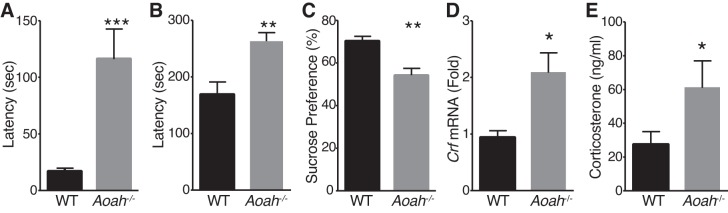
Fig. 1.
Fig. 1.
Acyloxyacyl hydrolase (AOAH)-deficient mice exhibit depressive-like behavioral phenotypes and corticotropin-releasing factor (Crf) dysregulation. A: female AOAH-deficient mice exhibit increased latency to reach food in novelty suppressed feeding assay (n = 17–18, P = 0.0006, two-tailed Student’s t-test). B: female AOAH-deficient mice consume food pellet (P = 0.0060), compared with wild-type (WT) mice. C: female Aoah−/− mice showed decreased preference for sucrose water in sucrose preference test as compared with B6 mice (n = 10–12, P = 0.0016, two-tailed Student’s t-test,). D: quantitation of Crf mRNA of WT and AOAH-deficient brain punches from the paraventricular nucleus (PVN) normalized to ribosomal protein L19. Female Aoah−/− mice have increased PVN Crf mRNA (n = 14–19, P = 0.0109, two-tailed Student’s t-test). E: female Aoah−/− mice have increased serum corticosterone by ELISA (n = 14–16, P = 0.0148, Mann-Whitney U-test). Data are means ± SE. Differences were considered statistically significant at *P < 0.05; **P < 0.01; ***P < 0.001.
Fig. 2.
Fig. 2.
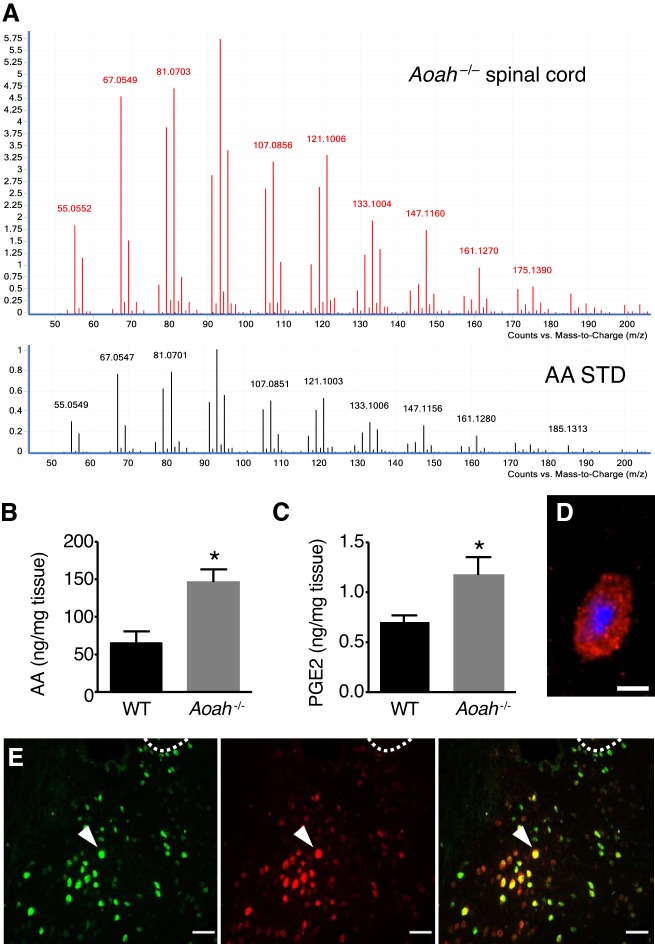
Acyloxyacyl hydrolase (AOAH)-deficient mice exhibit increased spinal arachidonic acid (AA) levels. A: MS-MS analyses of m/z 305.3 peak and AA standard reveals similar fragment spectra. B: lipidomic analyses in sacral spinal cords of female B6 and Aoah−/− mice shows increased AA (n = 4–6, *P = 0.0107, two-tailed Student’s t-test). C: the test showed increased PGE2 in Aoah−/− mice (n = 6, *P = 0.0329). Data are means ± SE. D: corticotropin-releasing factor immunoreactivity detected in the paraventricular nucleus (PVN) of female B6 mice. Red is CRF staining, and blue is DAPI. E: immunoreactivity of AOAH (green) and CRF (red) in brain sections of female B6 mice shows double-labeled cells (yellow) in the PVN. Dotted line, margin of the third ventricle as a landmark for the PVN.
Fig. 3.
Fig. 3.
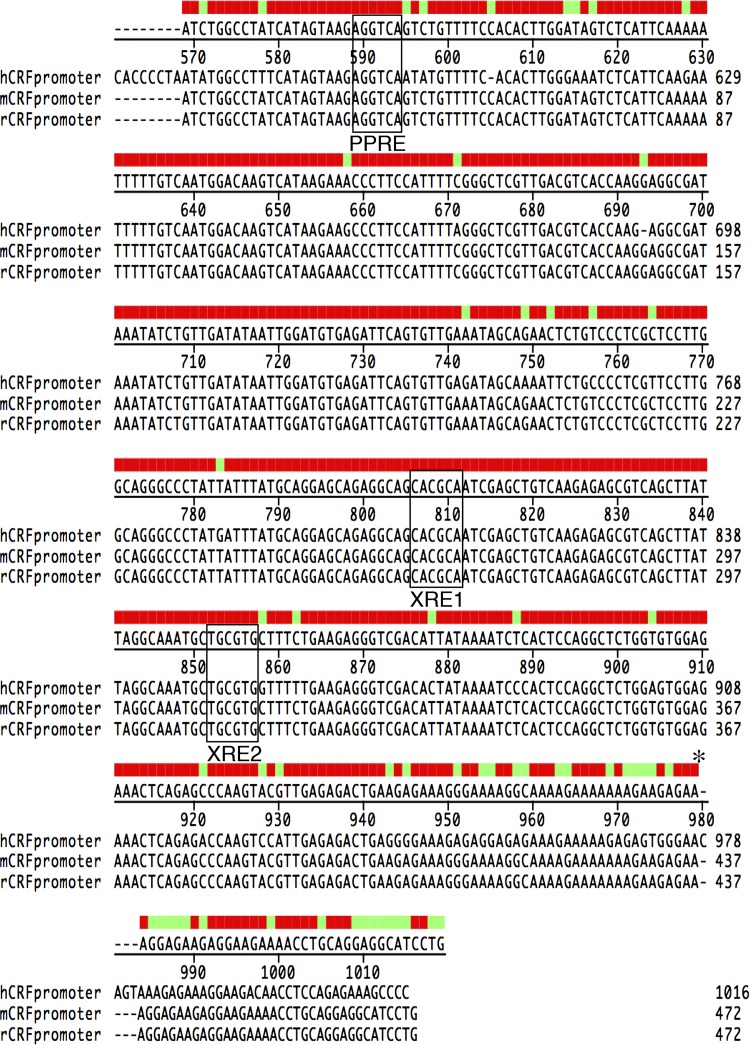
Corticotropin-releasing factor (Crf) promoter is highly conserved. Consensus proliferator hormone recepton element (PPRE) and xenobiotic responsive element (XRE) sites are conserved within the Crf promoter of humans, rats, and mice. *Start site.
Fig. 4.
Fig. 4.
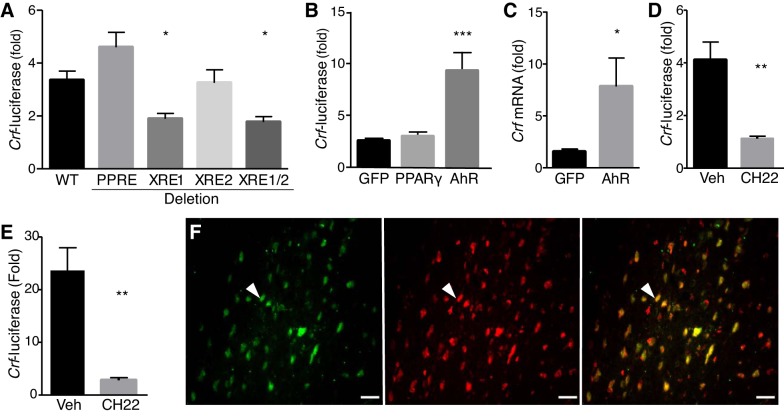
Aryl hydrocarbon receptor (AhR) mediates arachidonic acid (AA)-induced corticotropin-releasing factor (Crf) expression. HEK 293T cells transfected with Crf-luciferase and stimulated with 300 µM AA. A: mutation of xenobiotic responsive element1 (XRE1) reduced AA-mediated Crf promoter activity (F = 8.884, df = 55, one-way ANOVA-Dunnett’s multiple comparisons test). B: 293T cells were also transfected with expression constructs for green fluorescent protein (GFP), peroxisome proliferator-activitor receptor-γ (PPARγ), or AhR. AA-dependent Crf expression was unaltered by PPARγ but was significantly increased by AhR (F = 15.17, df = 33, ANOVA-Dunnett’s multiple comparisons test). C: AhR overexpression in N42 cells showed increased AA-induced Crf mRNA compared with GFP when quantified by qRT-PCR and normalized to L19 (P = 0.0354, two-tailed Student’s t-test). D: in transfected 293T cells, CH-223191 inhibited AA-induced Crf-luciferase (F = 21.37, df = 6, ANOVA-Dunnett’s multiple comparisons test). E: in cultures overexpressing AhR, AA-induced Crf-luciferase is similarly inhibited by CH-223191 (F = 15.08, df = 15, ANOVA-Dunnett’s multiple comparisons test). Data are means ± SE; differences were considered statistically significant at *P < 0.05; **P < 0.01; ***P < 0.001. F: AhR (green) and CRF (red) immunoreactivity in brain sections of female B6 show double-labeled cells (yellow) in the paraventricular nucleus.
Fig. 5.
Fig. 5.
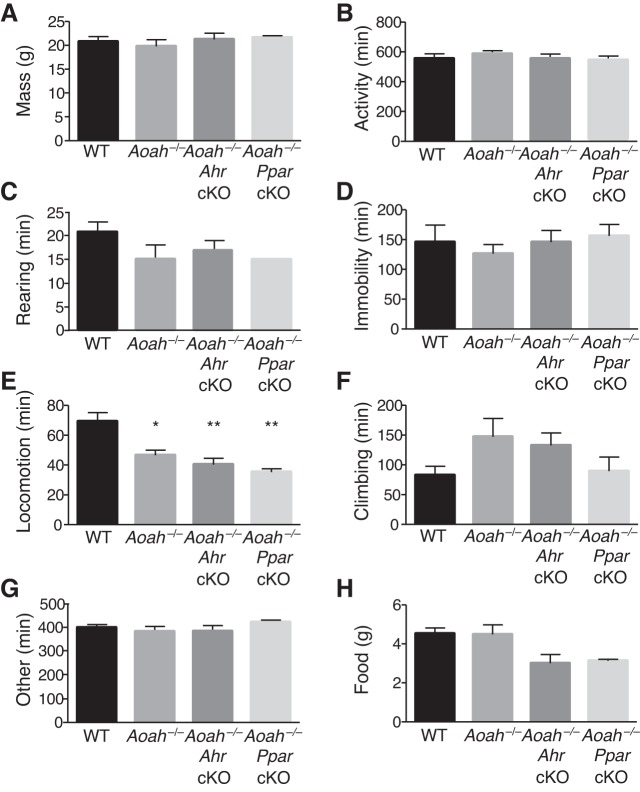
Overall activity levels are unperturbed by Acyloxyacyl hydrolase (AOAH) deficiency or conditional knockouts. Female wild-type (WT) (n = 4), AOAH-deficient (n = 5), AOAH-deficient Ahr conditioned knockout (Ahr cKO, n = 8), and AOAH-deficient peroxisome proliferator-activated receptorγ (Pparγ) cKO mice (n = 3) were monitored during a 12-h period using LABORAS to determine the number of minutes spent doing each activity. All mouse strains showed similar mass (A), combined activity (locomotion, rearing, climbing) (B), and other rearing (C), or immobility (D). AOAH-deficiency results in decreased locomotion that is not restored by cKO (E). All strains spent a similar amount of time climbing (F) and other activities (G) and consumed similar amounts of chow (H). Statistical analysis was determined by one-way ANOVA followed by Dunnett’s multiple comparisons test. *P < 0.05; **P < 0.01, statistically significant differences. Data are means ± SE.
Fig. 6.
Fig. 6.
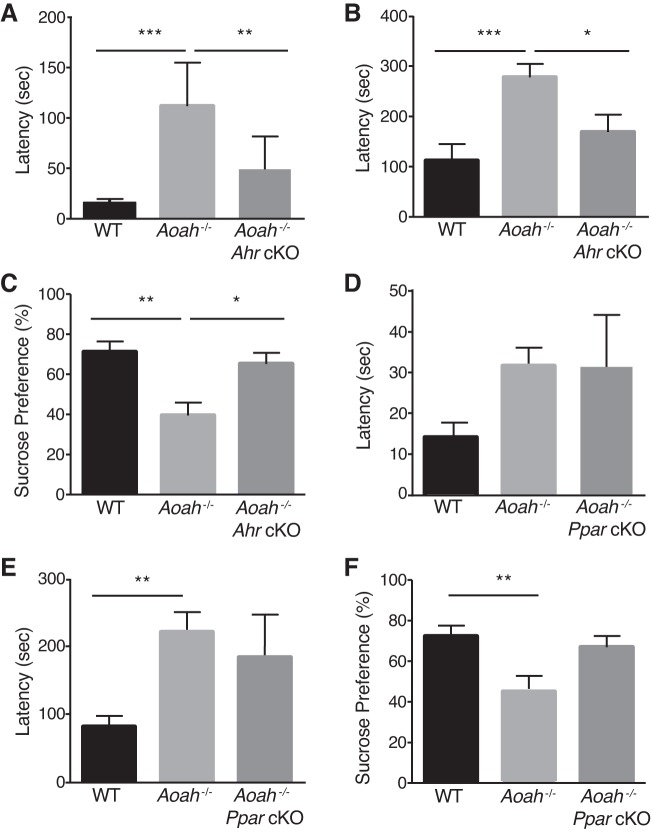
AhR is a mediator of depressive behaviors of AOAH-deficient mice. A–C: Ahr conditional knockout (cKO) in Crf-expressing cells of Aoah−/− mice rescues depression (n = 8 WT, n = 7 Aoah–/–, n = 6 cKO). A: female Aoah−/− mice show increased latency to approach food pellet (F = 17.22, df = 15, ANOVA-Tukey’s multiple comparisons test). B: they consume food pellet (F = 18.10, df = 16) compared with B6 and Aoah−/− Ahr cKO mice, in novelty-suppressed feeding (NSF) assay; outliers were identified using Prism Statistical Software C: female Aoah−/− mice showed decreased sucrose preference compared with B6 and Aoah−/−Ahr cKO in sucrose preference test (F = 9.533, df = 18, ANOVA-Tukey’s multiple comparisons test). D–F: Pparγ conditional knockout in Crf-expressing cells of female Aoah−/− mice does not alter depression-like phenotype (n = 19 WT, n = 9 Aoah–/–, n = 5 cKO). D: female Aoah−/− mice had increased latency to approach food pellet (F = 3.239, df = 20, ANOVA-Tukey’s multiple comparisons test). E: they consume food pellet (F = 6.977, df = 20) compared with B6 mice, in NSF assay. F: female Aoah−/− mice showed decreased preference for sucrose water (F = 7.546, df = 20, ANOVA-Tukey’s multiple comparisons test) compared with B6 mice in sucrose preference test. Data are means ± SE; differences were considered statistically significant at *P < 0.05; **P < 0.01; ***P < 0.001.
Fig. 7.
Fig. 7.
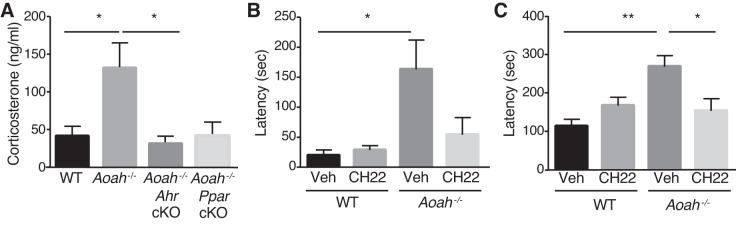
AhR is a therapeutic target for AOAH deficiency. A: Ahr conditional knockout in Crf-expressing cells of female Aoah−/− mice rescues HPA axis dysfunction. Female Aoah−/− mice had increased serum corticosterone levels compared with WT and Aoah−/− AhR cKO (n = 5, F = 4.665, df = 41, ANOVA-Tukey’s multiple comparisons test). B–C: AhR inhibition in female Aoah−/− mice rescues NSF depressive-like behaviors. B: female Aoah−/− mice fed CH-223191 (CH22) had decreased latency to approach food pellet (n = 5, F = 5.215, df = 16, ANOVA-Tukey’s multiple comparisons test). C: they consume food pellet (n = 5, F = 6.661, df = 16) compared with vehicle-fed (Veh) Aoah−/− mice. Data are means ± SE; differences were considered statistically significant at *P < 0.05; **P < 0.01.

References

    1. Agudelo LZ, Femenía T, Orhan F, Porsmyr-Palmertz M, Goiny M, Martinez-Redondo V, Correia JC, Izadi M, Bhat M, Schuppe-Koistinen I, Pettersson AT, Ferreira DMS, Krook A, Barres R, Zierath JR, Erhardt S, Lindskog M, Ruas JL. Skeletal muscle PGC-1α1 modulates kynurenine metabolism and mediates resilience to stress-induced depression. Cell 159: 33–45, 2014. [Erratum in Cell 160: P351, 2015]. doi: 10.1016/j.cell.2014.07.051. - DOI - PubMed
    1. Aguilera G, Rabadan-Diehl C, Nikodemova M. Regulation of pituitary corticotropin releasing hormone receptors. Peptides 22: 769–774, 2001. doi: 10.1016/S0196-9781(01)00390-4. - DOI - PubMed
    1. Alesci S, Martinez PE, Kelkar S, Ilias I, Ronsaville DS, Listwak SJ, Ayala AR, Licinio J, Gold HK, Kling MA, Chrousos GP, Gold PW. Major depression is associated with significant diurnal elevations in plasma interleukin-6 levels, a shift of its circadian rhythm, and loss of physiological complexity in its secretion: clinical implications. J Clin Endocrinol Metab 90: 2522–2530, 2005. doi: 10.1210/jc.2004-1667. - DOI - PubMed
    1. Arató M, Bánki CM, Bissette G, Nemeroff CB. Elevated CSF CRF in suicide victims. Biol Psychiatry 25: 355–359, 1989. doi: 10.1016/0006-3223(89)90183-2. - DOI - PubMed
    1. Arborelius L, Owens MJ, Plotsky PM, Nemeroff CB. The role of corticotropin-releasing factor in depression and anxiety disorders. J Endocrinol 160: 1–12, 1999. doi: 10.1677/joe.0.1600001. - DOI - PubMed

Publication types

MeSH terms