. 2019 Apr 23;20(8):1984.
doi: 10.3390/ijms20081984.

Lipid Modulating Anti-oxidant Stress Activity of Gastrodin on Nonalcoholic Fatty Liver Disease Larval Zebrafish Model

Affiliations

Lipid Modulating Anti-oxidant Stress Activity of Gastrodin on Nonalcoholic Fatty Liver Disease Larval Zebrafish Model

Owais Ahmad et al. Int J Mol Sci. .

Abstract

Non-alcoholic fatty liver disease (NAFLD) and nonalcoholic steatohepatitis (NASH) is the most common chronic liver disease in the world. However, there are still no drugs for NAFLD/NASH in the market. Gastrodin (GAS) is a bioactive compound that is extracted from Gastrodia elata, which is used as an active compound on nervous system diseases. Recent reports showed that GAS and Gastrodia elata possess anti-oxidant activity and lipid regulating effects, which makes us curious to reveal the anti-NAFLD effect of GAS. A high cholesterol diet (HCD) was used to induce a NAFLD larval zebrafish model, and the lipid regulation and anti-oxidant effects were tested on the model. Furthermore, qRT-PCR studied the underlying mechanism of GAS. To conclude, this study revealed a lipid regulation and anti-oxidant insights of GAS on NAFLD larval zebrafish model and provided a potential therapeutic compound for NAFLD treatment.

Keywords: Gastrodin; larval zebrafish; non-alcoholic fatty liver disease; non-alcoholic steatohepatitis.


Conflict of interest statement

The authors declare no conflict of interest.

Figures
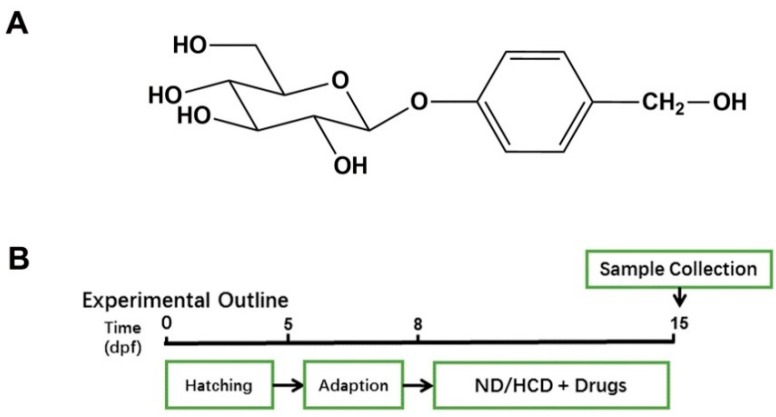
Figure 1
Figure 1
Effect of Gastrodin (GAS) on high cholesterol diet (HCD) induced larval zebrafish. (A) Chemical structure of GAS; (B) Experimental outline of the feeding protocol.
Figure 2
Figure 2
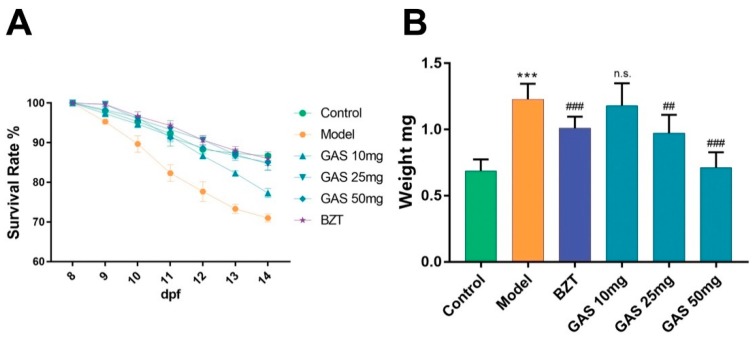
Effect of GAS on HCD induced larval zebrafish. (A) Mortality of larval zebrafish (n = 3); (B) Weight of larval zebrafish (n = 30). Bar indicate means ± SD. n.s. indicate no significant; *** p < 0.001 represent as compared with the control. ## p < 0.01, ### p < 0.001 represent compared with Model. p < 0.05 was considered to statistically significant, as calculated by One-way ANOVA, followed by Tukey’s test.
Figure 3
Figure 3
Lipid is regulating the effect of GAS on HCD induced larval zebrafish. (A) Nile red stain of larval zebrafish; (B) Triglyceride (TG) levels; and (C) total cholesterol (TC) levels of larval zebrafish in each group. (D) hematoxylin and eosin (HE) staining of larval zebrafish liver, macrovesicular steatosis and the differences mentioned with red arrows. Bar indicate means ± SD. *** p < 0.001 represent compared with the control. # p < 0.05, ### p < 0.001 represent compared with Model. p < 0.05 was considered as statistically significant, calculated by One-way ANOVA, followed by Tukey’s test. (n = 30).
Figure 4
Figure 4
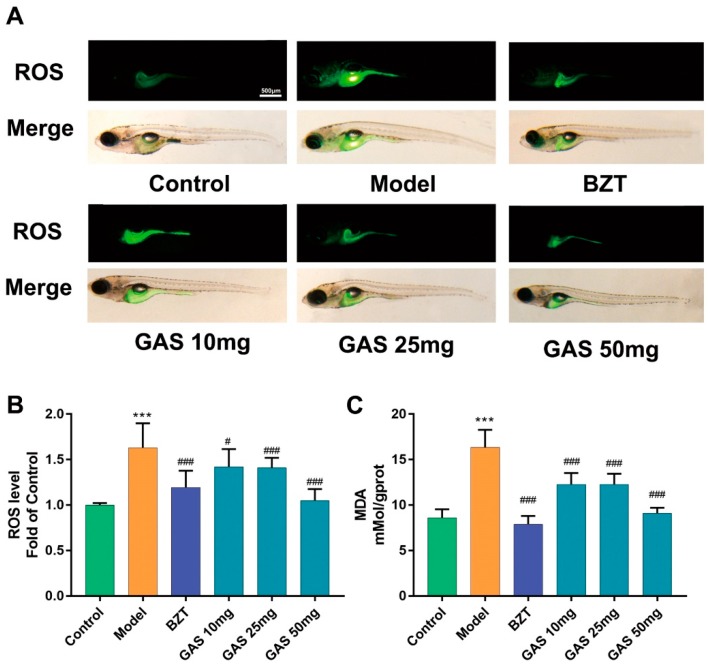
The anti-oxidant stress effect of GAS on HCD induced larval zebrafish. (A) The ROS production showed in fluorescence image and merged with a light field image. (B,C) Quantitation of reactive oxygen species C malondialdehyde (ROS. C. MDA) of each treated larval zebrafish group. Bar indicate means ± SD. *** p < 0.001 represent compared with the control. # p < 0.05, ### p < 0.001 represent compared with Model. p < 0.05 was considered as statistically significant, as calculated by One-way ANOVA followed by Tukey’s test. (n = 30).
Figure 5
Figure 5
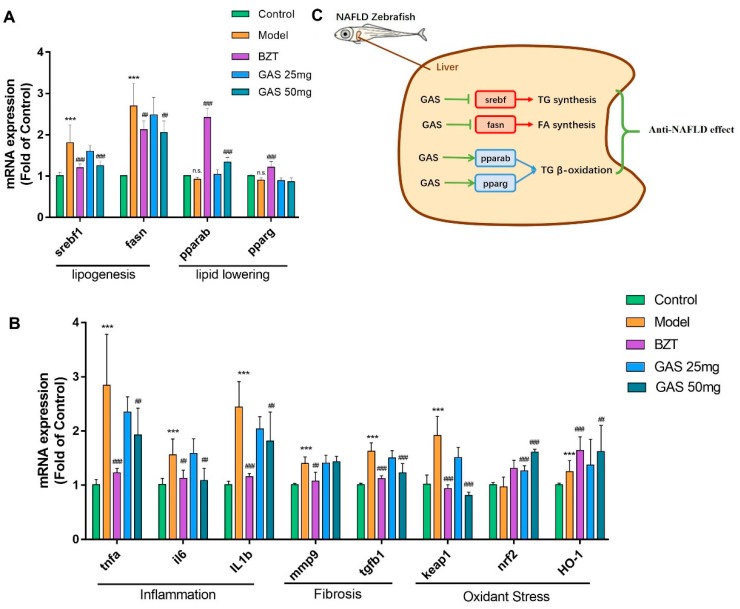
mRNA expression profile of GAS on HCD induced larval zebrafish and Molecular Mechanism of GAS. (A) mRNA expression of lipogenesis and lipid-lowering of larval zebrafish. (B) mRNA expression of inflammation, Fibrosis and oxidant stress of larval zebrafish. (C)molecular mechanisms of lipid metabolism modulation by GAS. Bar indicate means ± SD. n.s. indicate no significant; *** p < 0.001 represent compared with the control. # p < 0.05, ### p < 0.001 represent compared with Model. p < 0.05 was considered as statistically significant, as calculated by One-way ANOVA followed by Tukey’s test. (n = 6).

References

    1. Goh B.B., Mccullough A.J. Natural History of Nonalcoholic Fatty Liver Disease. Dig. Dis. Sci. 2016;61:1–8. doi: 10.1007/s10620-016-4095-4. - DOI - PMC - PubMed
    1. Diehl A.M., Day C. Cause, Pathogenesis, and Treatment of Nonalcoholic Steatohepatitis. N. Engl. J. Med. 2017;377:2063–2072. doi: 10.1056/NEJMra1503519. - DOI - PubMed
    1. Ying L., Yan F., Zhao Y., Gao H., Williams B.R., Hu Y., Li X., Tian R., Xu P., Wang Y. (−)–Epigallocatechin-3-gallate and atorvastatin treatment down-regulates liver fibrosis-related genes in non-alcoholic fatty liver disease. Clin. Exp. Pharmacol. Physiol. 2017;44:1180. doi: 10.1111/1440-1681.12844. - DOI - PubMed
    1. Malaguarnera M., Rosa M.D., Nicoletti F., Malaguarnera L. Molecular mechanisms involved in NAFLD progression. J. Mol. Med. 2009;87:679. doi: 10.1007/s00109-009-0464-1. - DOI - PubMed
    1. Qin G., Ma J., Huang Q., Yin H., Han J., Li M., Deng Y., Wang B., Hassan W., Shang J. Isoquercetin Improves Hepatic Lipid Accumulation by Activating AMPK Pathway and Suppressing TGF-beta Signaling on an HFD-Induced Nonalcoholic Fatty Liver Disease Rat Model. Int. J. Mol. Sci. 2018;19:4126. doi: 10.3390/ijms19124126. - DOI - PMC - PubMed

MeSH terms

LinkOut - more resources