


Preterm birth disrupts the development of feeding and breathing coordination
- PMID: 31018743
- PMCID: PMC6620663
- DOI: 10.1152/japplphysiol.00101.2019
Preterm birth disrupts the development of feeding and breathing coordination
Abstract
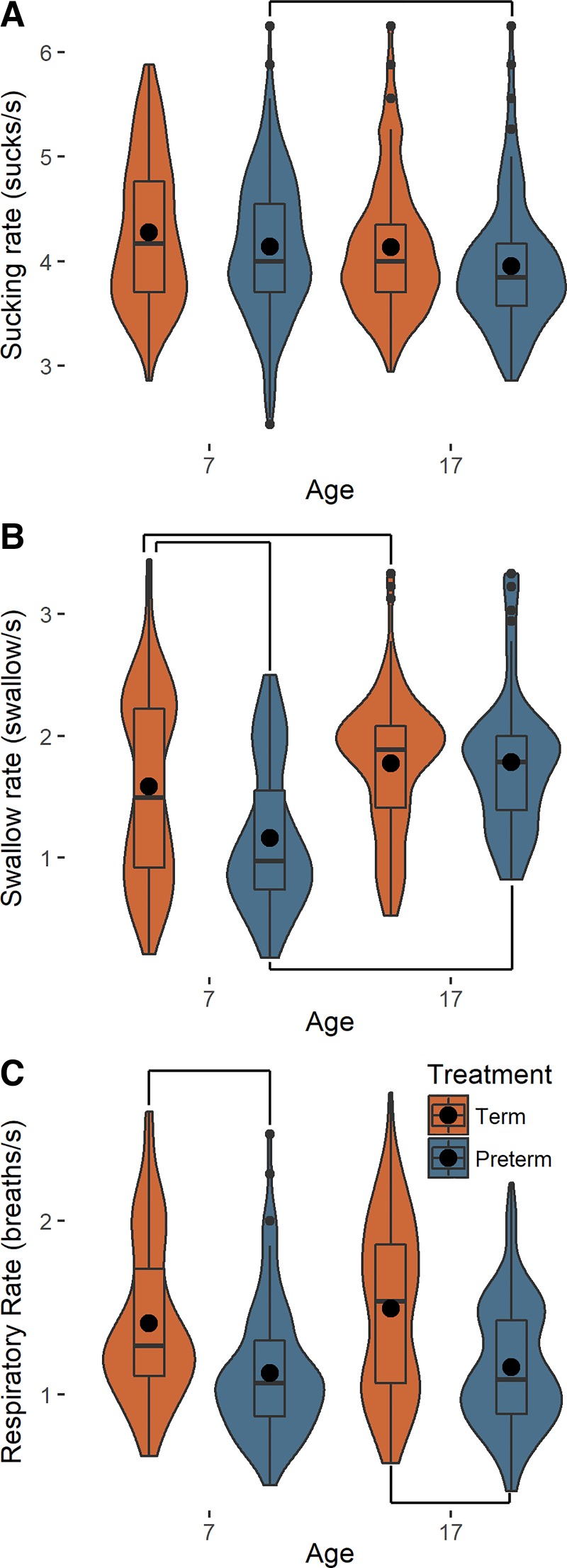
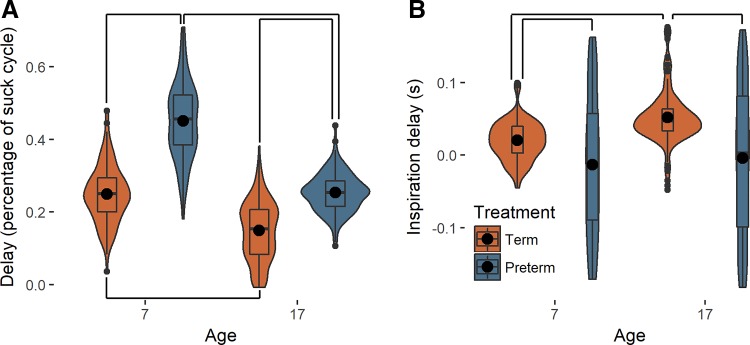
All mammals must breathe and breathe continuously from birth. Similarly, all mammals, including infants, have high functional demands for feeding. However, the pathway that food takes through the pharynx interrupts respiration. The coordination between swallowing and breathing is therefore critical for all infant mammals. Clinically, this coordination differs between term and preterm infants. However, the neurological mechanisms underlying this coordination and how it matures as infants grow are poorly understood. Here, we integrate high-resolution data from multiple physiologic processes across a longitudinal time frame to study suck-swallow-breathe dynamics in a preterm animal model, the infant pig. In doing so, we test the hypothesis that preterm birth will have an impact on some, but not all, behaviors associated with suck-swallow-breath performance. We hypothesize that coordination will be disrupted, reflecting incomplete connections in the brainstem. We found that preterm pigs became rhythmic and mature in sucking and swallowing behaviors, suggesting substantial postnatal maturation in the coordination of these behaviors. However, their ability to coordinate swallowing and breathing never developed. These results have implications for the nature of clinical care of human infants, as well as for how feeding processes develop in mammals. Clinically, they provide a foundation for developing interventions for preterm infants. Additionally, these results suggest that the lack of coordination between swallowing and breathing may be a significant factor in determining the minimum gestation time across mammals. NEW & NOTEWORTHY Preterm infants face a variety of challenges associated with safe feeding, but obtaining high-resolution longitudinal data to understand these challenges in humans is challenging. We used a pig model to acquire high-speed videofluoroscopic and respiratory inductance plethysmograph data throughout the nursing period to show that preterm birth does not have substantial impacts on the ability of infants to perform isolated behaviors. However, it does decrease the ability of preterm infants to coordinate among behaviors during feeding.
Keywords: aerodigestive; dysphagia; feeding; neonate; premature.
Conflict of interest statement
No conflicts of interest, financial or otherwise, are declared by the authors.
Figures
References
-
- Ballester A, Gould F, Bond L, Stricklen B, Ohlemacher J, Gross A, DeLozier K, Buddington R, Buddington K, Danos N, German R. Maturation of the coordination between respiration and deglutition with and without recurrent laryngeal nerve lesion in an animal model. Dysphagia 33: 627–635, 2018. doi: 10.1007/s00455-018-9881-z. - DOI - PMC - PubMed
-
- Bates D, Mächler M, Bolker B, Walker S. Fitting linear mixed-effects models using lme4. J Stat Softw 67: 1–48, 2015. doi: 10.18637/jss.v067.i01. - DOI
-
- Biewener AA, Patek SN. Animal Locomotion (2nd ed.). Oxford, UK: Oxford University Press, 2018.
Publication types
MeSH terms
Grants and funding
LinkOut - more resources
Full Text Sources
Medical
