. 2019 Apr 25;14(1):60.
doi: 10.1186/s13014-019-1267-3.

Retrospective study on the benefit of adjuvant radiotherapy in men with intraductal carcinoma of prostate

Affiliations

Retrospective study on the benefit of adjuvant radiotherapy in men with intraductal carcinoma of prostate

Vincent Q Trinh et al. Radiat Oncol. .

Abstract

Background: Intraductal carcinoma of the prostate (IDC-P) is an independent biomarker of recurrence and survival with particular treatment response, yet no study has tested its response to radiotherapy. The aim of our project was to test the impact of adjuvant radiotherapy (ART) in patients with localized to locally advanced prostate cancer (PC) and IDC-P.

Materials and methods: We performed a retrospective study of men with pT2-T3 PC treated by radical prostatectomy (RP) with or without ART, from two centres (1993-2015). Exclusion criteria were the use of another type of treatment prior to biochemical recurrence (BCR), and detectable prostate- specific antigen (PSA) following RP or ART. Primary outcome was BCR (2 consecutive PSA ≥ 0.2 ng/ml). Patients were grouped by treatment (RPonly/RP + ART), IDC-P status, and presence of high-risk features (HRF: Grade Groups 4-5, positive margins, pT3 stage).

Results: We reviewed 293 RP specimens (median follow-up 99 months, 69 BCR). Forty-eight patients (16.4%) were treated by RP + ART. Multivariate Cox regression for BCR indicated that IDC-P had the strongest impact (hazard ratio [HR] = 2.39, 95% confidence interval [CI]:1.44-3.97), while ART reduced the risk of BCR (HR = 0.38, 95%CI: 0.17-0.85). Other HRF were all significant except for pT3b stage. IDC-P[+] patients who did not receive ART had the worst BCR-free survival (log-rank P = 0.023). Furthermore, IDC-P had the same impact on BCR-free survival as ≥1 HRF (log-rank P = 0.955).

Conclusion: Men with IDC-P who did not receive ART had the highest BCR rates, and IDC-P had the same impact as ≥1 HRF, which are often used as ART indications. Once validated, ART should be considered in patients with IDC-P.

Keywords: Adjuvant radiotherapy; Biochemical recurrence; Prostate cancer; Radical prostatectomy.


Conflict of interest statement

Ethics approval and consent to participate

Ethics committee approval and consent to participate were obtained.

Consent for publication

All authors approved the manuscript for publication.

Competing interests

The authors declare that they have no competing interests.

Publisher’s Note

Springer Nature remains neutral with regard to jurisdictional claims in published maps and institutional affiliations.

Figures

Fig. 1
Fig. 1
Routine hematoxylin and eosin (200X) of intraductal carcinoma of the prostate. Shown is the defining dense cribriform proliferation in a dilated duct/acinus with preservation of basal cells (arrow)
Fig. 2
Fig. 2
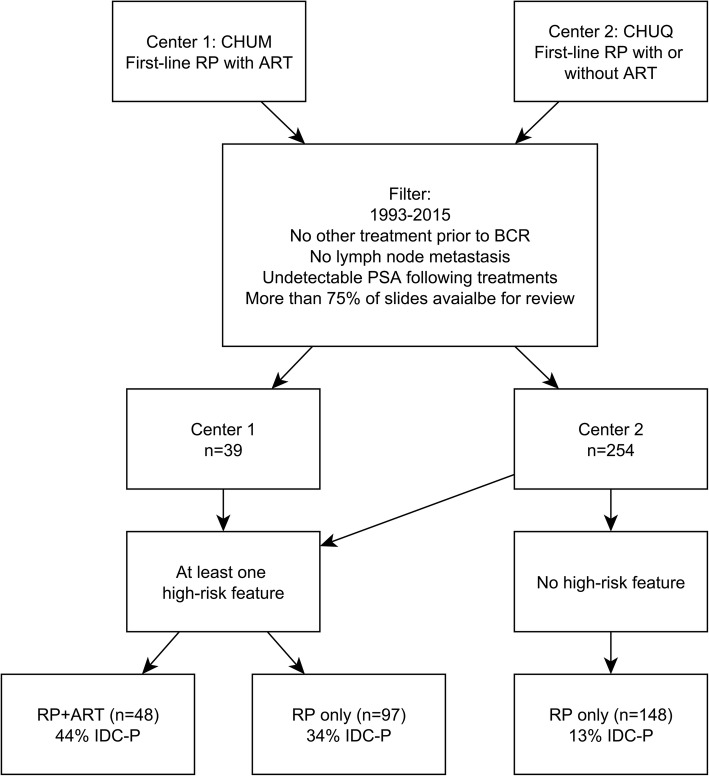
Study workflow. For the main study purpose, patients were mainly separated according to the presence of high-risk features (Grade groups 4–5, seminal vesicle invasion, extraprostatic extension, positive margins). Abbreviations: CHUM: Centre hospitalier de l’Université de Montréal (Centre 1); CHUQ: Centre hospitalier universitaire de Québec-Université Laval (Centre 2); RP: radical prostatectomy; IDC-P: intraductal carcinoma of prostate
Fig. 3
Fig. 3
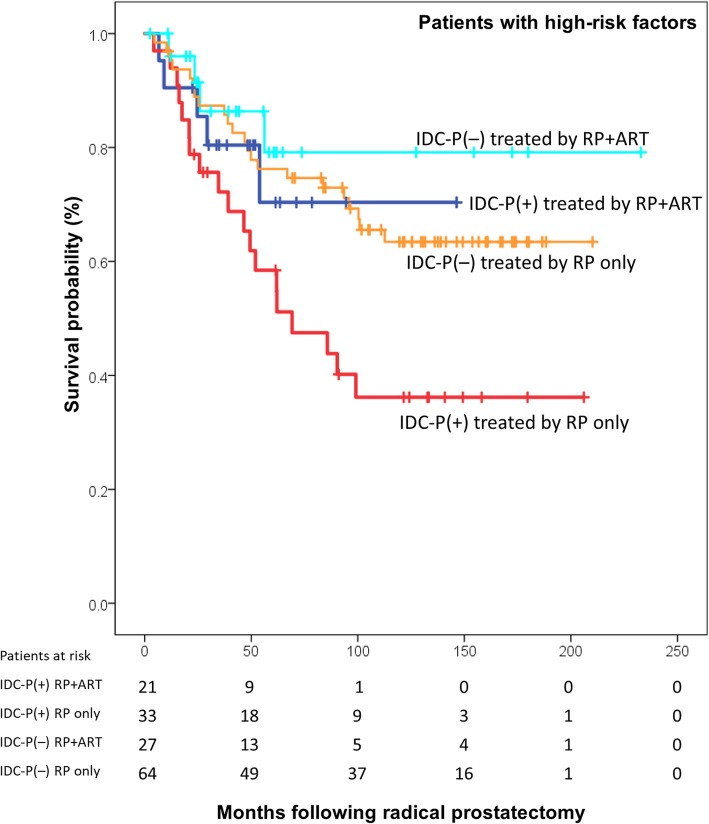
Kaplan-Meier curve of BCR-free survival following radical prostatectomy in patients with at least one high-risk feature, according to IDC-P and treatment status. Patients treated by RPonly and who had IDC-P were the outlying group with poor outcome. Log-rank testing P = 0.023. When comparing IDC-P patients only (red and blue curves), mean survival of RP + ART patients was 112 months (95% CI: 85–138, median not yet reach), and median survival of RPonly patients was 69 months (95% CI: 28–111), with log-rank testing P = 0.158. Abbreviations: IDC-P: intraductal carcinoma of prostate. RP: radical prostatectomy. ART: adjuvant radiotherapy. HRF: High-risk features (GG4–5, seminal vesicle invasion, positive margins, extraprostatic extension)
Fig. 4
Fig. 4
Kaplan-Meier curve of BCR-free survival following radical prostatectomy of patients without any high-risk features. Mean survival of IDC-P[+] patients was 138 months (95% CI:108–169, median survival not yet reached), and mean survival of IDC-P[−] patients was 218 months (95% CI:202–234, median survival not yet reached). Log-rank testing P < 0.002. Abbreviations: IDC-P: intraductal carcinoma of the prostate. RP: radical prostatectomy. ART: adjuvant radiotherapy. High-risk features: Grade groups 4–5, seminal vesicle invasion, positive margins, extraprostatic extension
Fig. 5
Fig. 5
Kaplan-Meier curve of BCR-free survival following radical prostatectomy, comparing the effect of IDC-P (without any high-risk features) against patients with at least one high-risk feature (without IDC-P). Mean survival of ≥1 HRF patients was 152 months (95% CI: 133–172, median survival not yet reached), and mean survival of IDC-P[+] patients was 138 months (95% CI: 107–169, median survival not yet reached). Log-rank testing P = 0.955. Abbreviations: IDC-P: intraductal carcinoma of prostate. RP: radical prostatectomy. ART: adjuvant radiotherapy. HRF: High-risk features (Grade groups 4–5, seminal vesicle invasion, positive margins, extraprostatic extension)

References

    1. Kato Masashi, Tsuzuki Toyonori, Kimura Kyosuke, Hirakawa Akihiro, Kinoshita Fumie, Sassa Naoto, Ishida Ryo, Fukatsu Akitoshi, Kimura Tohru, Funahashi Yasuhito, Matsukawa Yoshihisa, Hattori Ryohei, Gotoh Momokazu. The presence of intraductal carcinoma of the prostate in needle biopsy is a significant prognostic factor for prostate cancer patients with distant metastasis at initial presentation. Modern Pathology. 2016;29(2):166–173. doi: 10.1038/modpathol.2015.146. - DOI - PubMed
    1. Kimura K, Tsuzuki T, Kato M, Saito AM, Sassa N, Ishida R, et al. Prognostic value of intraductal carcinoma of the prostate in radical prostatectomy specimens. Prostate. 2014;74(6):680–687. doi: 10.1002/pros.22786. - DOI - PubMed
    1. Guo CC, Epstein JI. Intraductal carcinoma of the prostate on needle biopsy: histologic features and clinical significance. Mod Pathol. 2006;19(12):1528–1535. doi: 10.1038/modpathol.3800702. - DOI - PubMed
    1. Henry PC, Evans AJ. Intraductal carcinoma of the prostate: a distinct histopathological entity with important prognostic implications. J Clin Pathol. 2009;62(7):579–583. doi: 10.1136/jcp.2009.065003. - DOI - PubMed
    1. Magers M, Kunju LP, Wu A. Intraductal carcinoma of the prostate: morphologic features, differential diagnoses, significance, and reporting practices. Arch Pathol Lab Med. 2015;139(10):1234–1241. doi: 10.5858/arpa.2015-0206-RA. - DOI - PubMed

MeSH terms