


Subclinical Cytomegalovirus DNA Is Associated with CD4 T Cell Activation and Impaired CD8 T Cell CD107a Expression in People Living with HIV despite Early Antiretroviral Therapy
- PMID: 31019052
- PMCID: PMC6580967
- DOI: 10.1128/JVI.00179-19
Subclinical Cytomegalovirus DNA Is Associated with CD4 T Cell Activation and Impaired CD8 T Cell CD107a Expression in People Living with HIV despite Early Antiretroviral Therapy
Abstract
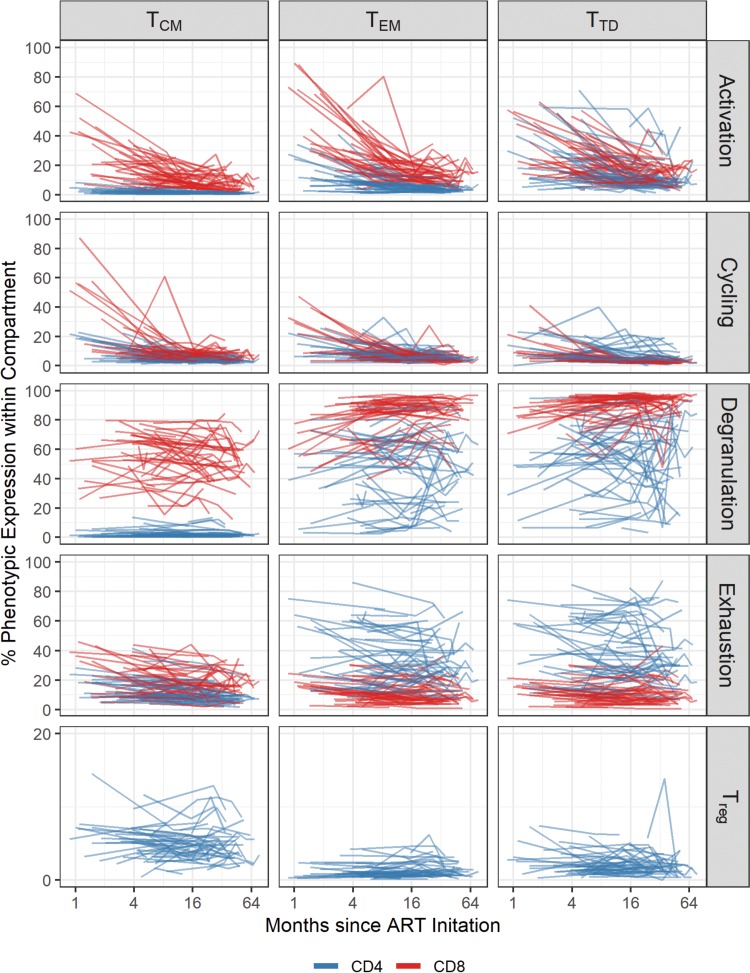
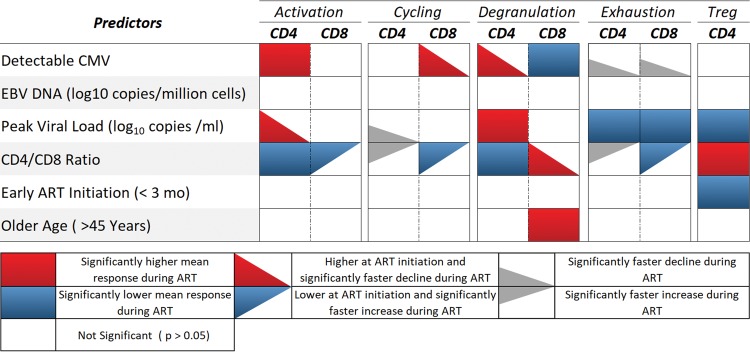
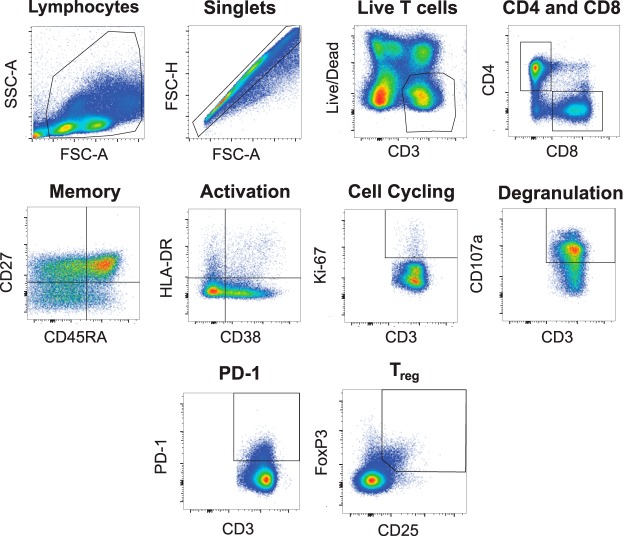
Most people living with HIV (PLWH) are coinfected with cytomegalovirus (CMV). Subclinical CMV replication is associated with immune dysfunction and with increased HIV DNA in antiretroviral therapy (ART)-naive and -suppressed PLWH. To identify immunological mechanisms by which CMV could favor HIV persistence, we analyzed 181 peripheral blood mononuclear cell (PBMC) samples from 64 PLWH starting ART during early HIV infection with subsequent virologic suppression up to 58 months. In each sample, we measured levels of CMV and Epstein-Barr virus (EBV) DNA by droplet digital PCR (ddPCR). We also measured expression of immunological markers for activation (HLA-DR+ CD38+), cycling (Ki-67+), degranulation (CD107a+), and the immune checkpoint protein PD-1 on CD4+ and CD8+ T cell memory subsets. Significant differences in percentages of lymphocyte markers by CMV/EBV shedding were identified using generalized linear mixed-effects models. Overall, CMV DNA was detected at 60/181 time points. At the time of ART initiation, the presence of detectable CMV DNA was associated with increased CD4+ T cell activation and CD107a expression and with increased CD8+ T cellular cycling and reduced CD107a expression on CD8+ T cells. While some effects disappeared during ART, greater CD4+ T cell activation and reduced CD107a expression on CD8+ T cells persisted when CMV was present (P < 0.01). In contrast, EBV was not associated with any immunological differences. Among the covariates, peak HIV RNA and CD4/CD8 ratio had the most significant effect on the immune system. In conclusion, our study identified immune differences in PLWH with detectable CMV starting early ART, which may represent an additional hurdle for HIV cure efforts.IMPORTANCE Chronic viral infections such as with HIV and CMV last a lifetime and can continually antagonize the immune system. Both viruses are associated with higher expression of inflammation markers, and recent evidence suggests that CMV may complicate efforts to deplete HIV reservoirs. Our group and others have shown that CMV shedding is associated with a larger HIV reservoir. Subclinical CMV replication could favor HIV persistence via bystander effects on our immune system. In this study, we collected longitudinal PBMC samples from people starting ART and measured immune changes associated with detectable CMV. We found that when CMV was detectable, CD4+ T cell activation was higher and CD8+ T cell degranulation was lower. Both results may contribute to the slower decay of the size of the reservoir during CMV replication, since activated CD4+ T cells are more vulnerable to HIV infection, while the loss of CD8+ T cell degranulation may impede the proper killing of infected cells.
Keywords: CMV; HIV; T cells; immune dysfunction.
Copyright © 2019 American Society for Microbiology.
Figures
References
-
- Durier N, Ananworanich J, Apornpong T, Ubolyam S, Kerr SJ, Mahanontharit A, Ferradini L, Ruxrungtham K, Avihingsanon A. 2013. Cytomegalovirus viremia in Thai HIV-infected patients on antiretroviral therapy: prevalence and associated mortality. Clin Infect Dis 57:147–155. doi: 10.1093/cid/cit173. - DOI - PubMed
Publication types
MeSH terms
Substances
Grants and funding
- K24 AI100665/AI/NIAID NIH HHS/United States
- R01 MH101012/MH/NIMH NIH HHS/United States
- UL1 TR001442/TR/NCATS NIH HHS/United States
- R21 HD094646/HD/NICHD NIH HHS/United States
- R01 AI118422/AI/NIAID NIH HHS/United States
- P30 AI036214/AI/NIAID NIH HHS/United States
- R01 MH097520/MH/NIMH NIH HHS/United States
- U01 AI043638/AI/NIAID NIH HHS/United States
- U01 AI068636/AI/NIAID NIH HHS/United States
- T32 AI007384/AI/NIAID NIH HHS/United States
- DP1 DA034978/DA/NIDA NIH HHS/United States
- P30 AI027763/AI/NIAID NIH HHS/United States
- P30 MH062512/MH/NIMH NIH HHS/United States
- UL1 TR000100/TR/NCATS NIH HHS/United States
- U19 AI096113/AI/NIAID NIH HHS/United States
- P01 AI074621/AI/NIAID NIH HHS/United States
- P01 AI131385/AI/NIAID NIH HHS/United States
- R01 MH100974/MH/NIMH NIH HHS/United States
- UM1 AI068636/AI/NIAID NIH HHS/United States
- R24 AI106039/AI/NIAID NIH HHS/United States
LinkOut - more resources
Full Text Sources
Other Literature Sources
Medical
Research Materials
