. 2019 Apr 24;9(1):6474.
doi: 10.1038/s41598-019-42876-6.

Fragment-based screening identifies inhibitors of ATPase activity and of hexamer formation of Cagα from the Helicobacter pylori type IV secretion system

Affiliations

Fragment-based screening identifies inhibitors of ATPase activity and of hexamer formation of Cagα from the Helicobacter pylori type IV secretion system

Tarun Arya et al. Sci Rep. .

Abstract

Type IV secretion systems are multiprotein complexes that mediate the translocation of macromolecules across the bacterial cell envelope. In Helicobacter pylori a type IV secretion system encoded by the cag pathogenicity island encodes 27 proteins and most are essential for virulence. We here present the identification and characterization of inhibitors of Cagα, a hexameric ATPase and member of the family of VirB11-like proteins that is essential for translocation of the CagA cytotoxin into mammalian cells. We conducted fragment-based screening using a differential scanning fluorimetry assay and identified 16 molecules that stabilize the protein suggesting that they bind Cagα. Several molecules affect binding of ADP and four of them inhibit the ATPase activity. Analysis of enzyme kinetics suggests that their mode of action is non-competitive, suggesting that they do not bind to the active site. Cross-linking suggests that the active molecules change protein conformation and gel filtration and transmission electron microscopy show that molecule 1G2 dissociates the Cagα hexamer. Addition of the molecule 1G2 inhibits the induction of interleukin-8 production in gastric cancer cells after co-incubation with H. pylori suggesting that it inhibits Cagα in vivo. Our results reveal a novel mechanism for the inhibition of the ATPase activity of VirB11-like proteins.


Conflict of interest statement

The authors declare no competing interests.

Figures
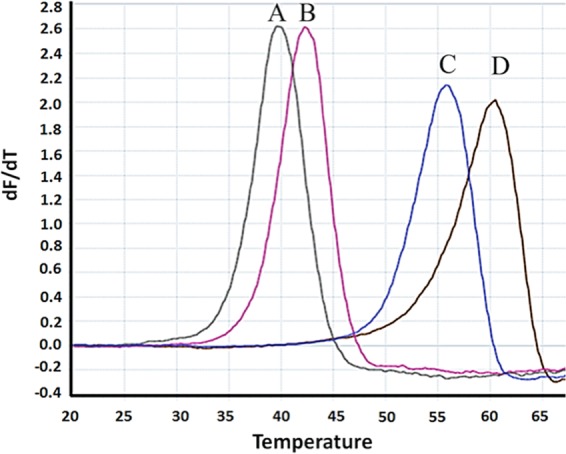
Figure 1
Figure 1
Melting temperature of Cagα in the presence of ligands and cofactors. Melting curves for Cagα were determined using differential scanning fluorimetry (DSF). (A) Cagα apoprotein (green, Tm = 37 °C), (B) Cagα and metal cofactor MgCl2 (pink, Tm = 42 °C), (C) Cagα with MgCl2 and ADP (blue, Tm = 56 °C) and (D) Cagα with MgCl2 and ATP-γ-S (black, Tm = 60 °C).
Figure 2
Figure 2
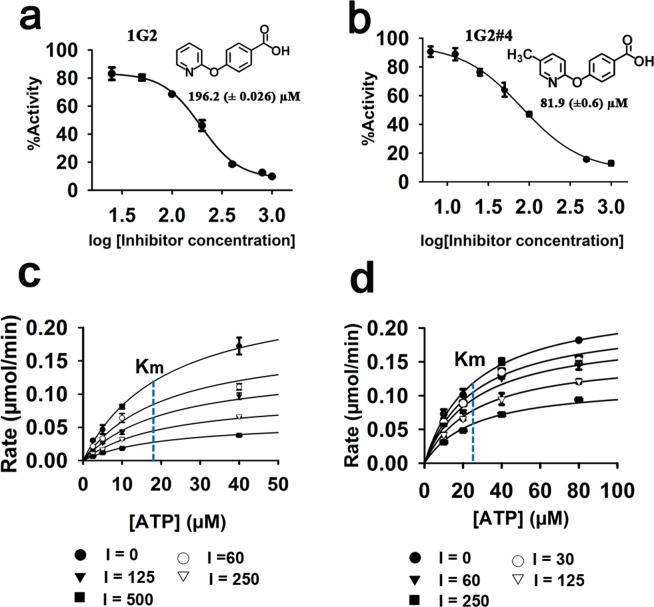
Enzyme Kinetics of Cagα in the presence of molecule 1G2 and 1G2#4. (a,b) Dose response curves of ATPase activity showing IC50 values in the presence of 1G2 and its derivative 1G2#4. (c,d) Plot of Cagα ATPase activity versus ATP concentration in the presence of 1G2 and 1G2#4. The data were globally fit to a model of non-competitive inhibition. Concentrations varied from 0 to 500 µM of inhibitors in the presence of 2 mM of MgCl2. The blue lines in (c) and (d) represent Km, which remains constant throughout different inhibitor concentrations.
Figure 3
Figure 3
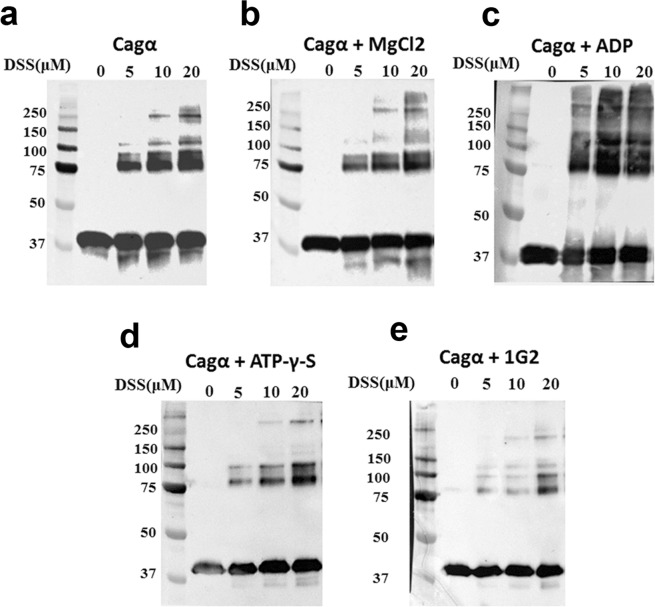
Chemical cross-linking using DSS to study the formation of Cagα oligomers in the presence of ligands. (a) Cagα apo protein; (b) Cagα with MgCl2; (c) Cagα with ADP and MgCl2; (d) Cagα with ATP-γ-S and MgCl2; (e) Cagα with 1G2 and MgCl2. The concentrations of DSS varied between 0 and 50 µM leading to formation of oligomers (indicated by arrows), detection by SDS-PAGE and western blotting using His-tag specific antibodies. Original blots are provided as supplementary dataset.
Figure 4
Figure 4
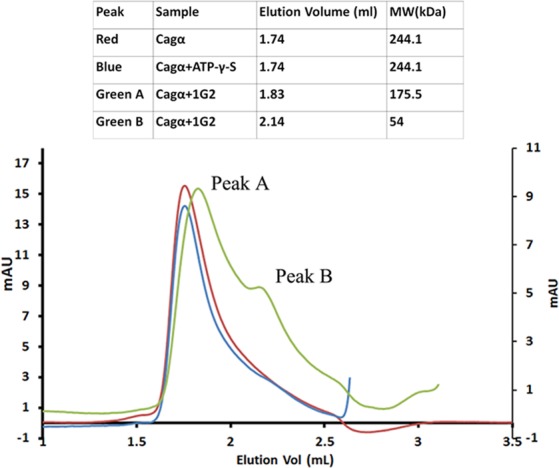
Analytical size exclusion chromatography of Cagα apoprotein and in the presence of ligands. Proteins were separated by gel filtration over a Superdex 200 column. Cagα apoprotein elutes as a hexamer (red curve), elution of Cagα-ATP-γ-S (blue curve) and of two lower molecular mass peaks (A and B) after incubation of Cagα with 1G2 (in green). The molecular masses characterized according to the elution volume are summarized in the table above the graph.
Figure 5
Figure 5
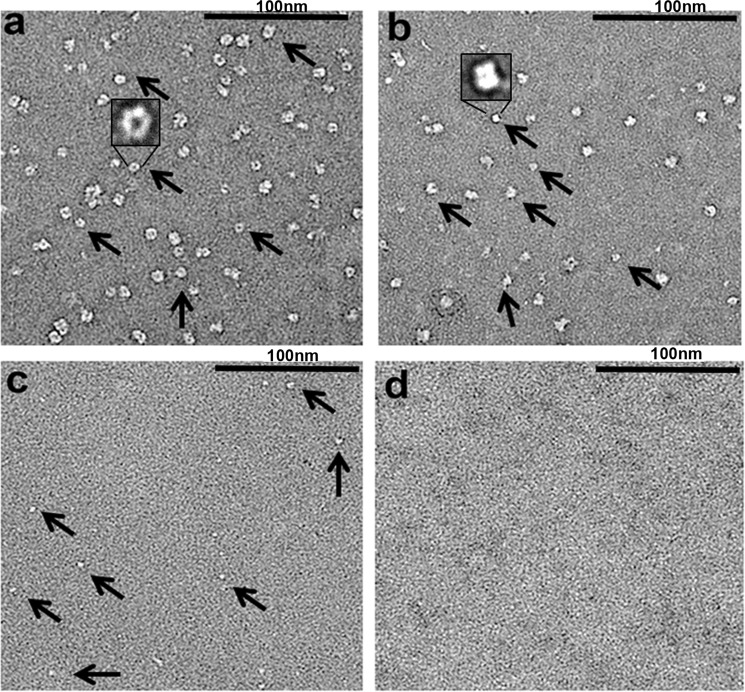
Electron micrographs of negatively stained Cagα apoprotein after gel filtration. Analysis by transmission electron microscopy and negative staining of (a) Cagα apoprotein shows a hexameric ring-like structure, insert shows a typical particle; (b) peak A of Cagα incubated with 1G2 after elution from the gel-filtration, inset shows a typical smaller particle, but the sample is heterogeneous and (c) peak B, probably representing monomeric Cagα. (d) Negative control grid. Arrows show the differently sized complexes and size bars indicate the dimensions.
Figure 6
Figure 6
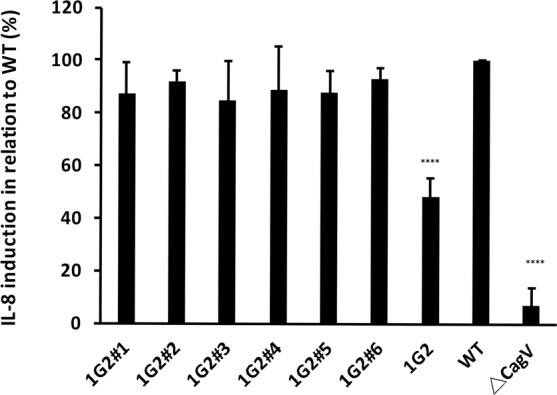
Molecule 1G2 decreases IL-8 induction in co-cultivated AGS cells. H. pylori 26695 without and after pre-incubation with 1G2 and its derivatives for 40 min. AGS cells were then co-cultured with H. pylori overnight and IL-8 induction was measured by ELISA. The induction of IL-8 by the wild type was calculated as 100% (WT), induction of IL-8 by the ΔcagV strain was used as negative control. The data represent the results from three experiments.

References

    1. Malfertheiner P, Link A, Selgrad M. Helicobacter pylori: perspectives and time trends. Nature reviews. Gastroenterology & hepatology. 2014;11(10):628–638. - PubMed
    1. Herrero R, Parsonnet J, Greenberg ER. Prevention of gastric cancer. Jama. 2014;312(12):1197–8. doi: 10.1001/jama.2014.10498. - DOI - PubMed
    1. Plummer M, Franceschi S, Vignat J, Forman D, de Martel C. Global burden of gastric cancer attributable to Helicobacter pylori. International journal of cancer. Journal international du cancer. 2015;136(2):487–90. doi: 10.1002/ijc.28999. - DOI - PubMed
    1. Gatta L, Vakil N, Vaira D, Scarpignato C. Global eradication rates for Helicobacter pylori infection: systematic review and meta-analysis of sequential therapy. Bmj. 2013;347:f4587. doi: 10.1136/bmj.f4587. - DOI - PMC - PubMed
    1. Ochman H, Lawrence JG, Groisman EA. Lateral gene transfer and the nature of bacterial innovation. Nature. 2000;405(6784):299–304. doi: 10.1038/35012500. - DOI - PubMed

Publication types

MeSH terms

Grants and funding