Review
. 2019 Jun;16(6):377-386.
doi: 10.1038/s41585-019-0184-4.

Blue light flexible cystoscopy with hexaminolevulinate in non-muscle-invasive bladder cancer: review of the clinical evidence and consensus statement on optimal use in the USA - update 2018

Affiliations
Review

Blue light flexible cystoscopy with hexaminolevulinate in non-muscle-invasive bladder cancer: review of the clinical evidence and consensus statement on optimal use in the USA - update 2018

Yair Lotan et al. Nat Rev Urol. 2019 Jun.

Abstract

Blue light cystoscopy (BLC) with hexaminolevulinate (HAL) during transurethral resection of bladder cancer improves detection of non-muscle-invasive bladder cancer (NMIBC) and reduces recurrence rates. Flexible BLC was approved by the FDA in 2018 for use in the surveillance setting and was demonstrated to improve detection. Results of a phase III prospective multicentre study of blue light flexible cystoscopy (BLFC) in surveillance of intermediate-risk and high-risk NMIBC showed that 20.6% of malignancies were identified only by BLFC. Improved detection rates in the surveillance setting are anticipated to lead to improved clinical outcomes by reducing future recurrences and earlier identification of tumours that are unresponsive to therapy. Thus, BLFC has a role in surveillance cystoscopy, and determining which patients will benefit from BLFC and optimal and cost-effective ways of incorporating this technology into surveillance cystoscopy must be developed.


Conflict of interest statement

All authors declare consultancy for Photocure.

Figures
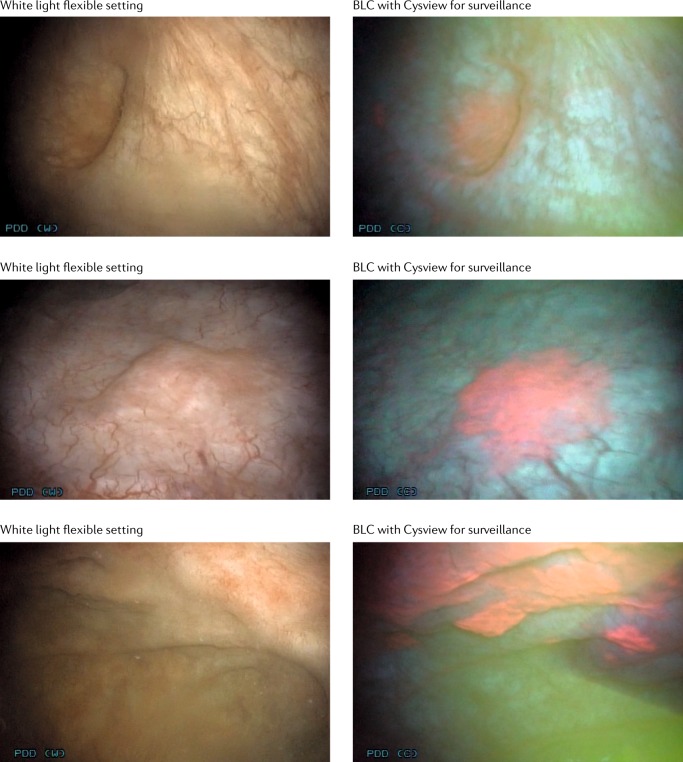
Fig. 1
Fig. 1. Detection of non-muscle-invasive bladder cancer with flexible white light and blue light cystoscopy with Cysview.
Blue light images depict the same area as white light cystoscopy but demonstrate pink lesions in areas of malignancy. Images are previously unpublished from the phase III multicentre trial involving Photocure. BLC, blue light cystoscopy.
Fig. 2
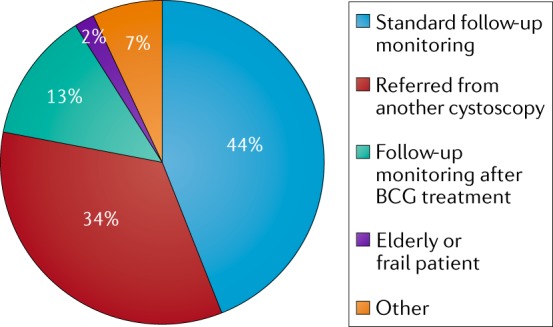
Fig. 2. Indications for BLFC.
Initial Nordic experience of indications for using blue light flexible cystoscopy (BLFC). Overall, the most frequent indication for BLFC was for standard follow-up monitoring (44%), followed by referral from another cystoscopy (34%) and follow-up monitoring after BCG treatment (13%). Being frail or an elderly individual was the least frequent indication (2%).
Fig. 3
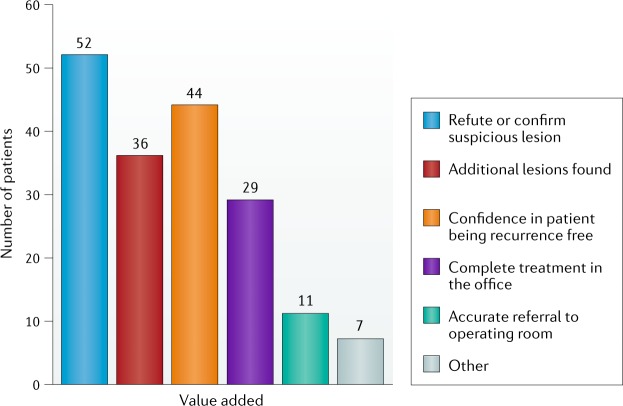
Fig. 3. Perceived value of BLFC by clinicians.
Added value was reported in 85% of procedures. One or more additional value could be listed per procedure. Blue light flexible cystoscopy (BLFC) added value for refuting or confirming suspicious lesions in 52 patients. In 36 patients, additional lesions were found, and in 44 patients, BLFC enabled the clinician to be confident that the disease had not recurred. For 29 patients, the procedure was able to be completed in an office setting, and BLFC enabled accurate referral to the operating room in 11 patients.
Fig. 4
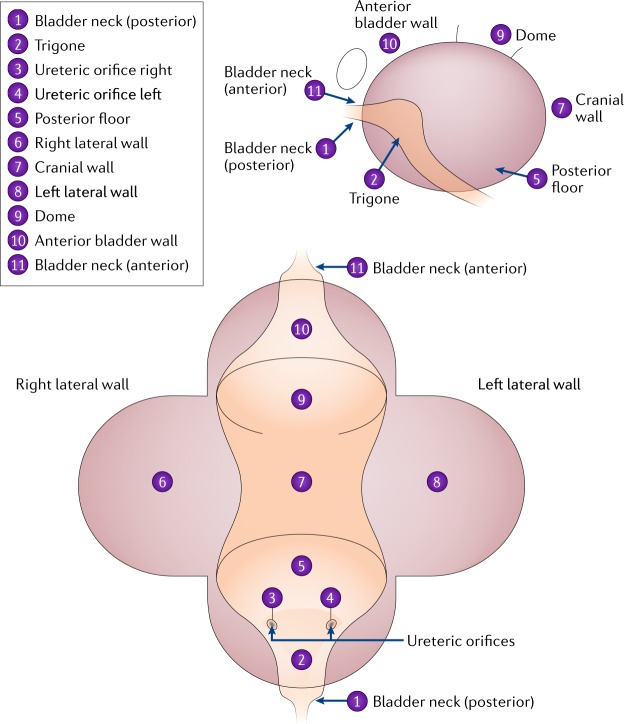
Fig. 4. The bladder map used in a phase III multicentre study to graph location of suspicious lesions.
An example of a bladder map. This bladder map was used in a phase III multicentre study to graph location of suspicious lesions.

References

    1. Kaufman DS, Shipley WU, Feldman AS. Bladder cancer. Lancet. 2009;374:239–249. doi: 10.1016/S0140-6736(09)60491-8. - DOI - PubMed
    1. Chang, S. S. et al. Diagnosis and treatment of non-muscle invasive bladder cancer: AUA/SUO guideline. AUAhttps://www.auanet.org/education/guidelines/non-muscle-invasive-bladder-... (2016).
    1. National Comprehensive Cancer Network. NCCN Clinical Practice Guidelines in Oncology: bladder cancer version 1.2019. NCCNhttps://www.nccn.org/professionals/physician_gls/pdf/bladder.pdf (2018). - PubMed
    1. Babjuk M, et al. EAU guidelines on non-muscle-invasive urothelial carcinoma of the bladder: update 2016. Eur. Urol. 2017;71:447–461. doi: 10.1016/j.eururo.2016.05.041. - DOI - PubMed
    1. Schneeweiss S, Kriegmair M, Stepp H. Is everything all right if nothing seems wrong? A simple method of assessing the diagnostic value of endoscopic procedures when a gold standard is absent. J. Urol. 1999;161:1116–1119. doi: 10.1016/S0022-5347(01)61605-7. - DOI - PubMed

Substances