


Percutaneous-transhepatic-endoscopic rendezvous procedures are effective and safe in patients with refractory bile duct obstruction
- PMID: 31019708
- PMCID: PMC6466745
- DOI: 10.1177/2050640619825949
Percutaneous-transhepatic-endoscopic rendezvous procedures are effective and safe in patients with refractory bile duct obstruction
Abstract
Background: Percutaneous-transhepatic-endoscopic rendezvous procedures (PTE-RVs) are rescue approaches used to facilitate biliary drainage.
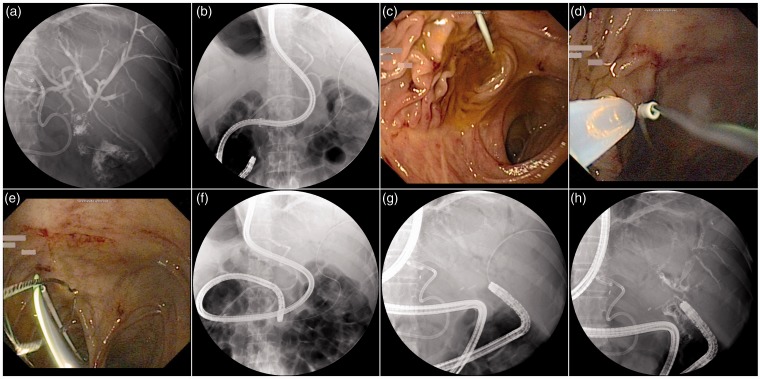
Objective: The objective of this article is to evaluate the safety and the technical success of PTE-RVs in comparison with those of percutaneous transhepatic cholangiographies (PTCs).
Methods: Percutaneous procedures performed over a 10-year period were retrospectively analyzed in a single-center cohort. Examinations were performed because of a previous or expected failure of standard endoscopic methods including endoscopic retrograde cholangiography (ERC) or balloon-assisted ERC to achieve biliary access.
Results: In total, 553 percutaneous procedures including 163 PTE-RVs and 390 PTCs were performed. Overall, 71.3% of the patients suffered from malignant disease with pancreas-carcinoma (32.8%) and cholangio-carcinoma (19.0%) as the most frequent, while 28.7% of the patients suffered from benign disease. Many patients had a postoperative change in bowel anatomy (50.8%).PTC had a higher technical success rate (89.7%); however, the technical success rate of PTE-RVs was still high (80.4%; p < 0.003). Overall complications occurred in 23.5% of all procedures. Significantly fewer complications occurred after performing PTE-RVs than after PTCs (16.6% vs 26.4%; p = 0.037).
Conclusion: Beside a high technical efficacy of PTE-RVs, significantly fewer complications occur following PTE-RVs than following PTCs; thus, PTE-RV should be preferred over PTC alone in selected patients.
Keywords: Cholangiography; endoscopic rendezvous procedures; percutaneous cholangiography; percutaneous-transhepatic-endoscopic rendezvous techniques; safety.
Figures
References
-
- Gupta K, Mallery S, Hunter D, et al. Endoscopic ultrasound and percutaneous access for endoscopic biliary and pancreatic drainage after initially failed ERCP. Rev Gastroenterol Disord 2007; 7: 22–37. - PubMed
-
- Kim ES, Lee BJ, Won JY, et al. Percutaneous transhepatic biliary drainage may serve as a successful rescue procedure in failed cases of endoscopic therapy for a post-living donor liver transplantation biliary stricture. Gastrointest Endosc 2009; 69: 38–46. - PubMed
-
- Morita S, Kitanosono T, Lee D, et al. Comparison of technical success and complications of percutaneous transhepatic cholangiography and biliary drainage between patients with and without transplanted liver. AJR Am J Roentgenol 2012; 199: 1149–1152. - PubMed
-
- Nam K, Lee SK, Song TJ, et al. Percutaneous transhepatic cholangioscopy for biliary complications after liver transplantation: A single center experience. J Hepatobiliary Pancreat Sci 2016; 23: 650–657. - PubMed
MeSH terms
LinkOut - more resources
Full Text Sources
