


Prognostic value of circulating tumour cells in limited-stage small-cell lung cancer: analysis of the concurrent once-daily versus twice-daily radiotherapy (CONVERT) randomised controlled trial
- PMID: 31020334
- PMCID: PMC6637373
- DOI: 10.1093/annonc/mdz122
Prognostic value of circulating tumour cells in limited-stage small-cell lung cancer: analysis of the concurrent once-daily versus twice-daily radiotherapy (CONVERT) randomised controlled trial
Abstract
Background: The clinical significance of circulating tumour cells (CTCs) in limited-stage small-cell lung cancer (LS-SCLC) is not well defined. We report a planned exploratory analysis of the prevalence and prognostic value of CTCs in LS-SCLC patients enrolled within the phase III randomised CONVERT (concurrent once-daily versus twice-daily chemoradiotherapy) trial.
Patients and methods: Baseline blood samples were enumerated for CTCs using CellSearch in 75 patients with LS-SCLC who were enrolled in the CONVERT trial and randomised between twice- and once-daily concurrent chemoradiation. Standard statistical methods were used for correlations of CTCs with clinical factors. Log-rank test and Cox regression analyses were applied to establish the associations of 2, 15 and 50 CTC thresholds with progression-free survival (PFS) and overall survival (OS). An optimal CTC count threshold for LS-SCLC was established.
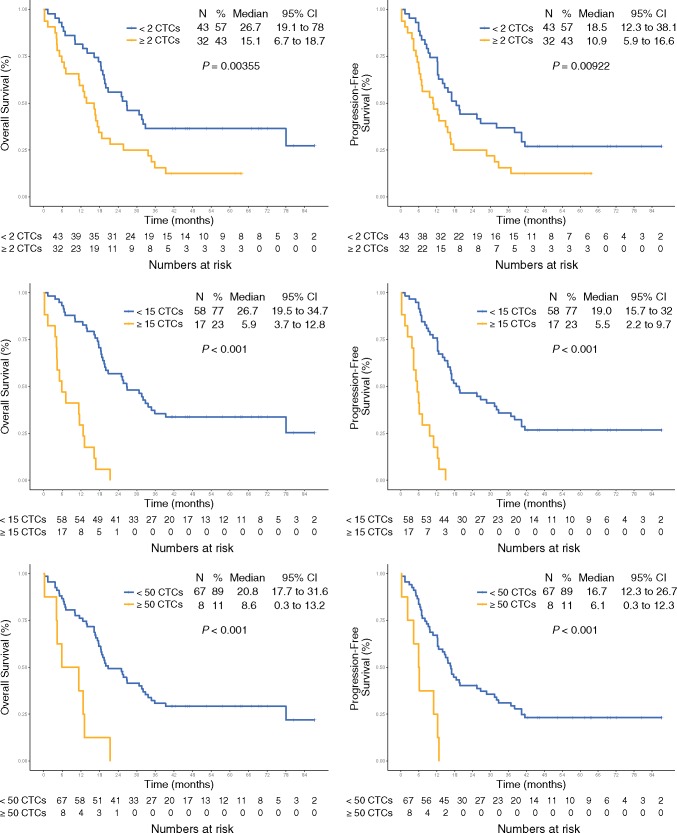
Results: CTCs were detected in 60% (45/75) of patients (range 0-3750). CTC count thresholds of 2, 15 and 50 CTCs all significantly correlate with PFS and OS. An optimal CTC count threshold in LS-SCLC was established at 15 CTCs, defining 'favourable' and 'unfavourable' prognostic risk groups. The median OS in <15 versus ≥15 CTCs was 26.7 versus 5.9 m (P = 0.001). The presence of ≥15 CTCs at baseline independently predicted ≤1 year survival in 70% and ≤2 years survival in 100% of patients.
Conclusion: We report the prognostic value of baseline CTC count in an exclusive LS-SCLC population at thresholds of 2, 15 and 50 CTCs. Specific to LS-SCLC, ≥15 CTCs was associated with worse PFS and OS independent of all other factors and predicted ≤2 years survival. These results may improve disease stratification in future clinical trial designs and aid clinical decision making.
Trial registration: ClinicalTrials.gov identifier: NCT00433563.
Keywords: chemoradiotherapy; circulating tumour cells; limited disease; limited stage; prognosis; small-cell lung cancer.
© The Author(s) 2019. Published by Oxford University Press on behalf of the European Society for Medical Oncology.
Figures
Comment in
-
Circulating tumor cells are prognostic in SCLC, but still lack clinical application.Ann Oncol. 2019 Jul 1;30(7):1031-1033. doi: 10.1093/annonc/mdz162. Ann Oncol. 2019. PMID: 31095269 No abstract available.
References
-
- Ferlay J, Soerjomataram I, Dikshit R. et al. Cancer incidence and mortality worldwide: sources, methods and major patterns in GLOBOCAN 2012. Int J Cancer 2015; 136(5): E359–E386. - PubMed
-
- American Cancer Society. Cancer Facts & Figures 2018. Atlanta: American Cancer Society; 2018.
-
- Govindan R, Page N, Morgensztern D. et al. Changing epidemiology of small-cell lung cancer in the United States over the last 30 years: analysis of the surveillance, epidemiologic, and end results database. J Clin Oncol 2006; 24(28): 4539–4544. - PubMed
-
- Pignon J-P, Arriagada R, Ihde DC. et al. A meta-analysis of thoracic radiotherapy for small-cell lung cancer. N Engl J Med 1992; 327(23): 1618–1624. - PubMed
Publication types
MeSH terms
Associated data
Grants and funding
LinkOut - more resources
Full Text Sources
Medical
