Review
. 2018 Oct;1(5):325-336.
doi: 10.1089/crispr.2018.0033.

Classification and Nomenclature of CRISPR-Cas Systems: Where from Here?

Affiliations
Review

Classification and Nomenclature of CRISPR-Cas Systems: Where from Here?

Kira S Makarova et al. CRISPR J. 2018 Oct.

Abstract

As befits an immune mechanism, CRISPR-Cas systems are highly variable with respect to Cas protein sequences, gene composition, and organization of the genomic loci. Optimal classification of CRISPR-Cas systems and rational nomenclature for CRISPR-associated genes are essential for further progress of CRISPR research. These are highly challenging tasks because of the complexity of CRISPR-Cas and their fast evolution, including frequent module shuffling, as well as the lack of universal markers for a consistent evolutionary classification. The complexity and variability of CRISPR-Cas systems necessitate a multipronged approach to classification and nomenclature. We present a brief summary of the current state of the art and discuss further directions in this area.


Conflict of interest statement

No competing financial interests exist.

Figures
<b>FIG. 1.</b>
FIG. 1.
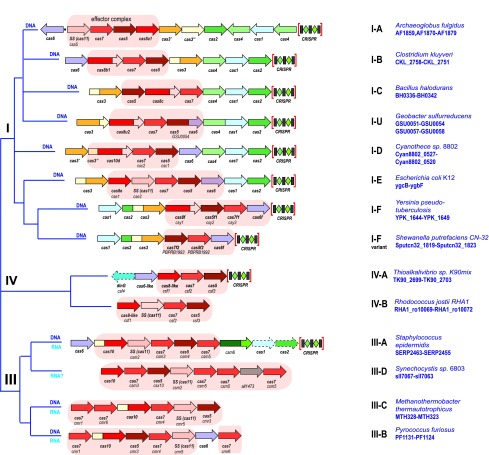
Updated classification of Class 1 CRISPR-Cas systems. Typical operon organization is shown for each CRISPR–Cas system subtype. For each CRISPR–Cas subtype, a representative genome and the respective gene locus tag names are indicated. Homologous genes are color-coded and identified by the respective family name. The gene names follow the classification from Makarova et al. Where both a systematic name and a legacy name are commonly used, the legacy name is given under the systematic name. The Cas11 gene name was reserved and is now used for small subunits. Most of them are found to be homologous and predicted to be fused to Cas8 protein in many type I systems. Predicted or known targets (DNA or RNA, or both) are shown for each subtype. The genes for the Class 1 effector module are shaded. The specific strains of bacteria in which these systems were identified and locus tags for the respective protein-coding genes are also indicated. The dashed border line indicates that the respective genes are functionally dispensable. The figure was modified from Koonin et al., with permission.
<b>FIG. 2.</b>
FIG. 2.
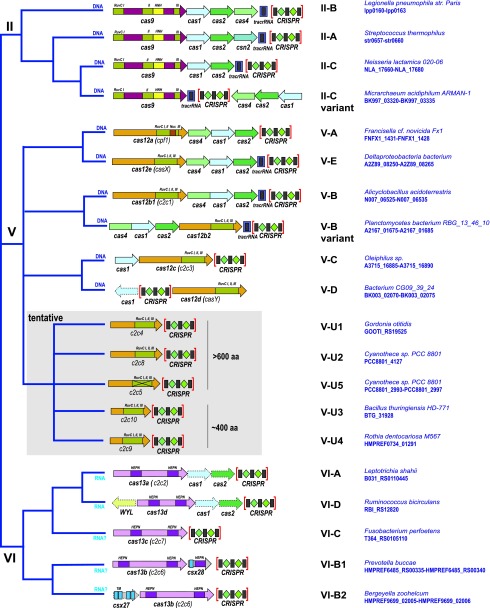
Updated classification of Class 2 CRISPR-Cas systems. RuvC I, RuvC II, and RuvC III are the three distinct motifs that contribute to the nuclease catalytic center. tracrRNA, trans-activating RNA, a helper RNA necessary for pre-crRNA processing and targeting functions; TM, predicted transmembrane segment. The proposed new systematic gene names are shown in red and bold type. Systematic gene names for effector protein candidates are shown below the respective shapes as follows; legacy or old names are also indicated in parentheses. For the V-U5 variant, the inactivation of the RuvC-like nuclease domain is indicated by a cross. The rest of the designations are as in Figure 1. The figure was modified from Koonin et al., with permission.
<b>FIG. 3.</b>
FIG. 3.
Cas1 phylogeny. The alignment of 2,512 representative Cas1 protein sequences was obtained using iterative clustering and alignment merging of Cas1 sequences (see text). The approximate ML tree was reconstructed using FastTree, with the WAG substitution model and gamma-distributed site rates. Large Cas1 clades that represent (mostly) monophyletic subtype (and other) specific variants are indicated; the other subtypes are scattered across the tree.
<b>FIG. 4.</b>
FIG. 4.
Deep relationships between sequence profiles of Cas proteins. (A) Relationships between sequence profiles for the type I large subunits. Profile–profile comparisons were performed using HHsearch; scores between two profiles were normalized by the minimum of the self-scores and converted to a distance matrix on the natural log scale. The UPGMA dendrogram was reconstructed from the distance matrix. The dashed line cuts the tree at the depth of 2 (D = 2 roughly corresponds to the pairwise HHsearch score of e−2D = 0.02 relative to the self-score). Profile names are colored according to their subtype specificity. According to the current CRISPR-Cas classification and nomenclature, the large subunits are described using the following notation: major type of the large subunit (Cas8, Cas10), a letter that indicates the subtype and a number corresponding to a distinct variant. For example, Cas8b8 is the large subunit of subtype I-B, family 8. (B) Relationships between the sequences of the type V effector proteins and the homologous TnpB-like proteins. The dendrogram was constructed using the same procedure as in (A); color highlights the recently discovered variants (minimal Cas12b, CasX and CasY). Proteins from the unclassified type V-U systems are shown in gray. “Cas12a var” includes several sequences typified by KFO67988.1 from Smithella sp. SCADC. “Cas12e var” includes two sequences: GBD34782.1 from bacterium HR35 and A3J58_03210 Candidatus Sungbacteria bacterium RIFCSPHIGHO2_02_FULL_52_2.
<b>FIG. 5.</b>
FIG. 5.
Unusual and derived CRISPR-Cas systems. The depicted unusual and derived CRISPR-Cas systems have the following principal features. (1) Based on the effector genes similarity, this is a subtype I-A variant but with the HD domain (a stand-alone gene in subtype I-A) fused to the C-terminus of Cas3, the effector gene organization typical of subtype I-B. (2) A I-B variant lacking both adaptation genes and cas3, carried by a Tn7-like transposon. (3) A I-E variant lacking both the adaptation module and Cas3, and associated with STAND family ATPase. (4) A I-F variant lacking the large subunit and containing atypical, highly diverged Cas5 and Cas7 proteins, a fully functional system that, however, would be considered partial by the current classification schemes. (5) A I-F variant lacking both the adaptation genes and cas3, carried by a Tn7-like transposon. (6) A I-U system variant lacking an identifiable large subunit and a cas6-like gene but containing the uncharacterized gene csb3; also would be considered partial but is widespread in bacteria and likely to be fully functional. (7) A locus identified in Thermococcus onnurineus and several other archaea that has been classified as type I based on the general organization of the effector module genes; the HD domain is more similar to that in Cas3 compared to that in Cas10, Cas3 is absent, and Cas7 is most similar to Cas7 protein (Csf2) from type IV systems. (8) A minimal type III system from Thermotoga that lacks multiple cas7-like genes present in all other type III systems. (9) Distinct type III variant present in several Crenarchaea; csx26, putative small subunit that share no detectable similarity with either csm2 or cmr5, the small subunit genes of subtypes III-A,D, and III-B,C, respectively. The rest of the designations are as in Figure 1.

References

    1. Stern A, Sorek R. The phage-host arms race: shaping the evolution of microbes. Bioessays 2011;33:43–51. DOI: 10.1002/bies.201000071 - DOI - PMC - PubMed
    1. Koonin EV, Makarova KS, Wolf YI. Evolutionary genomics of defense systems in archaea and bacteria. Annu Rev Microbiol 2017;71:233261. DOI: 10.1146/annurev-micro-090816-093830 - DOI - PMC - PubMed
    1. Makarova KS, Wolf YI, Alkhnbashi OS, et al. An updated evolutionary classification of CRISPR-Cas systems. Nat Rev Microbiol 2015;13:722–736. DOI: 10.1038/nrmicro3569 - DOI - PMC - PubMed
    1. Koonin EV, Makarova KS, Zhang F. Diversity, classification and evolution of CRISPR-Cas systems. Curr Opin Microbiol 2017;37:67–78. DOI: 10.1016/j.mib.2017.05.008 - DOI - PMC - PubMed
    1. Takeuchi N, Wolf YI, Makarova KS, et al. Nature and intensity of selection pressure on CRISPR-associated genes. J Bacteriol 2012;194:1216–1225. DOI: 10.1128/JB.06521-11 - DOI - PMC - PubMed