


Bulk storage of mango (Mangifera indica L.) and pineapple (Ananas comosus L.) pulp: effect of pulping and storage temperature on phytochemicals and antioxidant activity
- PMID: 31021401
- PMCID: PMC6771788
- DOI: 10.1002/jsfa.9762
Bulk storage of mango (Mangifera indica L.) and pineapple (Ananas comosus L.) pulp: effect of pulping and storage temperature on phytochemicals and antioxidant activity
Abstract
Background: The effects of pulp extraction, thermal treatment and bulk storage of mango (Mangifera indica L.) and pineapple (Ananas comosus L.) pulps for 20 weeks at ambient (28 ± 2 °C) and cold (4 °C) temperatures on the bioactive phytochemicals and antioxidant activity were investigated.
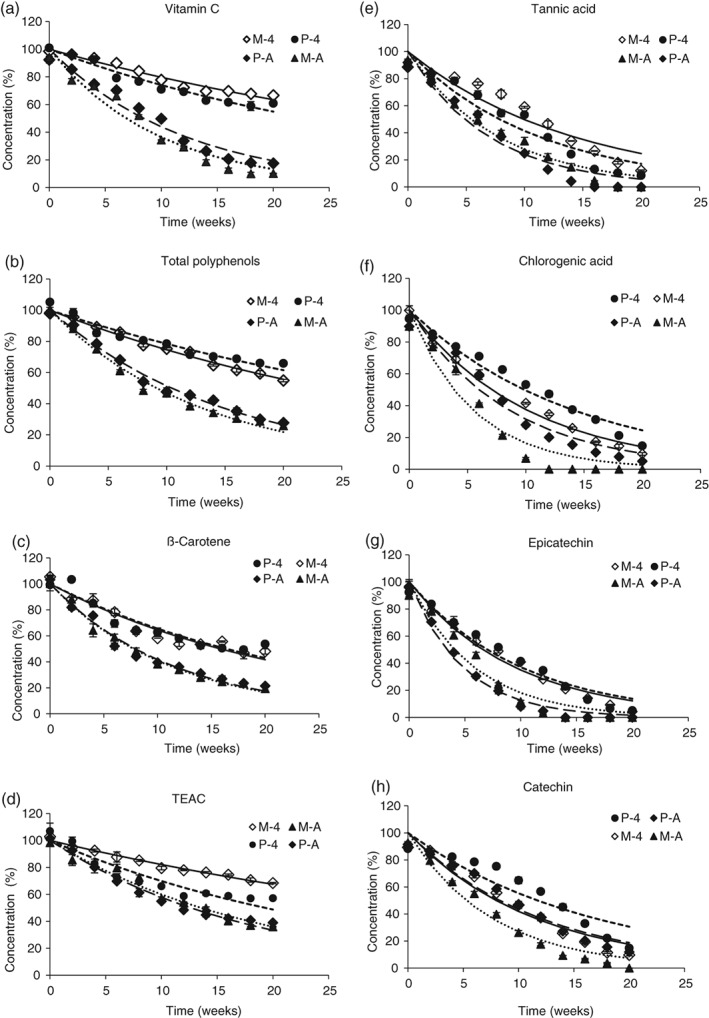
Results: The contents of total polyphenols in mango (10.5%) and pineapple (5.4%) increased during pulping. The ratio of the degradation rate constants (kd values) (28 ± 2 °C: 4 °C) of vitamin C, polyphenols, Trolox equivalent antioxidant capacity (TEAC) and β-carotene ranged from 2-4.5 and 1.5-2.7 in mango and pineapple pulps, respectively. The kd values of tannic acid, chlorogenic acid, epicatechin and catechin in mango pulp were 1.5-1.8 times higher under ambient storage than in cold storage. Furthermore, in pineapple pulp, the degradation rates of the same components were 1.6, 1.6, 2.1 and 1.4 times, respectively, faster at room temperature than in cold storage. The bulk storage of pulps at 4 °C provided better retention of health-promoting compounds than ambient temperature storage for up to 20 weeks.
Conclusion: Bulk storage of mango and pineapple pulp under cold storage conditions (4 °C) is recommended as a better pulp preservation method than storage at ambient (28 ± 2 °C) temperature. © 2019 The Authors. Journal of The Science of Food and Agriculture published by John Wiley & Sons Ltd on behalf of Society of Chemical Industry.
Keywords: antioxidant; bulk storage; health promoting; kinetics; mango; pineapple.
© 2019 The Authors. Journal of The Science of Food and Agriculture published by John Wiley & Sons Ltd on behalf of Society of Chemical Industry.
Conflict of interest statement
The authors have no conflicts of interest to disclose.
Figures
References
-
- Berardini N, Carle R and Schieber A, Characterization of gallotannins and benzophenone derivatives from mango (<styled-content style="italic-in-any-context">Mangifera indica</styled-content> L. cv. “Tommy Atkins”) peels, pulp and kernels by high‐performance liquid chromatography/electrospray ionization mass spectrometry. Rapid Commun Mass Spectrom 18:2208–2216 (2004). - PubMed
-
- Bartholomew DP, Paull RE and Rohrbach KG, The Pineapple Botany, Production and Uses. CAB International Publishing, Honolulu: (2003).
-
- Luximon‐Ramma A, Bahorun T and Crozier A, Antioxidant actions and phenolic and vitamin C contents of common Mauritian exotic fruits. J Sci Food Agric 83:496–502 (2003).
-
- Brat P, Hoang LNT, Soler A, Reynes M and Brillouet JM, Physicochemical characterization of a new pineapple hybrid (FLHORAN41 cv.). J Agric Food Chem 52:6170–6177 (2004). - PubMed
-
- Ulloa JA, Escalona H and Diaz L, Colour behaviour on mango (<styled-content style="italic-in-any-context">Mangifera indica</styled-content>) slices self stabilized in glass jars by hurdle technology during storage. Afr J Biotechnol 7:487–494 (2008).
Publication types
MeSH terms
Substances
Grants and funding
LinkOut - more resources
Full Text Sources
Medical
