


Identification of essential biofilm proteins in middle ear fluids of otitis media with effusion patients
- PMID: 31021431
- PMCID: PMC6814449
- DOI: 10.1002/lary.28011
Identification of essential biofilm proteins in middle ear fluids of otitis media with effusion patients
Abstract
Objectives: Otitis media with effusion (OME) is a common disease of childhood that is largely asymptomatic. However, middle ear fluid can persist for months and negatively impact a child's quality of life. Many cases of OME remain chronic and require surgical intervention. Because biofilms are known to contribute to the persistence of many diseases, this study examined effusions collected from children with chronic OME for the presence of essential biofilm structural components, members of the DNABII family of bacterial DNA-binding proteins.
Methods: Middle ear effusions were recovered from 38 children with chronic OME at the time of tympanostomy tube insertion. A portion of each specimen was submitted for microbiology culture. The remaining material was assessed by immunoblot to quantitate individual DNABII proteins, integration host factor (IHF), and histone-like protein (HU).
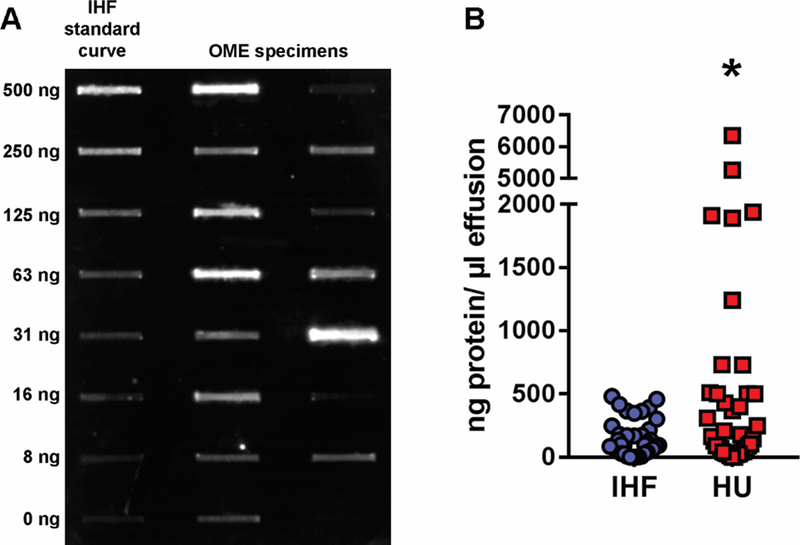
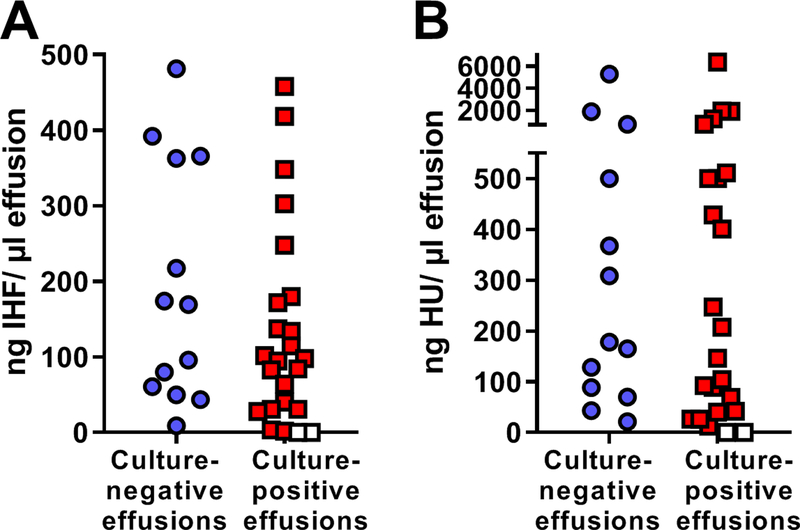
Results: Sixty-five percent of effusions (24 of 37) were culture-positive for bacterial species or yeast, whereas 35% (13 of 37) were culture-negative. IHF was detected in 95% (36 of 38) at concentrations from 2 to 481 ng/μL effusion. HU was detected in 95% (36 of 38) and quantitated from 13 to 5,264 ng/μL effusion (P ≤ 0.05 compared to IHF).
Conclusion: Because DNABII proteins are essential structural components of bacterial biofilms, these data lend further support to our understanding that biofilms are present in the vast majority of chronic middle ear effusions, despite negative culture results. The presence and ubiquity of DNABII proteins in OME specimens indicated that these proteins can serve as an important clinical target for our novel DNABII-directed strategy to treat biofilm diseases such as chronic OME.
Level of evidence: NA Laryngoscope, 130:806-811, 2020.
Keywords: DNABII proteins; HU; IHF; chronic otitis media with effusion; pediatric otolaryngology.
© 2019 The American Laryngological, Rhinological and Otological Society, Inc.
Conflict of interest statement
Figures
References
-
- Rosenfeld RM, Shin JJ, Schwartz SR et al. Clinical Practice Guideline: Otitis Media with Effusion (Update). Otolaryngology--head and neck surgery : official journal of American Academy of Otolaryngology-Head and Neck Surgery 2016; 154:S1–S41. - PubMed
-
- Kubba H, Pearson JP, Birchall JP. The aetiology of otitis media with effusion: a review. Clinical otolaryngology and allied sciences 2000; 25:181–194. - PubMed
-
- Williamson IG, Dunleavey J, Bain J, Robinson D. The natural history of otitis media with effusion--a three-year study of the incidence and prevalence of abnormal tympanograms in four South West Hampshire infant and first schools. The Journal of laryngology and otology 1994; 108:930–934. - PubMed
Publication types
MeSH terms
Substances
Grants and funding
LinkOut - more resources
Full Text Sources
Research Materials
