


Efficacy of an RNA-based multigene assay with core needle biopsy samples for risk evaluation in hormone-positive early breast cancer
- PMID: 31023265
- PMCID: PMC6485070
- DOI: 10.1186/s12885-019-5608-2
Efficacy of an RNA-based multigene assay with core needle biopsy samples for risk evaluation in hormone-positive early breast cancer
Abstract
Background: Gene expression profiling provides key information for prognosis of breast cancer to establish treatment strategy. However, the genetic assessment should be available before induction of treatment to be useful for clinical practice. To evaluate the reliability of using needle biopsy samples for gene assays, we compared gene-expression profiling results between core needle biopsy (CNB) samples and surgical specimens in breast cancer.
Methods: Thirty-one paired, formalin-fixed, paraffin-embedded CNB and surgical specimen samples were selected from patients with hormone receptor-positive breast cancer. Total RNA was extracted from the samples and the risk classifications based on GenesWell BCT scores were compared.
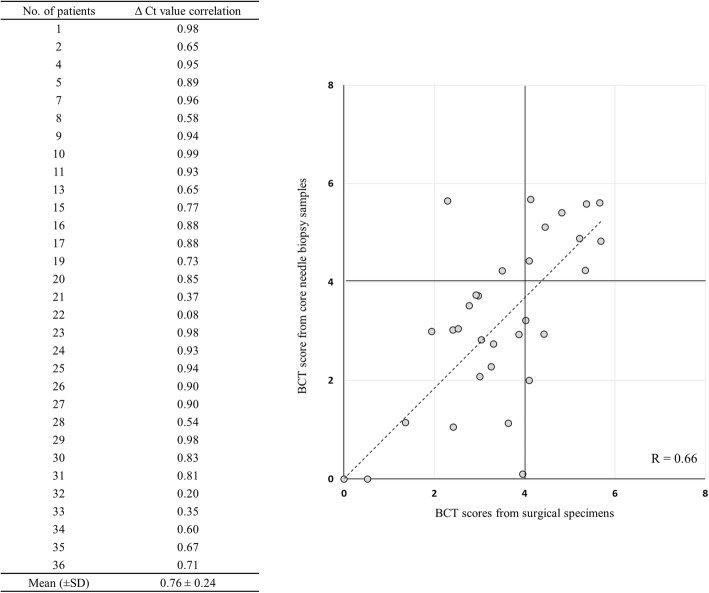
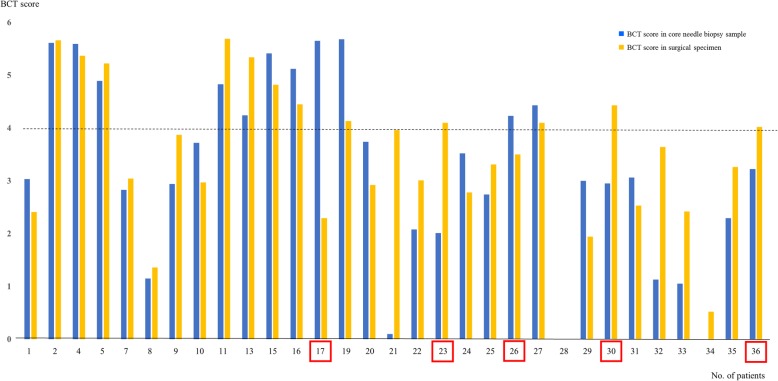
Results: The BCT scores correlated between CNB samples and surgical specimens of hormone receptor-positive breast cancer (Pearson r = 0.66). The overall concordance rate of risk classification (high/low risk) was 83.9%. However, when the breast cancer does not contain intratumoral microcalcification, the concordance rate increased as 92.0%. And, when the breast cancer formed a solitary nodule (non-multifocal), the concordance rate increased up to 95.8%.
Conclusion: Risk classification using the GenesWell BCT multigene kit with CNB samples could be considered reliable, when the breast cancer is a solitary nodule without intratumoral microcalcification. Such genetic profiling results should be helpful for establishing a treatment plan for hormone receptor-positive breast cancer before treatment induction.
Keywords: Biopsy; Breast; Carcinoma; Gene.
Conflict of interest statement
Ethics approval and consent to participate
Informed consent was obtained from all patients and the protocol used in this study was approved by the Institutional Review Board (IRB) Committee of Kyungpook National University Chilgok Hospital, Daegu, Republic of Korea (2018-06-014). And the specific inclusion and exclusion criteria were defined in the approved IRB protocol. The informed consents were obtained by written documents from all patients.
Consent for publication
Not applicable.
Competing interests
The authors declare that they have no competing interests.
Publisher’s Note
Springer Nature remains neutral with regard to jurisdictional claims in published maps and institutional affiliations.
Figures
References
-
- Tao Z, Shi A, Lu C, Song T, Zhang Z, Zhao J. Breast cancer: epidemiology and etiology. Cell Biochem Biophys. 2015;72(2):333–338. - PubMed
-
- Bardia A, Hurvitz S. Targeted therapy for premenopausal women with HR+, HER2- advanced breast cancer: focus on special considerations and latest advances. Clin Cancer Research. 2018;24:2506–18. - PubMed
-
- Filipits M, Rudas M, Jakesz R, Dubsky P, Fitzal F, Singer CF, et al. A new molecular predictor of distant recurrence in ER-positive, HER2-negative breast cancer adds independent information to conventional clinical risk factors. Clin Cancer Res. 2011;17(18):6012–6020. - PubMed
-
- Rayhanabad JA, Difronzo LA, Haigh PI, Romero L. Changing paradigms in breast cancer management: introducing molecular genetics into the treatment algorithm. Am Surg. 2008;74(10):887–890. - PubMed
MeSH terms
Substances
Grants and funding
LinkOut - more resources
Full Text Sources
Medical
