Review
. 2019 Jun 3;216(6):1234-1243.
doi: 10.1084/jem.20181739. Epub 2019 Apr 25.

Modulating inflammation for cancer therapy

Affiliations
Review

Modulating inflammation for cancer therapy

Birgit Ritter et al. J Exp Med. .

Abstract

A link between chronic inflammation and development of tumors is well established. Moreover, it has become evident that tumorigenesis is not a cell autonomous disease, and an inflammatory microenvironment is a prerequisite of basically all tumors, including those that emerge in the absence of overt inflammation. This knowledge has led to the development of anti-inflammatory concepts to treat and prevent cancer. In contrast, immunotherapies, in particular checkpoint inhibitors, representing the most significant progress in the therapy of several malignancies depend on the presence of a pro-inflammatory "hot" environment. Here, we discuss pro- and anti-inflammatory concepts for the treatment of cancer.


Figures

Figure 1.
Figure 1.
Time course from first documented cancer cases to modern therapy. Ab, antibody; ABL, Abelson murine leukemia viral oncogene homologue 1; AML, acute myeloid leukemia; CAR, chimeric antigen receptor; CML, chronic myeloid leukemia; CTCL, cutaneous T cell lymphoma; RA, rheumatoid arthritis; T-VEC, talimogene laherparepvec; VEGF, vascular endothelial growth factor.
Figure 2.
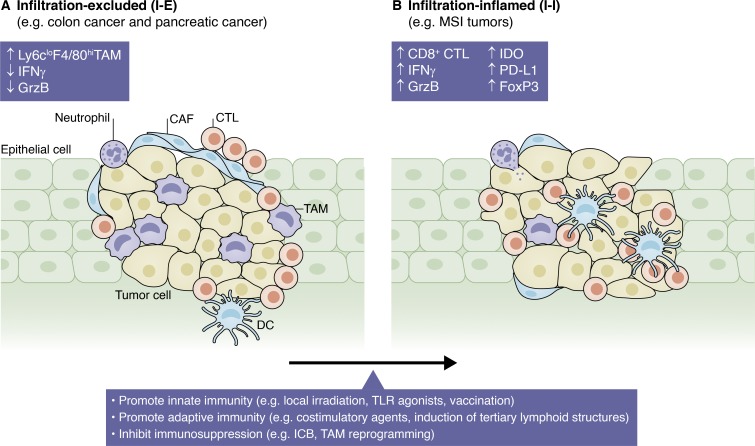
Figure 2.
Tumor immune statuses. Infiltration-excluded tumors (left) accumulate cytotoxic T lymphocytes (CTLs) around their margins, where they interact with Ly6cloF4/80hi TAMs or are impeded by cancer-associated fibroblasts (CAFs). Infiltration-inflamed tumors (right) show activated PD1+ CTLs in their core that express IFNγ and granzyme B (GrzB). They may form tertiary lymphoid structures and are generally associated with good prognosis and response to ICB. Therefore, therapies aim to promote this state. DC, dendritic cell; IDO, indoleamine (2,3)-dioxygenase; MSI, microsatellite instability.

References

    1. Arkan M.C. 2017. The intricate connection between diet, microbiota, and cancer: A jigsaw puzzle. Semin. Immunol. 32:35–42. 10.1016/j.smim.2017.08.009 - DOI - PubMed
    1. Bajor D.L., Mick R., Riese M.J., Huang A.C., Sullivan B., Richman L.P., Torigian D.A., George S.M., Stelekati E., Chen F., et al. 2018. Long-term outcomes of a phase I study of agonist CD40 antibody and CTLA-4 blockade in patients with metastatic melanoma. OncoImmunology. 7:e1468956 10.1080/2162402X.2018.1468956 - DOI - PMC - PubMed
    1. Balkwill F., and Mantovani A.. 2001. Inflammation and cancer: back to Virchow? Lancet. 357:539–545. 10.1016/S0140-6736(00)04046-0 - DOI - PubMed
    1. Balkwill F.R., and Mantovani A.. 2012. Cancer-related inflammation: common themes and therapeutic opportunities. Semin. Cancer Biol. 22:33–40. 10.1016/j.semcancer.2011.12.005 - DOI - PubMed
    1. Beatty G.L., Chiorean E.G., Fishman M.P., Saboury B., Teitelbaum U.R., Sun W., Huhn R.D., Song W., Li D., Sharp L.L., et al. 2011. CD40 agonists alter tumor stroma and show efficacy against pancreatic carcinoma in mice and humans. Science. 331:1612–1616. 10.1126/science.1198443 - DOI - PMC - PubMed

Publication types