


Preoxygenation in difficult airway management: high-flow oxygenation by nasal cannula versus face mask (the PREOPTIDAM study). Protocol for a single-centre randomised study
- PMID: 31028041
- PMCID: PMC6501956
- DOI: 10.1136/bmjopen-2018-025909
Preoxygenation in difficult airway management: high-flow oxygenation by nasal cannula versus face mask (the PREOPTIDAM study). Protocol for a single-centre randomised study
Abstract
Introduction: Although preoxygenation and airway management respond to precise algorithms, difficult intubation (DI) remains a daily challenge in intensive care units and in the operating rooms because of its frequent complications, including hypoxaemia. To prevent desaturation during DI, high-flow oxygenation by nasal cannula (HFNC) could prove beneficial. Indeed, contrary to standard preoxygenation device, it can be held in place throughout the intubation trying to perform apnoeic oxygenation during DI. Hence, recent guidelines recommend HFNC during DI, but its relevance has never been evaluated in this setting in a large randomised study until now.
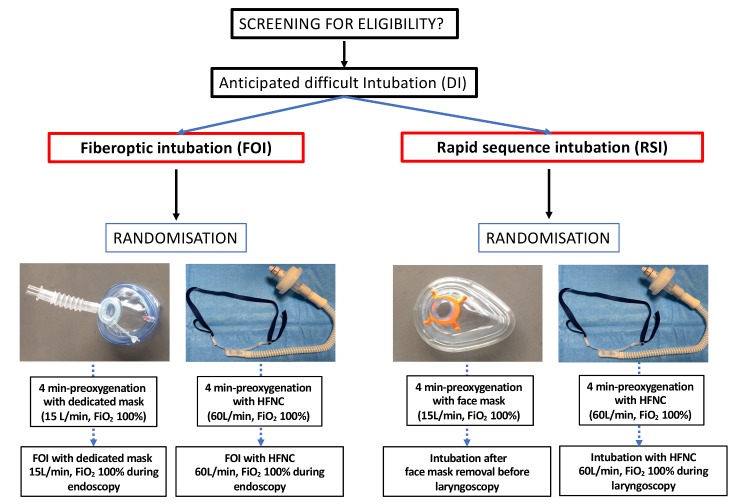
Methods and analysis: The PREOPTIDAM trial is a prospective, single-centre, randomised, controlled study in Nantes University Hospital. In anticipated DI, we hypothesised that HFNC can decrease the incidence of desaturation ≤94% or face mask ventilation from 16% to 4% compared with standard device. Using a two-sided t-test with a first species risk of 5% and 80% power, a total of 186 patients will be included. Using a computer-generated randomisation, with a 1:1 allocation ratio, patients will be randomised to HFNC or face mask preoxygenation. Randomisation will be stratified on intubation sequence: Rapid sequence intubation or awake fibreoptic intubation. The primary objective is to determine whether HFNC is more efficient than standard oxygenation techniques to prevent desaturation ≤94% or face mask ventilation during DI. Intent-to-treat and per-protocol analysis are planned for the primary outcome.
Ethics and dissemination: The study project has been approved by an independent ethics committee. Written informed consent will be obtained before study inclusion. Participant recruitment begins in September 2018. Results will be submitted to international peer-reviewed medical journals.
Trial registration number: NCT03604120.
Keywords: anticipated difficult intubation; apneic oxygenation; fiberoptic intubation; high-flow nasal cannula; video-laryngoscopy.
© Author(s) (or their employer(s)) 2019. Re-use permitted under CC BY-NC. No commercial re-use. See rights and permissions. Published by BMJ.
Conflict of interest statement
Competing interests: MV reports personal fees from MSD, Pfizer, Baxter, grants from Fischer Paykel, outside the submitted work. SJ reports personal fees from Draeger, Fresenius-Xenios and Fisher Paykel Healthcare, outside the submitted work. KA declares personal fees from Fisher Paykel Healthcare, Baxter, LFB, Fresenius. The other authors declared to have no conflict of interest.
Figures
References
-
- Cheney FW, Posner KL, Lee LA, et al. Trends in anesthesia-related death and brain damage: A closed claims analysis. Anesthesiology 2006;105:1081–6. - PubMed
