The plant stomatal lineage at a glance
- PMID: 31028153
- PMCID: PMC6503951
- DOI: 10.1242/jcs.228551
The plant stomatal lineage at a glance
Abstract
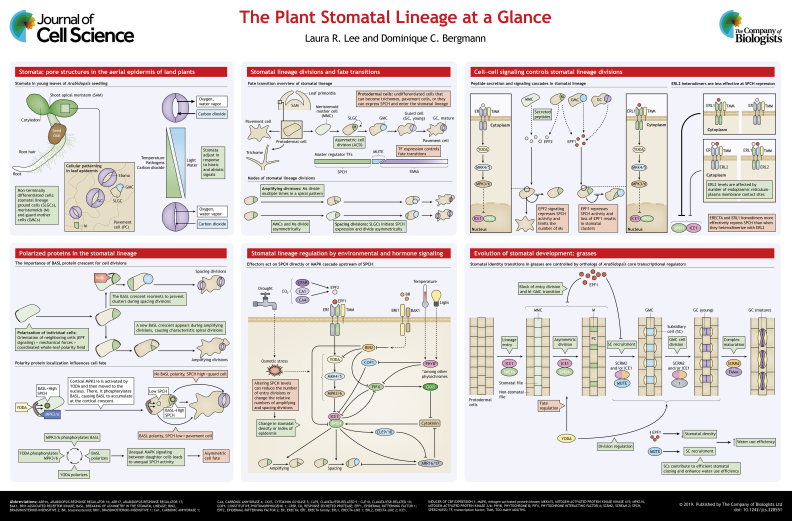
Stomata are structures on the surfaces of most land plants that are required for gas exchange between plants and their environment. In Arabidopsis thaliana, stomata comprise two kidney bean-shaped epidermal guard cells that flank a central pore overlying a cavity in the mesophyll. These guard cells can adjust their shape to occlude or facilitate access to this pore, and in so doing regulate the release of water vapor and oxygen from the plant, in exchange for the intake of carbon dioxide from the atmosphere. Stomatal guard cells are the end product of a specialized lineage whose cell divisions and fate transitions ensure both the production and pattern of cells in aerial epidermal tissues. The stomatal lineage is dynamic and flexible, altering stomatal production in response to environmental change. As such, the stomatal lineage is an excellent system to study how flexible developmental transitions are regulated in plants. In this Cell Science at a Glance article and accompanying poster, we will summarize current knowledge of the divisions and fate decisions during stomatal development, discussing the role of transcriptional regulators, cell-cell signaling and polarity proteins. We will highlight recent work that links the core regulators to systemic or environmental information and provide an evolutionary perspective on stomata lineage regulators in plants.
Keywords: Arabidopsis; Asymmetric cell division; Cell–cell signaling; SPEECHLESS; Stem cell; Stomata.
© 2019. Published by The Company of Biologists Ltd.
References
-
- Adrian J., Chang J., Ballenger C. E., Bargmann B. O. R., Alassimone J., Davies K. A., Lau O. S., Matos J. L., Hachez C., Lanctot A. et al. (2015). Transcriptome dynamics of the stomatal lineage: birth, amplification, and termination of a self- renewing population. Dev. Cell 33, 107-118. 10.1016/j.devcel.2015.01.025 - DOI - PMC - PubMed
Publication types
MeSH terms
Substances
Grants and funding
LinkOut - more resources
Full Text Sources