


Head tremor at disease onset: an ataxic phenotype of cervical dystonia
- PMID: 31028543
- PMCID: PMC6642013
- DOI: 10.1007/s00415-019-09341-w
Head tremor at disease onset: an ataxic phenotype of cervical dystonia
Abstract
Background: Cervical dystonia (CD) can present with head tremor. It is unclear whether ataxic features are differentially associated with this phenotype at onset of CD.
Objectives: We sought to evaluate: (1) the demographic features of CD patients with (Tr-CD) and without head tremor (nTr-CD) at onset, and (2) the differential ataxic features between these CD subtypes.
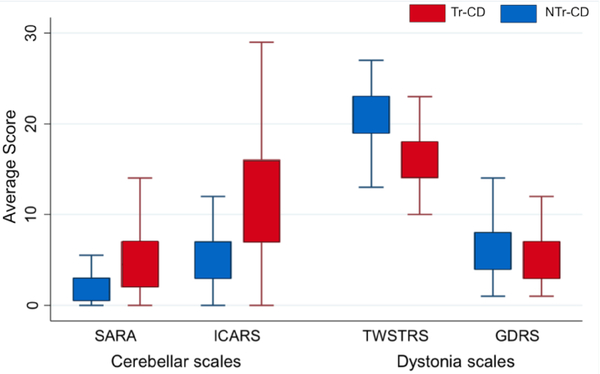
Methods: For the first objective, we compared demographic data in Tr-CD versus nTr-CD subtypes in the entire cohort of CD subjects enrolled in the Dystonia Coalition Natural History and Biorepository studies (n = 1608). For the second objective, we rated the standardized videos from consecutively enrolled Tr-CD subjects (n = 50) and age-, gender-, and disease duration-matched nTr-CD subjects (n = 50) for ataxia severity scoring using the Scale for the Assessment and Rating of Ataxia (SARA) and the International Cooperative Ataxia Rating Scale (ICARS); and for dystonia severity using the Toronto Western Spasmodic Torticollis Rating Scale section-I (TWSTRS) and the Global Dystonia Rating Scale (GDRS).
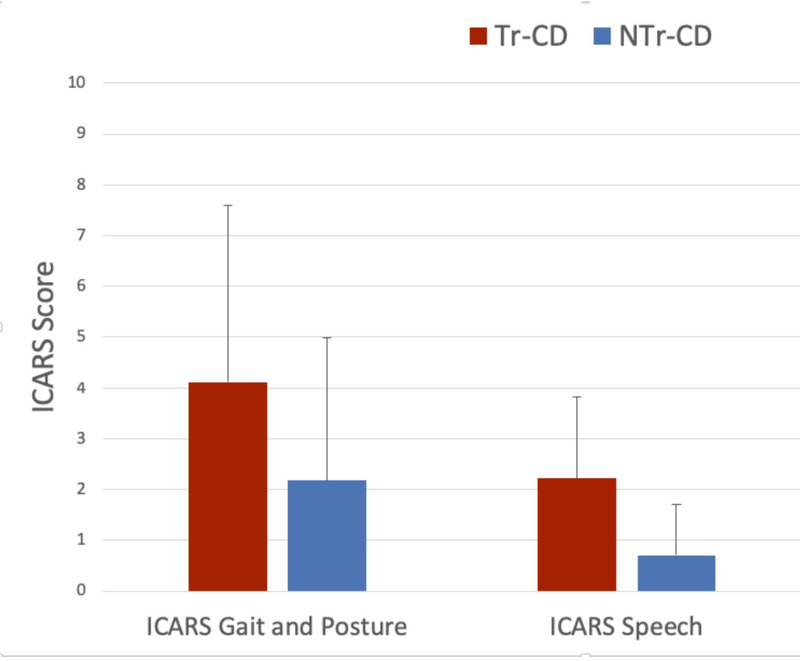
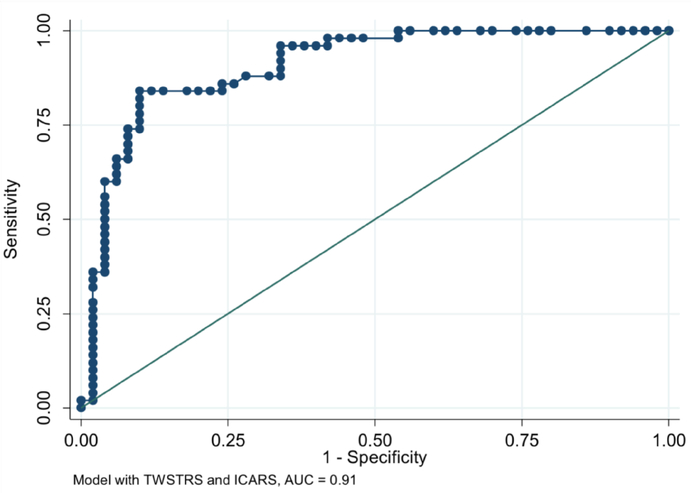
Results: Of 1,608 subjects, 18.1% (n = 291) were classified as Tr-CD and 81.9% (n = 1317) as nTr-CD. The Tr-CD cohort was older, predominantly female, and had longer disease duration than the nTr-CD cohort (p = 0.01). Compared to nTr-CD, Tr-CD subjects had worse generalized ataxia, speech, and gait and posture scores. High ataxia severity with low dystonia severity distinguished Tr-CD from nTr-CD with high accuracy (area under the curve, 0.91 (95% CI 0.85-0.97).
Conclusions: Head tremor at disease onset represents a clinically distinguishable subtype of cervical dystonia affecting predominantly older women, with worse ataxia and milder dystonia than the non-tremulous dystonic phenotype.
Keywords: Ataxia; Cerebellum; Dystonia; Head tremor; Tremor.
Figures
References
-
- Rivest J, Marsden CD (1990) Trunk and head tremor as isolated manifestations of dystonia. Mov Disord 5:60–65. - PubMed
-
- Masuhr F, Wissel J, Müller J, Scholz U, Poewe W (2000) Quantification of sensory trick impact on tremor amplitude and frequency in 60 patients with head tremor. Mov Disord 15:960–964. - PubMed
-
- Fahn S The varied clinical expressions of dystonia (1984) Neurol Clin 2:541–554. - PubMed
Publication types
MeSH terms
Grants and funding
- KL2 TR001426/TR/NCATS NIH HHS/United States
- U54 NS116025/NS/NINDS NIH HHS/United States
- KL2 TR001080/TR/NCATS NIH HHS/United States
- NS065701/National Center for Advancing Translational Sciences (US)
- R01 NS075321/NS/NINDS NIH HHS/United States
- U54 TR001456/NS/NINDS NIH HHS/United States
- U54 NS065701/NS/NINDS NIH HHS/United States
- R01 NS074343/NS/NINDS NIH HHS/United States
- R01 HL125016/HL/NHLBI NIH HHS/United States
- R01 NS092865/NS/NINDS NIH HHS/United States
- R01 NS041509/NS/NINDS NIH HHS/United States
- U54 TR001456/TR/NCATS NIH HHS/United States
- R01 NS058714/NS/NINDS NIH HHS/United States
- U10 NS077384/NS/NINDS NIH HHS/United States
- R21 AI118228/AI/NIAID NIH HHS/United States
- RF1 NS075321/NS/NINDS NIH HHS/United States
LinkOut - more resources
Full Text Sources
Medical
