


Immunoglobulin G responses against falciparum malaria specific antigens are higher in children with homozygous sickle cell trait than those with normal hemoglobin
- PMID: 31029083
- PMCID: PMC6486967
- DOI: 10.1186/s12865-019-0294-z
Immunoglobulin G responses against falciparum malaria specific antigens are higher in children with homozygous sickle cell trait than those with normal hemoglobin
Abstract
Background: High Immunoglobulin G (IgG) response to Plasmodium falciparum antigens is associated with partial malaria protection in sickle hemoglobin (HbS) children. However, this response has been more studied in children with heterozygous sickle cell trait (HbAS) but little explored in those with homozygous sickle cell trait (HbSS). The current study was conducted to determine the IgG responses against specific Plasmodium falciparum antigens in children with homozygous sickle cell trait (HbSS) by comparing to those with normal hemoglobin (HbAA).
Methods: A cross sectional study was conducted between April and July 2018 in Dar es Salaam tertiary hospitals. Parents were consented for their child to give about 5 ml of venous blood. IgG concentration from the blood plasma of 220 children (110 HbAA vs. 110 HbSS) were determined using indirect Enzyme Linked Immunosorbent Assay (ELISA). Then IgG medians were compared between the groups with prism 5 software (GraphPad) using Mann Whitney U test. Where the differences in age, hemoglobin levels and body weight between the groups was analyzed using independent sample t test. Multiple linear regressions were used to control cofounding variables such as body weight, age and hemoglobin level using statistical package for social sciences software (SPSS version 23). P value <0.05 was considered statistically significant.
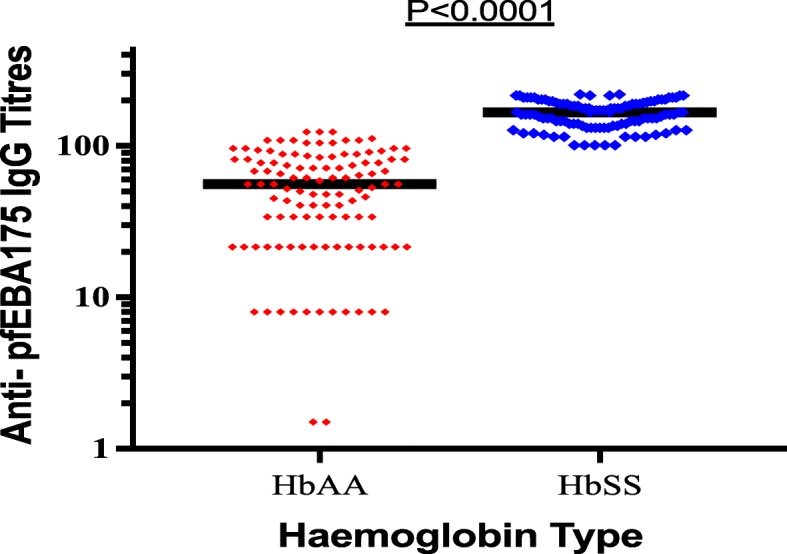
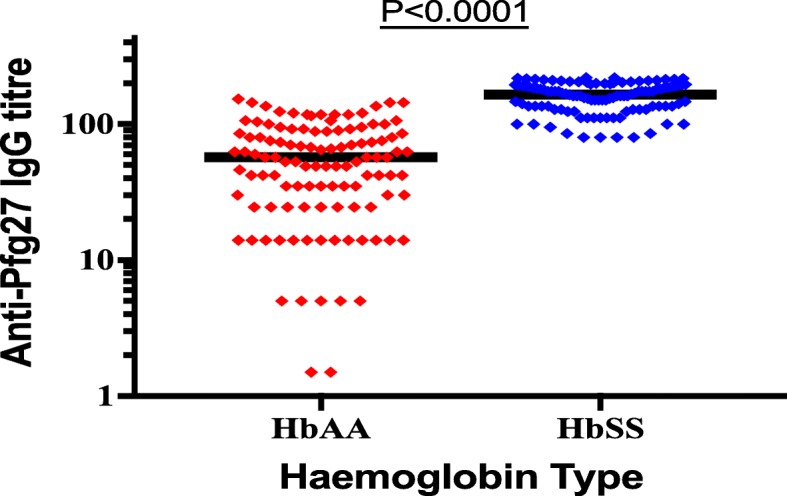
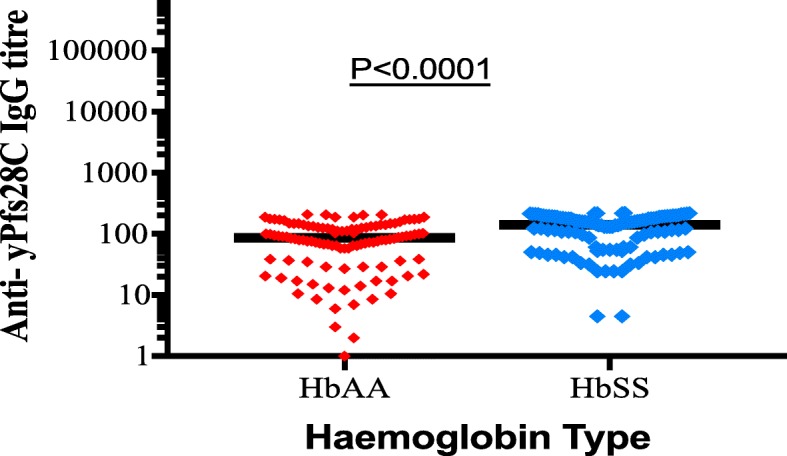
Results: The median IgG concentration to PfEBA-175, Pfg27, yPfs28C antigens were HbSS; 20.7 ng/ml (IQR; 18.1-25.6) vs. HbAA; 2.3 ng/ml (IQR; 1.21-3.04), HbSS; 2.76 ng/ml (IQR: 2.08-5.69) vs. HbAA; 1.36 ng/ml (IQR: 1.28-1.76), and HbSS; 26,592 ng/ml (IQR: 10817-41,462) vs. HbAA; 14,164 ng/ml (IQR; 3069-24,302) respectively (p < 0.0001 for all IgG). In both groups; age, body weight and hemoglobin level had no impact on the levels of IgG responses to Plasmodium falciparum antigens except for HbAA group which showed a significant increase in IgG against Pfg27 by 0.004 ng/ml with 1 g/dl increase in Hb level (p = 0.028).
Conclusions: This study found significant higher levels of specific Plasmodium falciparum IgG responses in children with homozygous sickle cell trait than those with normal hemoglobin.
Keywords: Children; Dar Es Salaam; ELISA; Immunoglobulin G; Plasmodium falciparum; Sickle cell.
Conflict of interest statement
Ethics approval and consent to participate
Ethical clearance was obtained from the Senate Research and Publications Ethical Committee of Muhimbili University of Health and Allied Sciences in Dar es Salaam, Tanzania (Ref No. DA.287/298/01A/). A written informed consent was obtained from parents of all children for giving venous blood about 5 ml and test for IgG against specific
Consent for publication
Not Applicable.
Competing interests
The authors declare that they have no competing interests.
Publisher’s Note
Springer Nature remains neutral with regard to jurisdictional claims in published maps and institutional affiliations.
Figures
References
-
- World Health Organization . Malaria Report. 2017.
-
- Abu-Zeid YA, Abdulhadi NH, Theander TG, Hviid L, Saeed BO, et al. Seasonal changes in cell mediated immune responses to soluble Plasmodium falciparum antigens in children with hemoglobin AA and hemoglobin AS. Trans R Soc Trop Med Hyg. 1992;86:20–22. - PubMed
Publication types
MeSH terms
Substances
Grants and funding
LinkOut - more resources
Full Text Sources
Miscellaneous
