Review
. 2019 Jun;15(6):840-858.
doi: 10.1016/j.jalz.2019.01.013. Epub 2019 Apr 25.

Quantifying blood-brain barrier leakage in small vessel disease: Review and consensus recommendations

Affiliations
Review

Quantifying blood-brain barrier leakage in small vessel disease: Review and consensus recommendations

Michael J Thrippleton et al. Alzheimers Dement. 2019 Jun.

Abstract

Cerebral small vessel disease (cSVD) comprises pathological processes of the small vessels in the brain that may manifest clinically as stroke, cognitive impairment, dementia, or gait disturbance. It is generally accepted that endothelial dysfunction, including blood-brain barrier (BBB) failure, is pivotal in the pathophysiology. Recent years have seen increasing use of imaging, primarily dynamic contrast-enhanced magnetic resonance imaging, to assess BBB leakage, but there is considerable variability in the approaches and findings reported in the literature. Although dynamic contrast-enhanced magnetic resonance imaging is well established, challenges emerge in cSVD because of the subtle nature of BBB impairment. The purpose of this work, authored by members of the HARNESS Initiative, is to provide an in-depth review and position statement on magnetic resonance imaging measurement of subtle BBB leakage in clinical research studies, with aspects requiring further research identified. We further aim to provide information and consensus recommendations for new investigators wishing to study BBB failure in cSVD and dementia.

Keywords: Blood-brain barrier; Cerebral small vessel disease; DCE-MRI; Dementia; Endothelial dysfunction; MRI; Permeability.


Figures

Fig. 1
Fig. 1
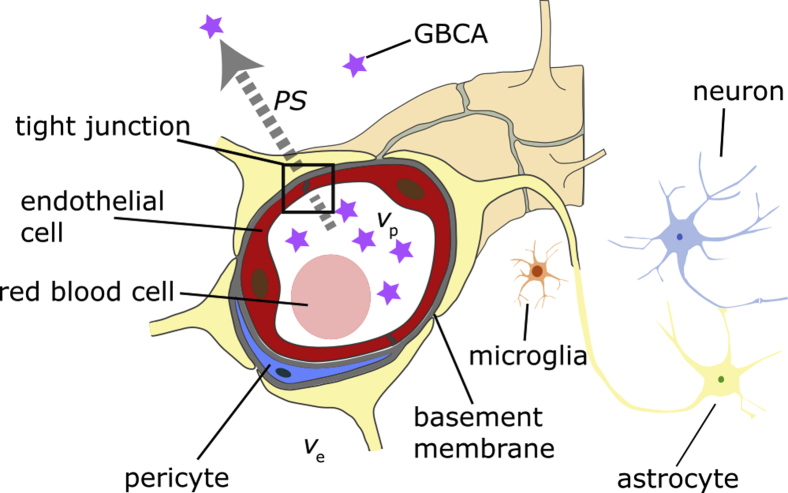
Schematic diagram showing the neurovascular unit. Leakage of gadolinium-based contrast agent (GBCA) molecules across the blood-brain barrier, from the capillary blood plasma space (volume fraction vp) to the extravascular extracellular space (volume fraction ve), is illustrated by the arrow. The rate of leakage per unit tissue volume and per unit capillary blood plasma GBCA concentration is described by the permeability–surface area product (PS).
Fig. 2
Fig. 2
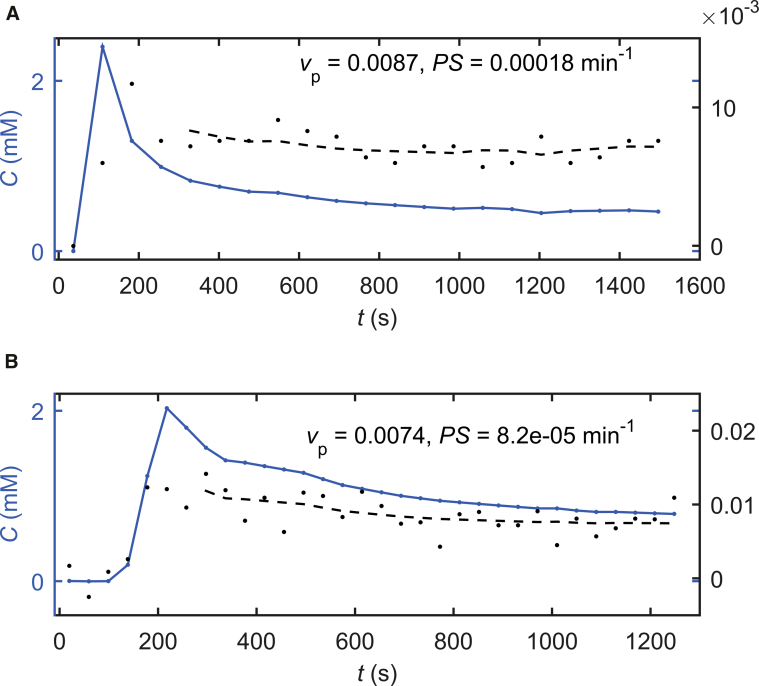
Illustrative dynamic contrast-enhanced magnetic resonance imaging (DCE-MRI) data in two patients with cerebral small vessel disease (cSVD) with a history of nondisabling stroke showing estimated concentrations of gadolinium-based contrast agent (GBCA) in blood plasma (cp, blue), white matter (Ct, black), and the fitted Patlak model (dashed line). Data were acquired and processed by the authors using the following protocols: (A) 1.5-T MRI with bolus injection of 0.1 mmol/kg gadoteric acid and a three-dimensional spoiled gradient echo (sGRE) sequence (acquired spatial resolution 0.94 × 1.25 × 4 mm, temporal resolution 73 s, post-injection acquisition time 24 min) and variable flip angle T1 measurement; the median signal from a semiautomatically generated normal-appearing white matter mask was fitted . (B) 3-T MRI with 3-minute slow injection of 0.1 mmol/kg gadobutrol, 3D sGRE (acquired spatial resolution 2 mm isotropic, temporal resolution 40 s, DCE-MRI acquisition time 21 minutes), and T1 and flip angle measurement via the DESPOT1-HIFI method; the mean white-matter signal from a region drawn manually in the centrum semiovale was modeled. Blood GBCA concentration (“vascular input function” [VIF]) was sampled in the superior sagittal sinus. The derived Patlak model parameters vP and PS represent the capillary blood plasma volume fraction and the permeability–surface area product, respectively.
Fig. 3
Fig. 3
Schematic block diagram illustrating the steps required to quantify subtle BBB leakage of GBCA. The steps indicated above the arrow are performed during the pilot phase or as part of quality assurance procedures. Abbreviations: BBB, Blood-brain barrier; DCE-MRI, dynamic contrast-enhanced magnetic resonance imaging; GBCA, gadolinium-based contrast agent; KTrans, volume transfer constant; PS, permeability–surface area product; VIF, vascular input function.
Fig. 4
Fig. 4
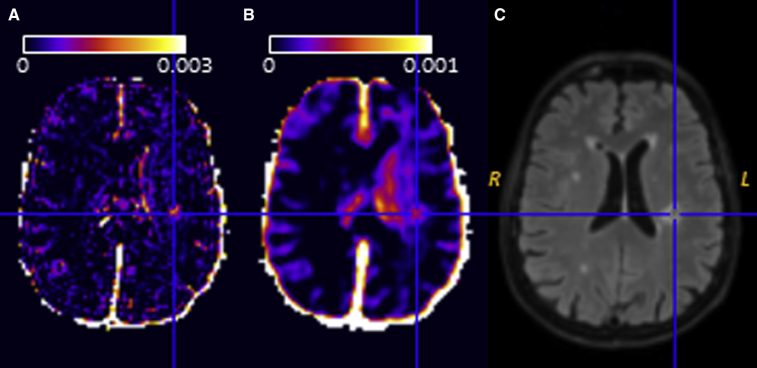
(A) Illustrative 3-T PS (units min−1) map in a patient with cSVD (71-year-old female) after acute lacunar stroke 6 weeks previously. For the corresponding PS map (B), the raw DCE-MRI images were smoothed using a three-dimensional gaussian kernel (full width at half-maximum 2 mm) during preprocessing to suppress the noise and Gibbs artifact apparent in (A). In both maps, the low level of leakage is apparent, with noticeably higher values in the stroke lesion (indicated by the cross hairs) and in the periventricular normal-appearing white matter ipsilateral to the stroke lesion. The corresponding T2w-FLAIR image is shown in (C). DCE-MRI data were acquired and processed by the authors as described in the caption to Fig. 2B. Abbreviations: cSVD, cerebral small vessel disease; DCE-MRI, dynamic contrast-enhanced magnetic resonance imaging; PS, permeability–surface area product.

References

    1. Wardlaw J.M., Smith C., Dichgans M. Mechanisms of sporadic cerebral small vessel disease: insights from neuroimaging. Lancet Neurol. 2013;12:483–497. - PMC - PubMed
    1. Wardlaw J.M., Smith E.E., Biessels G.J., Cordonnier C., Fazekas F., Frayne R. Neuroimaging standards for research into small vessel disease and its contribution to ageing and neurodegeneration. Lancet Neurol. 2013;12:822–838. - PMC - PubMed
    1. Blair G.W., Hernandez M.V., Thrippleton M.J., Doubal F.N., Wardlaw J.M. Advanced neuroimaging of cerebral small vessel disease. Curr Treat Options Cardiovasc Med. 2017;19:56. - PMC - PubMed
    1. Blair G.W., Appleton J.P., Law Z.K., Doubal F., Flaherty K., Dooley R. Preventing cognitive decline and dementia from cerebral small vessel disease: The LACI-1 Trial. Protocol and statistical analysis plan of a phase IIa dose escalation trial testing tolerability, safety and effect on intermediary endpoints of isosorbide mononitrate and cilostazol, separately and in combination. Int J Stroke. 2018;13:530–538. - PubMed
    1. Farrall A.J., Wardlaw J.M. Blood-brain barrier: Ageing and microvascular disease–systematic review and meta-analysis. Neurobiol Aging. 2009;30:337–352. - PubMed

Publication types

MeSH terms