A period without PER: understanding 24-hour rhythms without classic transcription and translation feedback loops
- PMID: 31031966
- PMCID: PMC6468715
- DOI: 10.12688/f1000research.18158.1
A period without PER: understanding 24-hour rhythms without classic transcription and translation feedback loops
Abstract
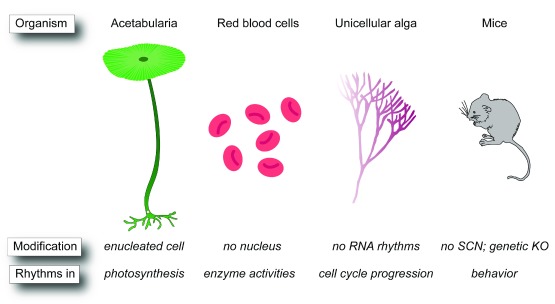
Since Ronald Konopka and Seymour Benzer's discovery of the gene Period in the 1970s, the circadian rhythm field has diligently investigated regulatory mechanisms and intracellular transcriptional and translation feedback loops involving Period, and these investigations culminated in a 2017 Nobel Prize in Physiology or Medicine for Michael W. Young, Michael Rosbash, and Jeffrey C. Hall. Although research on 24-hour behavior rhythms started with Period, a series of discoveries in the past decade have shown us that post-transcriptional regulation and protein modification, such as phosphorylation and oxidation, are alternatives ways to building a ticking clock.
Keywords: circadian rhythms; dopaminergic ultradian oscillator; peroxiredoxin; phosphorylation; post-transcriptional oscillator; red blood cells; transcriptional-translation feedback loop.
Conflict of interest statement
No competing interests were disclosed.No competing interests were disclosed.No competing interests were disclosed.
Figures
References
Publication types
MeSH terms
LinkOut - more resources
Full Text Sources
Miscellaneous