Review
. 2019 Apr 29;20(9):2123.
doi: 10.3390/ijms20092123.

Experimental Models of Brugada syndrome

Affiliations
Review

Experimental Models of Brugada syndrome

Franziska Sendfeld et al. Int J Mol Sci. .

Abstract

Brugada syndrome is an inherited, rare cardiac arrhythmogenic disease, associated with sudden cardiac death. It accounts for up to 20% of sudden deaths in patients without structural cardiac abnormalities. The majority of mutations involve the cardiac sodium channel gene SCN5A and give rise to classical abnormal electrocardiogram with ST segment elevation in the right precordial leads V1 to V3 and a predisposition to ventricular fibrillation. The pathophysiological mechanisms of Brugada syndrome have been investigated using model systems including transgenic mice, canine heart preparations, and expression systems to study different SCN5A mutations. These models have a number of limitations. The recent development of pluripotent stem cell technology creates an opportunity to study cardiomyocytes derived from patients and healthy individuals. To date, only a few studies have been done using Brugada syndrome patient-specific iPS-CM, which have provided novel insights into the mechanisms and pathophysiology of Brugada syndrome. This review provides an evaluation of the strengths and limitations of each of these model systems and summarizes the key mechanisms that have been identified to date.

Keywords: Brugada syndrome; SCN5A; induced pluripotent stem cells (iPS); model systems.


Conflict of interest statement

The authors declare no conflict of interest.

Figures
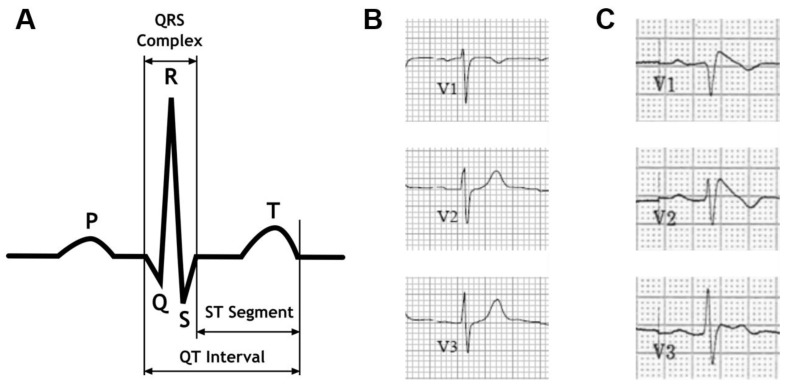
Figure 1
Figure 1
The electrocardiogram in the Brugada syndrome. (A) Schematic diagram of a normal electrocardiographic complex representing sinus rhythm. (B) Precordial leads V1-V3 from a normal electrocardiogram. (C) Precordial leads V1-V3 from a patient with Brugada syndrome.
Figure 2
Figure 2
A Schematic overview of the experimental models predominately used for studying Brugada syndrome. Murine Models: Generated through targeted disruption of Scn5a. Manipulated ES cells are transfected into blastocysts to give rise to a male chimera. Crossing with wild type females results in heterozygous offspring (Scn5a+/−). Canine Models: Wedges of canine left or right ventricles are perfused arterially. Brugada syndrome is drug-induced with Na+-channel blockers (e.g., pilsicainide), Ca2+-channel blockers (e.g., verapamil) or K+-channel openers (e.g., pinacidil), which are administered either by themselves or in combination. Expression Systems: Families displaying symptoms of Brugada syndrome are screened for mutations using direct sequencing with a candidate gene approach. Relevant mutations are then introduced into vectors carrying the gene of interest using site-directed mutagenesis, and subsequently transfected into a host cell (e.g., tsA201 cells) or in vitro transcribed and injected into Xenopus oocytes. Cardiomyocytes from Induced Pluripotent Stem (iPS) Cells: Dermal fibroblasts are isolated, cultured and transfected with the pluripotency factors Oct3/4, Klf4, Sox2, and c-Myc. Transfected fibroblasts are then cultured in human embryonic stem cell selection media until colonies of iPS cells are detected. Selected iPS cells then undergo cardiomyocyte differentiation using either unguided (spontaneous) differentiation, guided differentiation (cytokines, growth factors) or through co-culture. The parameters analyzed and key findings for each model system are summarized at the bottom of each panel.
Figure 3
Figure 3
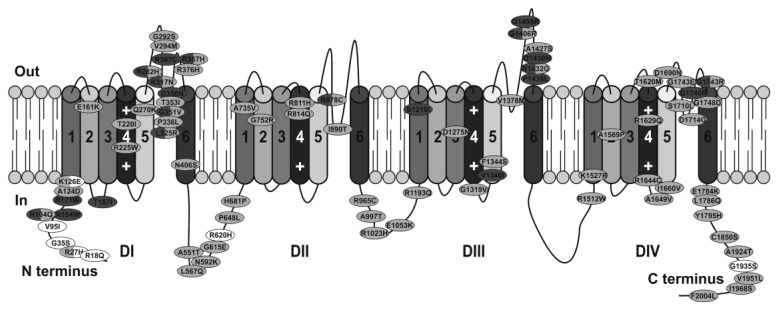
Nav1.5 channel scheme showing the location of mutations in SCN5A identified in patients with the Brugada syndrome. Only missense mutations that have been functionally characterized using expression systems are displayed. Nonsense and insertion or deletion mutations are not shown. Mutations found to cause a complete loss of INa are dark grey, those reported to reduce INa and/or alter Nav1.5 properties are light grey, and white indicates no changes in channel properties. Mutations for which two different types of alterations have been described are displayed in both colors.

References

    1. Brugada P., Brugada J. Right bundle branch block, persistent ST segment elevation and sudden cardiac death: A distinct clinical and electrocardiographic syndrome. A multicenter report. J. Am. Coll. Cardiol. 1992;20:1391–1396. doi: 10.1016/0735-1097(92)90253-J. - DOI - PubMed
    1. Chen Q., Kirsch G., Zhang D., Brugada R., Brugada J., Brugada P., Potenza D., Moya A., Borggrefe M., Breithardt G., et al. Genetic basis and molecular mechanism for idiopathic ventricular fibrillation. Nature. 1998;392:293–296. doi: 10.1038/32675. - DOI - PubMed
    1. Coronel R., Casini S., Koopmann T.T., Wilms-Schopman F.J., Verkerk A.O., de Groot J.R., Bhuiyan Z., Bezzina C.R., Veldkamp M.W., Linnenbank A.C., et al. Right ventricular fibrosis and conduction delay in a patient with clinical signs of Brugada syndrome: A combined electrophysiological, genetic, histopathologic, and computational study. Circulation. 2005;112:2769–2777. doi: 10.1161/CIRCULATIONAHA.105.532614. - DOI - PubMed
    1. Wilde A.A.M., Amin A.S. Clinical Spectrum of SCN5A Mutations: Long QT Syndrome, Brugada Syndrome, and Cardiomyopathy. JACC Clin. Electrophysiol. 2018;4:569–579. doi: 10.1016/j.jacep.2018.03.006. - DOI - PubMed
    1. Brugada J., Brugada R., Brugada P. Pharmacological and device approach to therapy of inherited cardiac diseases associated with cardiac arrhythmias and sudden death. J. Electrocardiol. 2000;33:41–47. doi: 10.1054/jelc.2000.20322. - DOI - PubMed

MeSH terms

Substances