


Child outcomes after placement of a cervical pessary in women with a multiple pregnancy: A 4-year follow-up of the ProTWIN trial
- PMID: 31032879
- PMCID: PMC6900136
- DOI: 10.1111/aogs.13630
Child outcomes after placement of a cervical pessary in women with a multiple pregnancy: A 4-year follow-up of the ProTWIN trial
Abstract
Introduction: The ProTWIN trial previously showed no beneficial effect of treatment with a cervical pessary vs usual care to prevent preterm birth in women with a multiple pregnancy. However, in women with a midtrimester short cervix (<38 mm), pessary did reduce the composite outcome of neonatal morbidity and mortality. This follow-up study evaluates the long-term outcomes of all children born to mothers who participated in the ProTWIN trial at 4 years of age.
Material and methods: Parents received the Ages and Stages Questionnaire, Strength and Difficulties Questionnaire and a health questionnaire. All questionnaires were reported separately and as a combined outcome (abnormal child outcome). A linear mixed effects model was used to adjust for correlated data in twins and correction for confounders was performed. In exploratory analysis, a composite outcome of death or survival with abnormal child outcome was used by combining extrapolated data on child outcome with survival data. All data were analyzed for the total group and the subgroup of women with midtrimester short cervix.
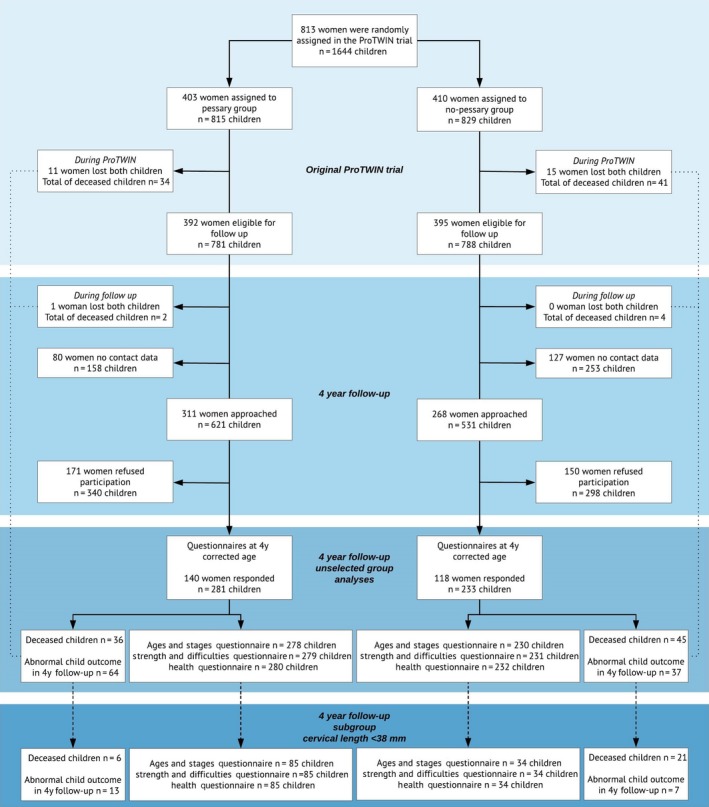
Results: Of the original 813 women of the ProTWIN trial, we approached 579, of whom 258 participated (45%) in follow-up. We received questionnaires of 514 children (281 pessary vs 233 control), with 119 children in the subgroup of women with midtrimester short cervix. An abnormal child outcome was found in 23% in the pessary group vs 16% in the control group (odds ratio 1.58; 95% confidence interval 0.94-2.65). In exploratory analysis with extrapolated data on child outcome (n = 815), no difference in abnormal child outcome was seen between the pessary and control group. In the subgroup of women with a short cervix (n = 268), this composite outcome indicated a favorable outcome for children born to mothers with pessary.
Conclusions: In women with a multiple pregnancy, the use of a cervical pessary did not improve development, behavior or physical outcomes of the surviving children at age 4.
Keywords: behavior; child; development; follow-up; multiple pregnancy; pessary; preterm birth.
© 2019 The Authors. Acta Obstetricia et Gynecologica Scandinavica published by John Wiley & Sons Ltd on behalf of Nordic Federation of Societies of Obstetrics and Gynecology (NFOG).
Conflict of interest statement
B.W.M. reports consultancies for ObsEva, Merck and Guerbet. The other authors report no conflict of interest.
Figures
References
-
- Goya M, De La Calle M, Pratcorona L, et al. Cervical pessary to prevent preterm birth in women with twin gestation and sonographic short cervix: a multicenter randomized controlled trial (PECEP‐Twins). Am J Obstet Gynecol. 2016;214(2):145‐152. - PubMed
-
- Saccone G, Ciardulli A, Xodo S, et al. Cervical pessary for preventing preterm birth in twin pregnancies with short cervical length: a systematic review and meta‐analysis. J Matern Fetal Neonatal Med. 2017;30(24):2918‐2925. - PubMed
-
- Senekjian EKK, Potkul RKK, Frey K, Herbst ALL. Infertility among daughters either exposed or not exposed to diethylstilbestrol. Am J Obstet Gynecol. 1988;158(3 Pt 1):493‐498. - PubMed
Publication types
MeSH terms
Associated data
Grants and funding
LinkOut - more resources
Full Text Sources
