. 2019 Aug 15;40(12):3415-3430.
doi: 10.1002/hbm.24606. Epub 2019 Apr 29.

Neural response to stress and perceived stress differ in patients with left temporal lobe epilepsy

Affiliations

Neural response to stress and perceived stress differ in patients with left temporal lobe epilepsy

Adam M Goodman et al. Hum Brain Mapp. .

Abstract

Patients with epilepsy are often able to predict seizure occurrence subsequent to an acute stress experience. However, neuroimaging investigations into the neural basis of this relationship or the potential influence of perceived life stress are limited. The current study assessed the relationship between perceived stress and the neurobehavioral response to stress in patients with left temporal lobe epilepsy (LTLE) and healthy controls (HCs) using heart rate, salivary cortisol level, and functional magnetic resonance imaging and compared these effects between HCs and LTLE. Matched on perceived stress levels, groups of 36 patients with LTLE and 36 HCs completed the Montreal Imaging Stress Task, with control and stress math task conditions. Among LTLEs, 27 reported that prior (acute) stress affected their seizures (LTLES+), while nine did not (LTLES-). The results revealed that increased perceived stress was associated with seizure frequency in LTLE. Further, cortisol secretion was greater in LTLE, but did not vary with perceived stress as observed in HCs. A linear mixed-effects analysis revealed that as perceived stress increased, activation in the hippocampal complex (parahippocampal gyrus and hippocampus) decreased during stressful math in the LTLES+, increased in HCs, but did not vary in the LTLES-. Task-based functional connectivity analyses revealed LTLE differences in hippocampal functional connectivity with sensory cortex specific to stressor modalities. We argue that the current study demonstrates an inhibitory hippocampal mechanism underlying differences in resilience to stress between HCs and LTLE, as well as LTLE patients who report stress as a precipitant of seizures.

Keywords: MIST; cortisol; fMRI; psychological stress; psychophysiology; temporal lobe epilepsy.


Figures

Figure 1
Figure 1
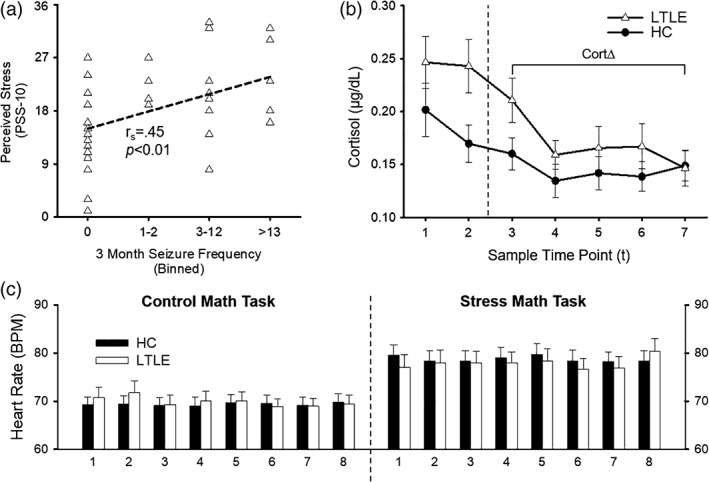
Psychological and physiological results for the healthy control (HC) and left temporal lobe epilepsy (LTLE) groups. The top left panel (a) shows the Spearman rank correlation between seizure frequency (binned by quartiles) in the past 3 months and Perceived Stress Scale (PSS‐10) within the LTLE group. The top right panel (b) shows the group comparison of cortisol secretion during the experimental session. Sample time points reflect collection at 30 min (t1) and 15 min (t2) prior to MRI scanning and 0 (t3), 15 min (t4), 30 min (t5), 45 min (t6), and 60 min (t7) following completion of MRI scanning. Cortisol reactivity (CortΔ = (t3–t7)/t7) was calculated by comparing poststress peak (t3) to recovery to baseline (t7) based on prior literature (Allendorfer et al., 2014). The bottom panel (c) shows the groups comparison of heart rate (HR; beats per minute [BPM]) between control math task and the stress math task (SMT). Each time point reflects the sequence of auditory feedback events during the tasks. There was a significant increase in HR between control and SMTs
Figure 2
Figure 2
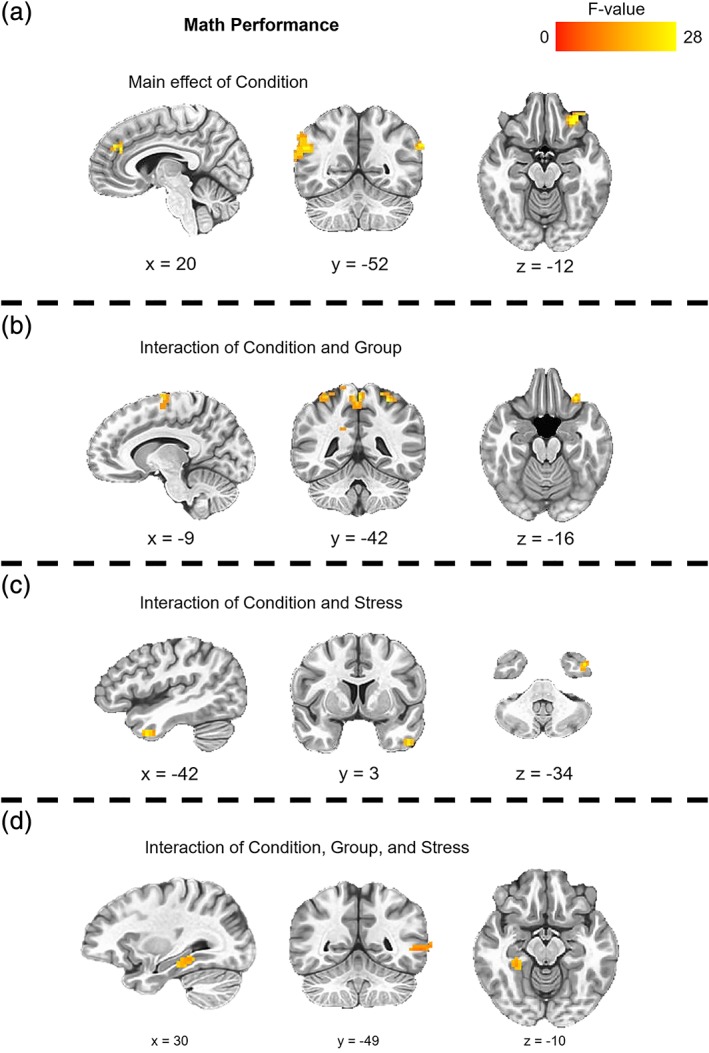
Clusters of significant activation during math performance for the main effect of condition (CMT vs. SMT), interaction of condition and group (HC vs. LTLE), and the interaction of condition, group, and perceived stress (PSS‐10). CMT, control math task; HC, healthy control; LTLE, left temporal lobe epilepsy; PSS, Perceived Stress Scale; SMT, stress math task
Figure 3
Figure 3
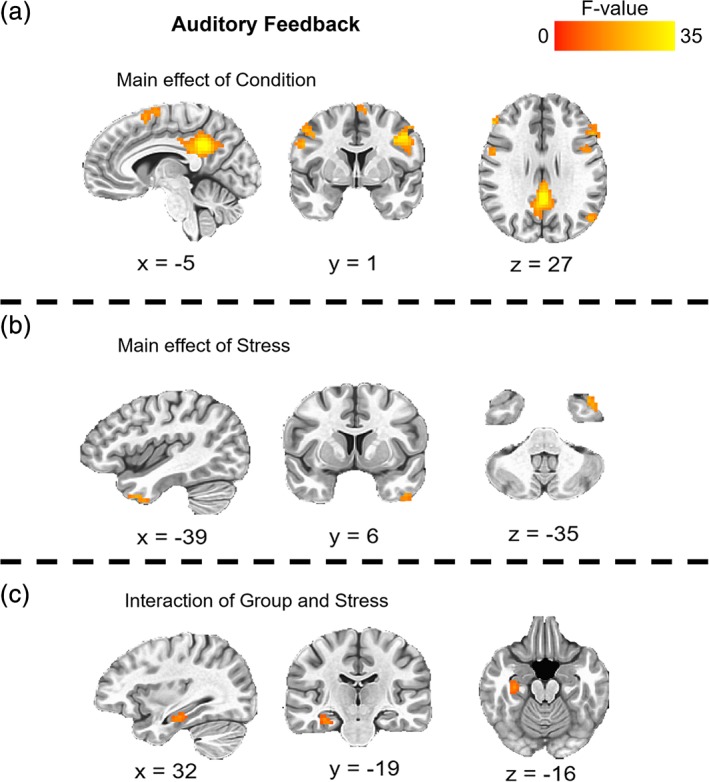
Clusters of significant activation during auditory feedback for the main effect of condition (CMT vs. SMT), the main effect perceived stress (PSS‐10), and the interaction of group (HC vs. LTLE) and perceived stress. CMT, control math task; HC, healthy control; LTLE, left temporal lobe epilepsy; PSS, Perceived Stress Scale; SMT, stress math task
Figure 4
Figure 4
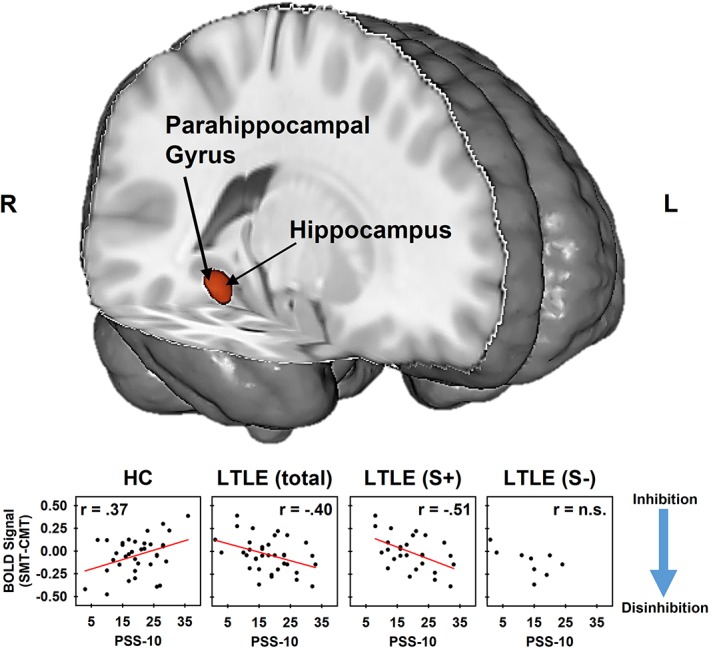
Cluster of activation (red) identified for the interaction of condition, group, and perceived stress in the right hippocampal complex (including parahippocampal gyrus and hippocampus regions). Signal extractions (bottom panel) separated by group reflect differences in the linear relationship between the neural response to stress and perceived stress between HC, LTLE, LTLE who report stress as a precipitate (LTLES+), and LTLE who report stress is not a precipitate (LTLES−) groups. Differences in the correlations between signal extractions and perceived stress reveal that the three‐way interaction condition, group, and perceived stress was due to a positive relationship in HCs and a negative relationship in LTLEs between differential (SMT–CMT) hippocampal activation and perceived stress (PSS‐10). Hippocampal activation serves an inhibitory role of in the emotional response to stress (blue arrow). Psychosocial stress decreases hippocampal activity and ultimately leads to disinhibition that results in the subsequent increase in arousal that is characteristic of the stress response (Dedovic et al., 2005; Goodman et al., 2016; Khalili‐Mahani et al., 2010; Pruessner et al., 2008). Alternatively, increased hippocampal activity has been linked to inhibition of emotional arousal in response to stress (Dedovic et al., 2009). CMT, control math task; HC, healthy control; LTLE, left temporal lobe epilepsy; PSS, Perceived Stress Scale; SMT, stress math task
Figure 5
Figure 5
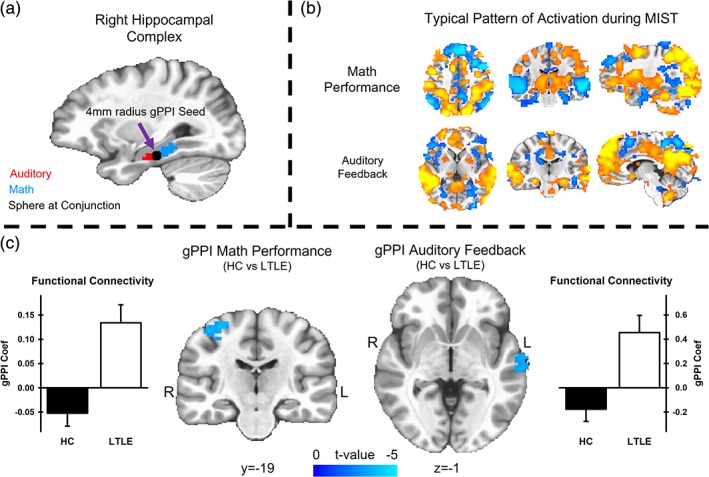
gPPI results comparing functional connectivity with the hippocampal seed region between HC and LTLE groups. The top left panel (a) depicts the conjunction between clusters activation resulting from the three‐way interaction of condition, group, and perceived stress during math performance (blue) and the two‐way interaction of group and perceived stress during auditory feedback (red). A 4 mm radius sphere (black) was constructed with a center voxel derived from the COM for the conjunction of the two interaction clusters. The top right panel (b) depicts the first‐level modeling results of a representative subject during math performance (top) and auditory feedback (bottom) during the stressful math task. The bottom panel shows the results of the gPPI analysis comparing HC and LTLE groups during stressful math performance and auditory feedback. During both math performance and auditory feedback events, the HC group demonstrated negative correlations, while the LTLE group demonstrated significantly increased positive correlations with the hippocampal seed regions during the SMT. COM, center‐of‐mass; CMT, control math task; gPPI, generalized psychophysiological interaction; HC, healthy control; LTLE, left temporal lobe epilepsy; PSS, Perceived Stress Scale; SMT, stress math task

References

    1. Allendorfer, J. B. , Heyse, H. , Mendoza, L. , Nelson, E. B. , Eliassen, J. C. , Storrs, J. M. , & Szaflarski, J. P. (2014). Physiologic and cortical response to acute psychosocial stress in left temporal lobe epilepsy—A pilot cross‐sectional fMRI study. Epilepsy & Behavior, 36, 115–123. - PubMed
    1. Beck, A. T. , Steer, R. A. , & Brown, G. K. (1996). Beck depression inventory‐II. San Antonio, 78(2), 490–498.
    1. Bonora, A. , Benuzzi, F. , Monti, G. , Mirandola, L. , Pugnaghi, M. , Nichelli, P. , & Meletti, S. (2011). Recognition of emotions from faces and voices in medial temporal lobe epilepsy. Epilepsy & Behavior, 20, 648–654. - PubMed
    1. Chen, Z. , Brodie, M. J. , Liew, D. , & Kwan, P. (2018). Treatment outcomes in patients with newly diagnosed epilepsy treated with established and new antiepileptic drugs: A 30‐year longitudinal cohort study. JAMA Neurology, 75, 279–286. - PMC - PubMed
    1. Chrousos, G. P. (2009). Stress and disorders of the stress system. Nature Reviews. Endocrinology, 5, 374–381. - PubMed

Publication types

MeSH terms