


Taking Repeated Exposure into Account: An Experimental Study of Direct-To-Consumer Prescription Drug Television Ad Effects
- PMID: 31033396
- PMCID: PMC9479315
- DOI: 10.1080/10810730.2019.1609139
Taking Repeated Exposure into Account: An Experimental Study of Direct-To-Consumer Prescription Drug Television Ad Effects
Abstract
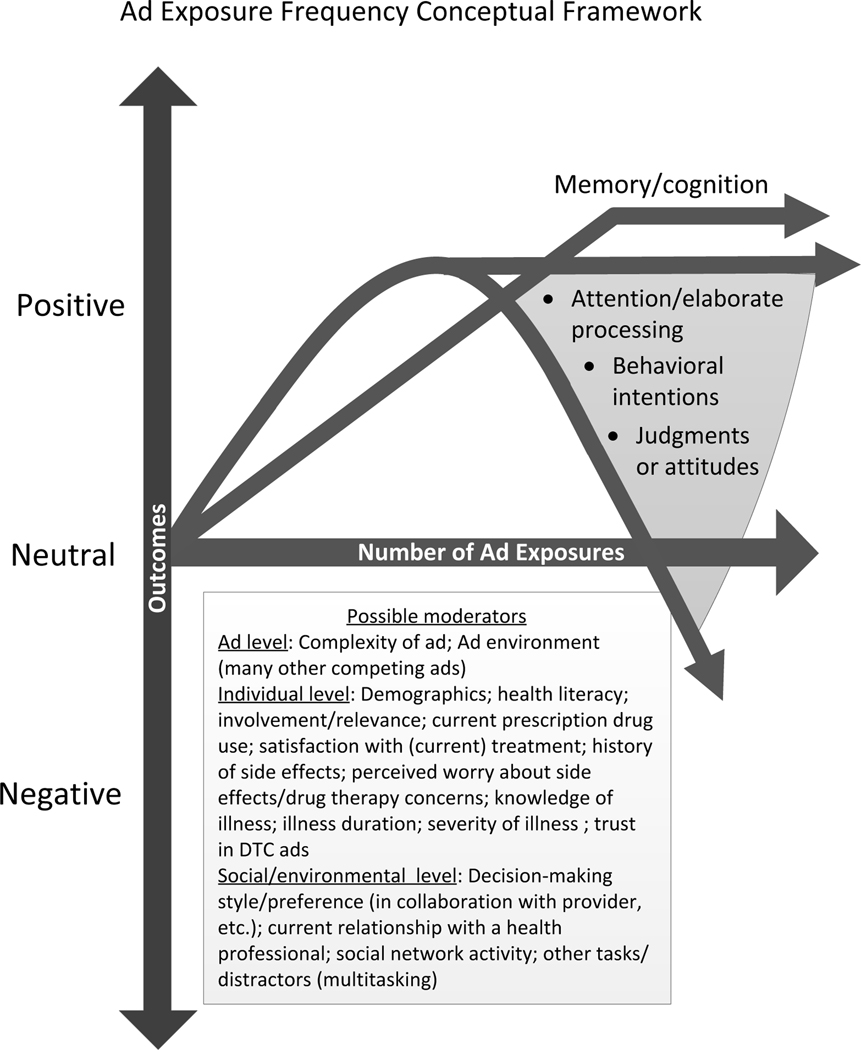
Introduction: Little is known about how repeated exposure to direct-to-consumer prescription drug promotion can impact consumers' retention and perceptions of drug information. The study described here tested the effects of varied ad exposure frequency on these outcomes. Methods: In an in-person experiment, participants with seasonal allergies (n = 616) were randomized to view a mock prescription drug television ad either once, twice, or four times within 1 h of television programming, embedded with six commercial breaks. Respondents then answered a 20-min survey administered via computer. Results: Those who viewed the ad more frequently were better able to recall both risk (X2 = 20.93, p < .001) and benefit information (X2 = 9.34, p = .009) and to recognize risk (F(2,597) = 11.89, p = .001) and benefit information (F(2,597) = 3.17, p = .043) than those who viewed the ad one time. Ad exposure frequency was not associated with perceptions about the magnitude or likelihood of risks or benefits. In general, risk information seemed to require more repetitions than benefit information to be accurately remembered. The recall was mediated by elaborate processing. Discussion: Effects on memory were small; retention of both risks and benefits remained low overall even after four exposures.
Figures
References
-
- Aikin KJ, Southwell BG, Paquin RS, Rupert DJ, O’Donoghue AC, Betts KR, & Lee PK (2017). Correction of misleading information in prescription drug television advertising: The roles of advertisement similarity and time delay. Research in Social and Administrative Pharmacy, 13(2), 378–388. 10.1016/j.sapharm.2016.04.004 - DOI - PubMed
-
- Anand P, & Sternthal B. (1990). Ease of message processing as a moderator of repetition effects in advertising. Journal of Marketing Research, 27(3), 345–353.
-
- Batra R, & Ray ML (1986). Situational effects of advertising repetition: The moderating influence of motivation, ability, and opportunity to respond. Journal of Consumer Research, 12(4), 432–445.
-
- Belch GE (1982). The effects of television commercial repetition on cognitive response and message acceptance. Journal of Consumer Research, 9(1), 56–65.
-
- Berlyne DE (1970). Novelty, complexity, and hedonic value. Perception & Psychophysics, 8(5a), 279. 10.3758/Bf03212593 - DOI
Publication types
MeSH terms
Substances
Grants and funding
LinkOut - more resources
Full Text Sources
Other Literature Sources
Miscellaneous