. 2019 Apr 29;14(4):e0215725.
doi: 10.1371/journal.pone.0215725. eCollection 2019.

Exploring the hereditary background of renal cancer in Denmark

Affiliations

Exploring the hereditary background of renal cancer in Denmark

Maria Bejerholm Christensen et al. PLoS One. .

Abstract

Background: Every year more than 800 patients in Denmark are diagnosed with renal cell carcinoma (RCC) of which 3-5% are expected to be part of a hereditary renal cancer syndrome. We performed genetic screening of causative and putative RCC-genes (VHL, FH, FLCN, MET, SDHB, BAP1, MITF, CDKN2B) in RCC-patients suspected of a genetic predisposition.

Methods: The cohort consisted of forty-eight Danish families or individuals with early onset RCC, a family history of RCC, a family history of RCC and melanoma or both RCC- and melanoma diagnosis in the same individual. DNA was extracted from peripheral blood samples or cancer-free formalin-fixed paraffin-embedded tissue.

Results: One start codon variant of unknown clinical significance (VUS) (c.3G>A, p.Met1Ile) and one missense VUS (c.631A>C, p.Met211Leu) was found in VHL in a patient with RCC-onset at twenty-eight years of age but without other manifestations or family history of von Hippel-Lindau (VHL). Furthermore, in three families we found three different variants in BAP1, one of which was a novel non-segregating missense variant (c.1502G>A, p.Ser501Asn) in a family with two brothers affected with RCC. Finally, we found the known E318K-substitution in MITF in a RCC-affected member of a family with multiple melanomas. No variants were detected in CDKN2B.

Conclusion: Although we did find three VUS's in BAP1 in three families and a pathogenic variant in MITF in one family, pathogenic germline variants in BAP1, MITF or CDKN2B are not frequent causes of hereditary renal cancer in Denmark. It is possible that the high prevalence of risk factors such as male gender, smoking and obesity has influenced the development of cancer in the patients of the current study. Further investigations into putative predisposing genes and risk factors of RCC are necessary to enable better prediction of renal cancer risk or presymptomatic testing of relatives in hereditary renal cancer families.


Conflict of interest statement

The authors have declared that no competing interests exist.

Figures
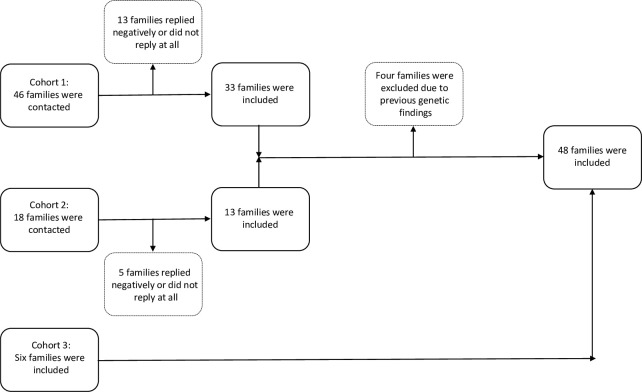
Fig 1
Fig 1. Flow chart illustrating the inclusion of patients.
Cohort 1 comprises families previously genetically counselled. Cohort 2 comprises patients identified through the Danish Cancer Registry. Cohort 3 comprises one family identified through the clinical setting at Copenhagen University Hospital and five families identified from another study in the research group.
Fig 2
Fig 2. Schematic presentation of the organization of the participating families into four groups.
The organization is based on clinical data. In group 1 one family member was affected with RCC (n = 20) either RCC < 40 years of age and/or bilateral or multifocal RCC < 60 years of age, in group 2 two family members were affected with RCC (n = 21), in group 3 more than two family members were affected with RCC and/or melanoma (minimum of one RCC) (n = 17) and in group 4 the proband had been diagnosed with both melanoma and RCC (n = 5) comprising sixty-three family members in forty-eight families. *No affected first-degree relatives with RCC or malignant melanoma.
Fig 3
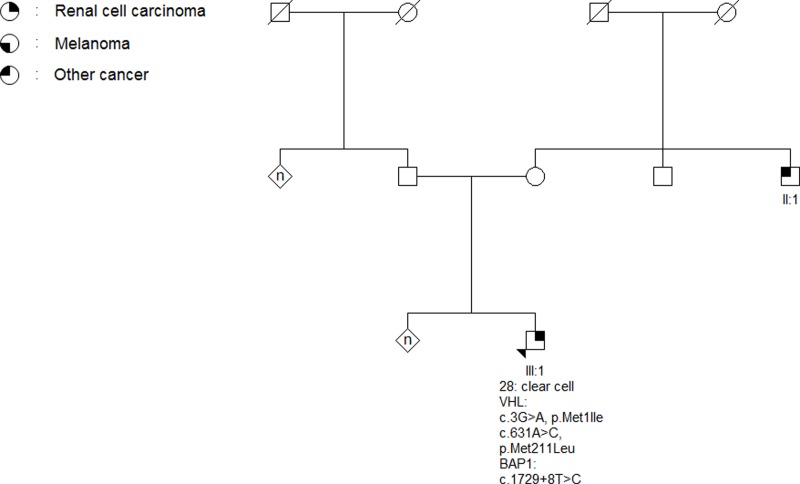
Fig 3. Pedigree of family 6002.
The arrow indicates the proband. The age of RCC-onset and histological subtype the renal tumor is listed below the proband (III:3). A start codon VUS (c.3G>A, p.Met1Ile) and a missense variant (c.631A>C, p. Met211Leu) in VHL and a intron variant (c.1729+8T>C) in BAP1 was identified in a peripheral blood sample from the proband. The proband’s maternal uncle (II:1) was diagnosed with testicular cancer.
Fig 4
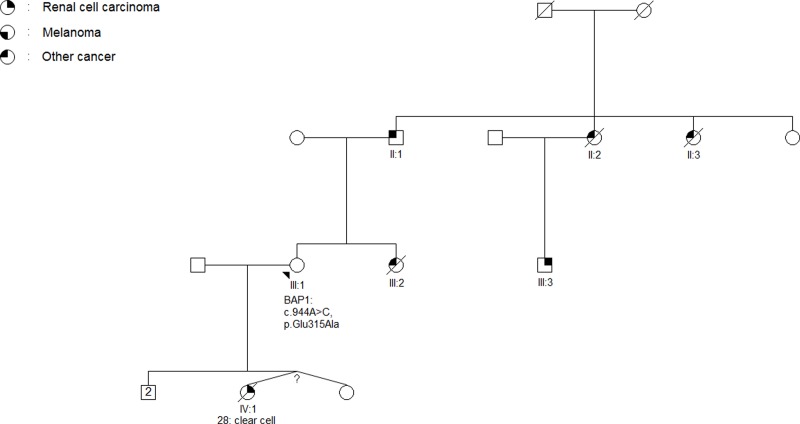
Fig 4. Pedigree of family 5001.
The arrow indicates the proband. The age of RCC-onset and histological subtype of the primary renal tumor is listed below the patient (IV:1). A VUS (c.944A>C, p.Glu315Ala) in BAP1 was identified in a peripheral blood sample from the proband. According to the family’s wishes we did not contact III:3. Additional cancers in the family are as follows: II:1: Prolactinoma, II:2: Pancreas, II:3: Thyroid, III:2 Sarcoma.
Fig 5
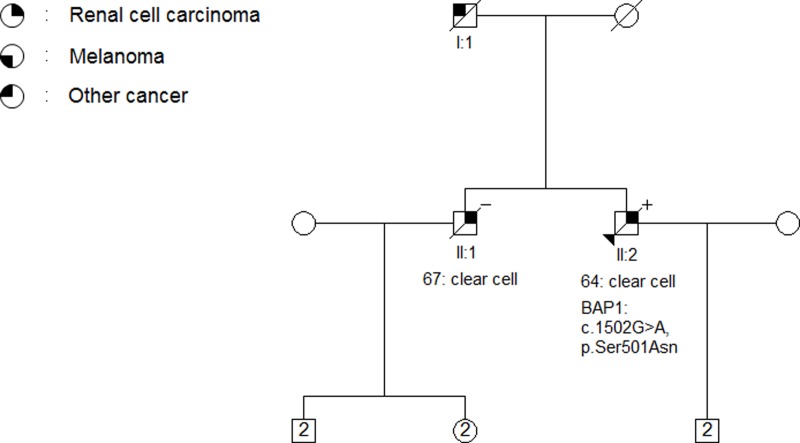
Fig 5. Pedigree of family 1013.
The arrow indicates the proband. The age of RCC-onset and histological subtype of each primary renal tumor is listed below the patient. A novel VUS (c.1502G>A, p.Ser501Asn) in BAP1 was identified in a peripheral blood sample from the proband (+) but was not found in two samples of FFPE from the proband’s brother (-).The proband’s father (I:1) was diagnosed with lung cancer.
Fig 6
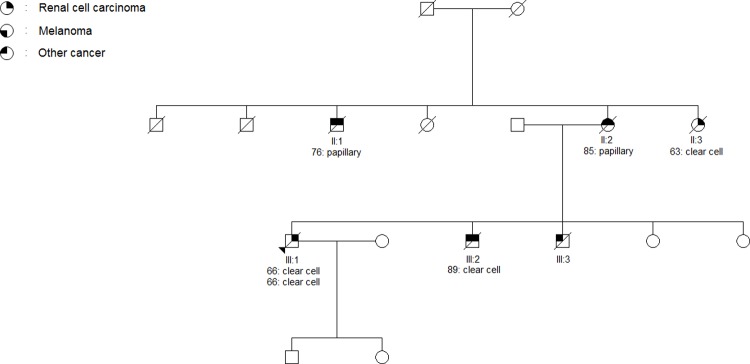
Fig 6. Pedigree of family 2006.
The arrow indicates the proband. The age of RCC-onset and histological subtype of each primary renal tumor is listed below the patient. Additional cancers in the family are as follows: II:1: Lung, II:2: Rectum, III:2: Prostate, III:3: Unknown.

References

    1. Shuch B, Amin A, Armstrong AJ, Eble JN, Ficarra V, Lopez-Beltran A, et al. Understanding Pathologic Variants of Renal Cell Carcinoma: Distilling Therapeutic Opportunities from Biologic Complexity. Eur Urol. 2015;67(1):85–97. 10.1016/j.eururo.2014.04.029 - DOI - PubMed
    1. Engholm G, Ferlay J, Christensen N, Bray F, Gjerstorff ML, Klint Å, et al. Cancer Incidence, Mortality, Prevalence and Survival in the Nordic Countries; 2018 [cited 2018 Aug 1]. Database: NORDCAN [Internet]. Available from http://www-dep.iarc.fr/NORDCAN/english/StatsFact.asp?cancer=290&country=208.
    1. Choudhary S, Sudarshan S, Choyke PL, Prasad SR. Renal Cell Carcinoma: Recent Advances in Genetics and Imaging. Semin Ultrasound, CT MRI. 2009. August;30(4):315–25. - PubMed
    1. Tsui K-H, Shvarts O, Smith RB, Figlin R, DeKernion JB, Belldegrun A. Renal cell carcinoma: prognostic significance of incidentally detected tumors. J Urol. 2000;163(2):426–30. - PubMed
    1. Chow W-H, Dong LM, Devesa SS. Epidemiology and risk factors for kidney cancer. Nat Rev Urol. 2010;7(5):245–57. 10.1038/nrurol.2010.46 - DOI - PMC - PubMed

Publication types

MeSH terms

Substances