


Aging circadian rhythms and cannabinoids
- PMID: 31035036
- PMCID: PMC6591053
- DOI: 10.1016/j.neurobiolaging.2019.03.008
Aging circadian rhythms and cannabinoids
Abstract
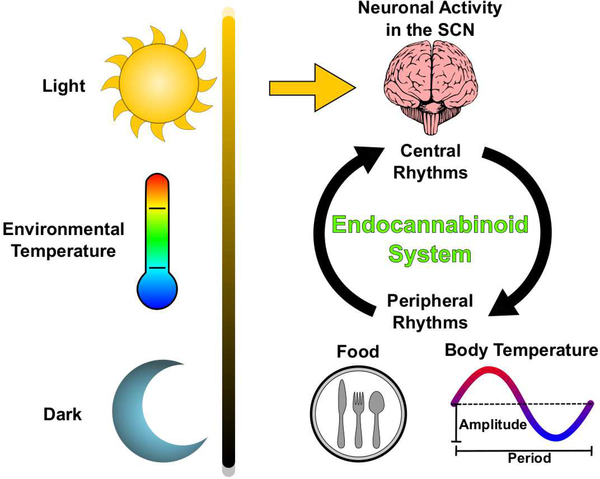
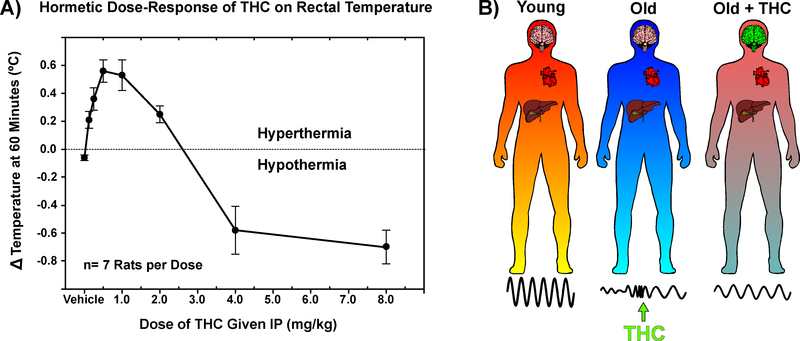
Numerous aspects of mammalian physiology exhibit cyclic daily patterns known as circadian rhythms. However, studies in aged humans and animals indicate that these physiological rhythms are not consistent throughout the life span. The simultaneous development of disrupted circadian rhythms and age-related impairments suggests a shared mechanism, which may be amenable to therapeutic intervention. Recently, the endocannabinoid system has emerged as a complex signaling network, which regulates numerous aspects of circadian physiology relevant to the neurobiology of aging. Agonists of cannabinoid receptor-1 (CB1) have consistently been shown to decrease neuronal activity, core body temperature, locomotion, and cognitive function. Paradoxically, several lines of evidence now suggest that very low doses of cannabinoids are beneficial in advanced age. One potential explanation for this phenomenon is that these drugs exhibit hormesis-a biphasic dose-response wherein low doses produce the opposite effects of higher doses. Therefore, it is important to determine the dose-, age-, and time-dependent effects of these substances on the regulation of circadian rhythms and other processes dysregulated in aging. This review highlights 3 fields-biological aging, circadian rhythms, and endocannabinoid signaling-to critically assess the therapeutic potential of endocannabinoid modulation in aged individuals. If the hormetic properties of exogenous cannabinoids are confirmed, we conclude that precise administration of these compounds may bidirectionally entrain central and peripheral circadian clocks and benefit multiple aspects of aging physiology.
Keywords: Advanced age; Cannabis; Chronobiotic; Chronopharmacology; Circadian rhythm; Cognition; Endocannabinoid; Hormesis.
Copyright © 2019 Elsevier Inc. All rights reserved.
Conflict of interest statement
Declarations of interest: None
Figures
References
-
- Abel EL, 1970. Marijuana and memory. Nature 227(5263), 1151–1152. - PubMed
-
- Abel EL, 1971. Marihuana and memory: acquisition or retrieval? Science 173(4001), 1038–1040. - PubMed
-
- Abel EL, 1973. Chronopharmacology of delta9-tetrahydrocannabinol hypothermia in mice. Experientia 29(12), 1528–1529. - PubMed
-
- Abel EL, 1975. Marihuana, learning, and memory. Int Rev Neurobiol 18, 329–356. - PubMed
Publication types
MeSH terms
Substances
Grants and funding
LinkOut - more resources
Full Text Sources
Medical
