


The furosemide stress test for prediction of worsening acute kidney injury in critically ill patients: A multicenter, prospective, observational study
- PMID: 31035185
- PMCID: PMC8704439
- DOI: 10.1016/j.jcrc.2019.04.011
The furosemide stress test for prediction of worsening acute kidney injury in critically ill patients: A multicenter, prospective, observational study
Abstract
Purpose: To validate the furosemide stress test (FST) for predicting the progression of acute kidney injury (AKI).
Materials and methods: We performed a multicenter, prospective, observational study in patients with stage I or II AKI. The FST (1 mg/kg for loop diuretic naïve patients and 1.5 mg/kg in patients previously exposed to loop diuretics) was administered. Subsequent urinary flow rate (UFR) recorded and predictive ability of urinary output was measured by the area under the curve receiver operatic characteristics (AuROC). Primary outcome was progression to Stage III AKI. Secondary outcomes included in-hospital mortality and adverse events.
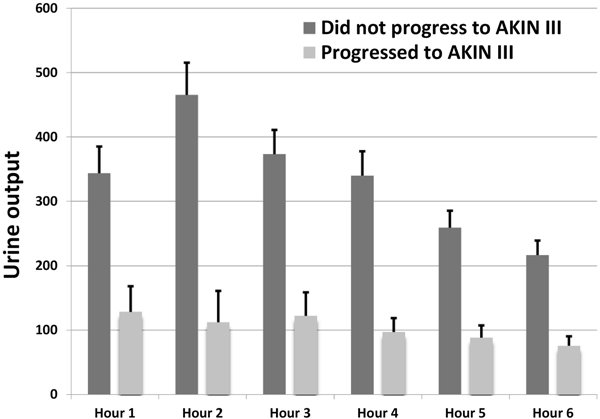
Results: We studied 92 critically ill patients. 23 patients progressed to stage III AKI and had significantly lower UFR (p < 0.0001). The UFR during the first 2 h was most predictive of progression to stage III AKI (AuROC = 0.87), with an ideal cut-off of less than 200mls, with a sensitivity of 73.9% and specificity of 90.0%.
Conclusion: In ICU patients without severe CKD with mild AKI, a UFR of less than 200mls in the first 2 h after an FST is predictive of progression to stage III AKI. Future studies should focus on incorporating a FST as part of a clinical decision tool for further management of critically ill patients with AKI.
Keywords: Acute kidney injury; Furosemide stress test; Intensive care unit.
Copyright © 2019 Elsevier Inc. All rights reserved.
Figures
References
-
- Brivet FG, Kleinknecht DJ, Loirat P, Landais PJ. Acute renal failure in intensive care units--causes, outcome, and prognostic factors of hospital mortality; a prospective, multicenter study. French Study Group on Acute Renal Failure. Crit Care Med. 1996;24(2):192–198. - PubMed
-
- Hou SH, Bushinsky DA, Wish JB, Cohen JJ, Harrington JT. Hospital-acquired renal insufficiency: a prospective study. Am J Med. 1983;74(2):243–248. - PubMed
-
- Hoste EA, Bagshaw SM, Bellomo R, et al. Epidemiology of acute kidney injury in critically ill patients: the multinational. Int Care Med. 2015;4(8)1411–23. - PubMed
-
- National Confidential Enquiry into Patient Outcome and Death. Adding Insult to Injury: A review of the care of patients who died in hospital with a primary diagnosis of acute kidney injury (acute renal failure). 2009. Available at https://www.ncepod.org.uk/2009report1/Downloads/AKI_report.pdf.
-
- Rewa O, Bagshaw SM. Acute kidney injury-epidemiology, outcomes and economics. Nat Rev Nephrol. 2014;10(4):193–207. - PubMed
Publication types
MeSH terms
Substances
Grants and funding
LinkOut - more resources
Full Text Sources
Other Literature Sources
Miscellaneous
