. 2019 Apr 28;24(9):1667.
doi: 10.3390/molecules24091667.

In Situ Incorporation of Diamino Silane Group into Waterborne Polyurethane for Enhancing Surface Hydrophobicity of Coating

Affiliations

In Situ Incorporation of Diamino Silane Group into Waterborne Polyurethane for Enhancing Surface Hydrophobicity of Coating

Jinghui Lyu et al. Molecules. .

Abstract

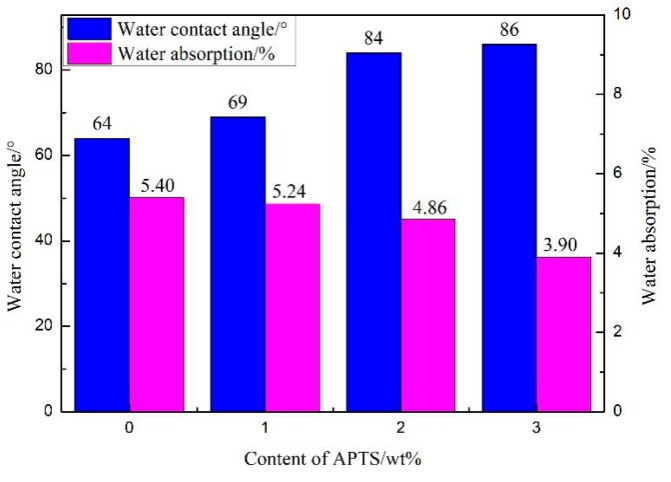
A series of waterborne polyurethanes (WPU) with crosslinked siloxane were obtained through introducing 3-(2-aminoethylamino)propyldimethoxymethylsilane (APTS) into WPU by in situ polymerization. The properties of WPU modified by APTS were studied through a variety of experimental methods. The water contact angle of the WPU coating surface increased from 64° to 86°, and the water resistance reduced to 3.90% when 3 wt% APTS was added, which improved the coating surface hydrophobicity. Firstly, Fourier transform infrared (FT-IR) and 1H-NMR spectra demonstrated the successful incorporation of APTS to polyurethanes and completed the hydrolytic condensation reaction-generated Si-O-Si crosslinking structure. Furthermore, the surface energy of the membrane was reduced when the crosslinking structure migrated and enriched on the surface of film. Besides, the crosslinking structure was abundant, and the distribution of siloxane in WPU was more uniform.

Keywords: APTS; cross-linked siloxane; waterborne polyurethane.


Conflict of interest statement

The authors declare no conflict of interest.

Figures
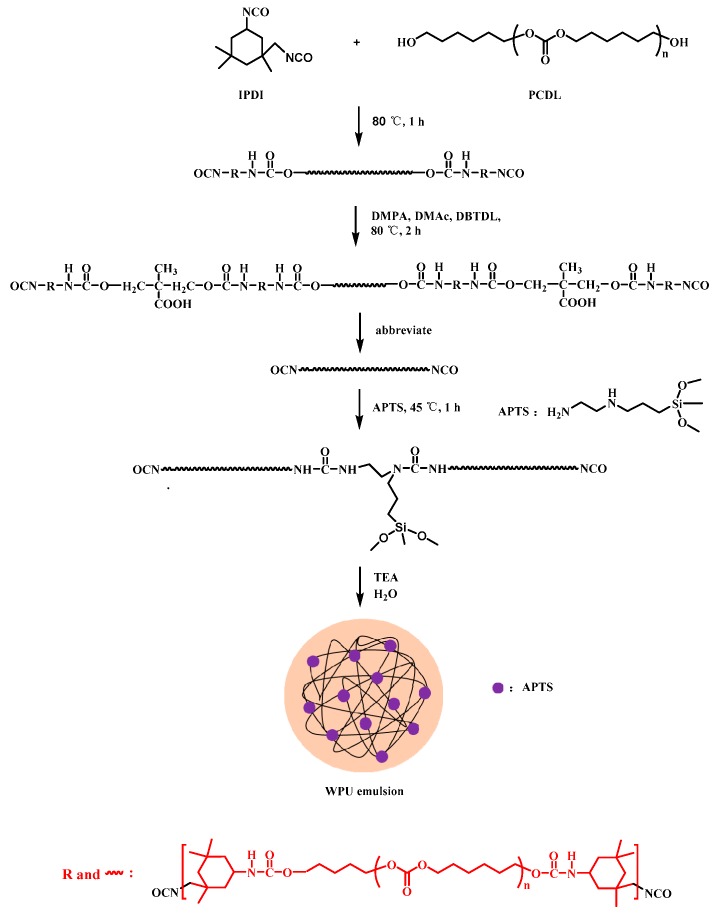
Figure 1
Figure 1
The synthesis process of waterborne polyurethanes (WPU) modified with APTS.
Figure 2
Figure 2
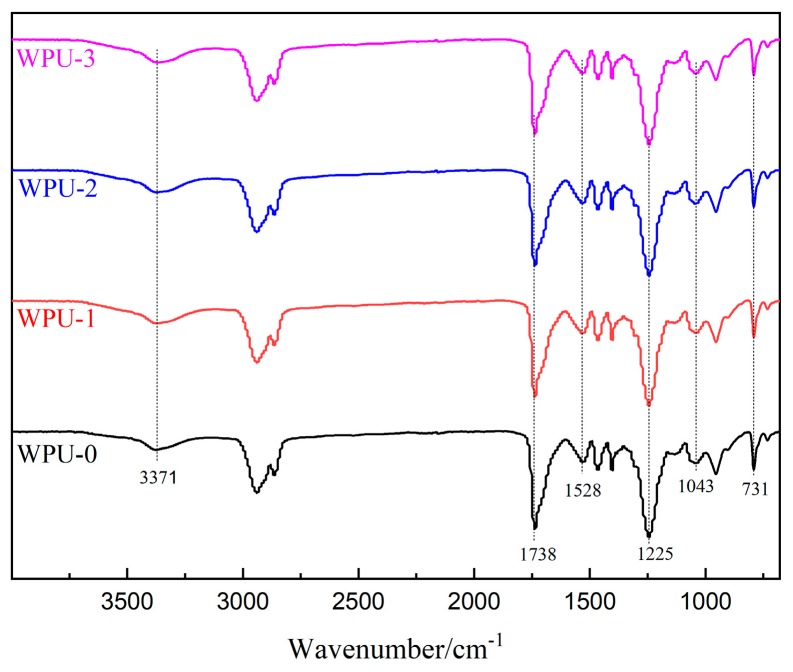
Infrared spectra of different WPU.
Figure 3
Figure 3
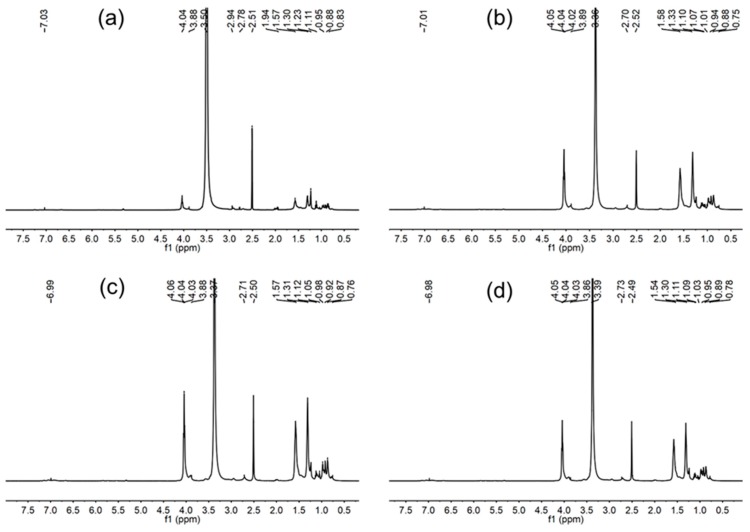
1H-NMR spectra of different WPU: (a) WPU-0; (b) WPU-1; (c) WPU-2; and (d) WPU-3.
Figure 4
Figure 4
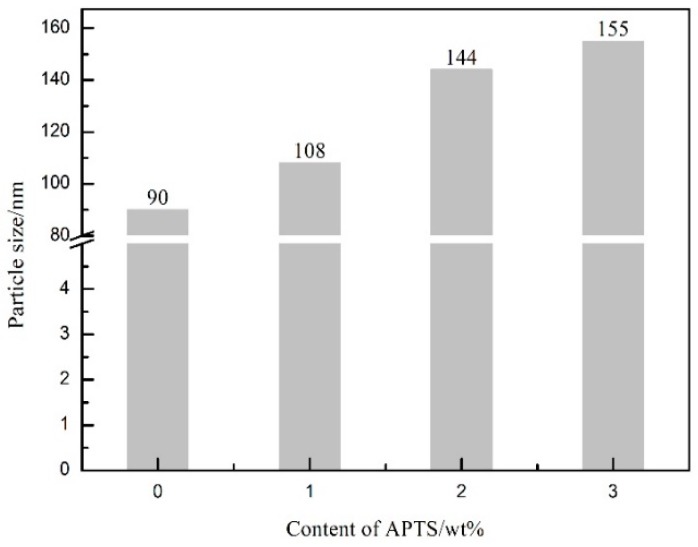
The average particle size of the different WPU emulsions.
Figure 5
Figure 5
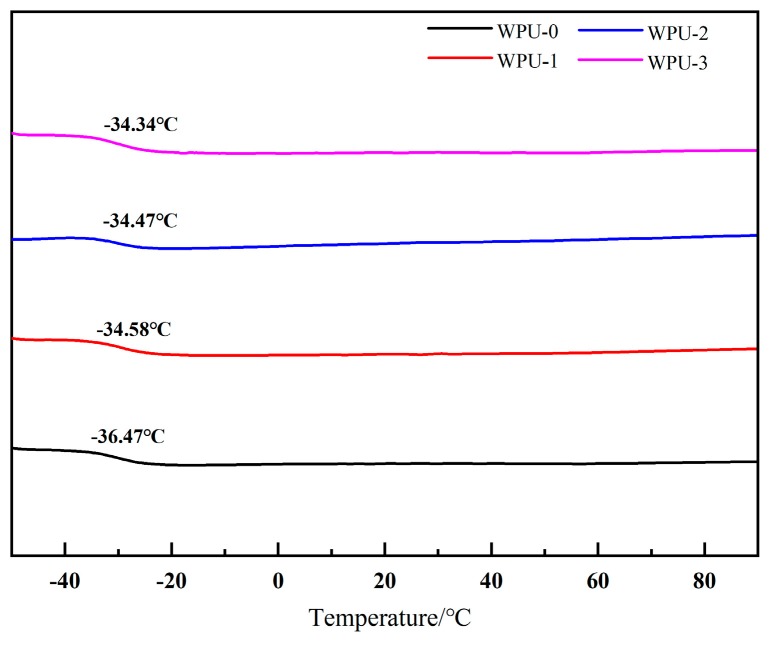
Differential scanning calorimetry (DSC) thermograms of WPU dispersions with different APTS contents.
Figure 6
Figure 6
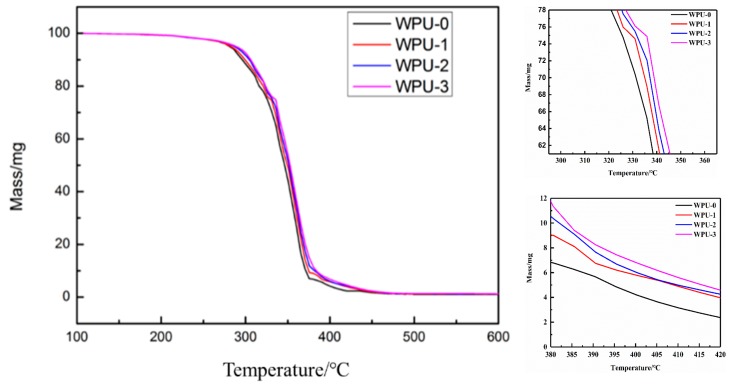
The TG curve of different WPU films.
Figure 7
Figure 7
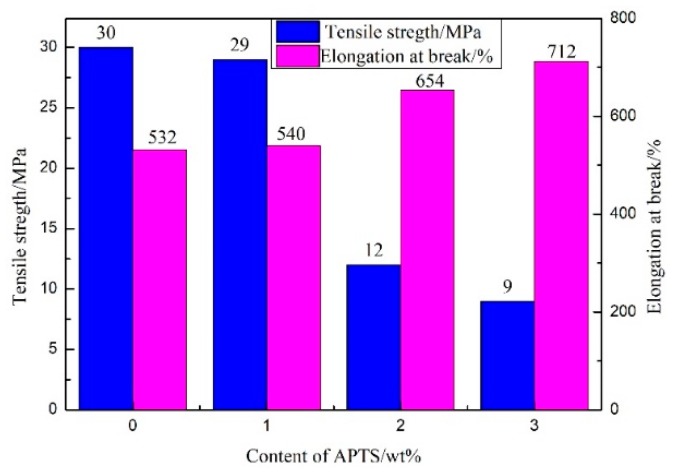
Effect of APTS on the mechanical properties of WPU films.
Figure 8
Figure 8
Water contact angles and water absorption of different WPU films.

References

    1. Feng J.Y., Wang X.C., Guo P.Y., Wang Y.J., Luo X.M. Mechanical Properties and Wear Resistance of Sulfonated Graphene/Waterborne Polyurethane Composites Prepared by In Situ Method. Polymers. 2018;10:75. doi: 10.3390/polym10010075. - DOI - PMC - PubMed
    1. Kang S.Y., Ji Z.X., Tseng L.F., Turner S.A., Villanueva D.A., Johnson R., Albano A., Langer R. Design and Synthesis of Waterborne Polyurethanes. Adv. Mater. 2018;30:1706237. doi: 10.1002/adma.201706237. - DOI - PubMed
    1. Yin X., Lin X.Y., Luo Y.J. Synthesis and Characterization of Multifunctional Two-Component Waterborne Polyurethane Coatings: Fluorescence, Thermostability and Flame Retardancy. Polymers. 2017;9:492. doi: 10.3390/polym9100492. - DOI - PMC - PubMed
    1. Wang F.F., Feng L.J., Li G.Z. Properties of Waterborne Polyurethane Conductive Coating with Low MWCNTs Content by Electrostatic Spraying. Polymers. 2018;10:1406. doi: 10.3390/polym10121406. - DOI - PMC - PubMed
    1. Chen H.B., Shen P., Chen M.J., Zhao H.B., Schiraldi D.A. Highly Efficient Flame Retardant Polyurethane Foam with Alginate/Clay Aerogel Coating. Appl. Mater. Inter. 2016;8:32557–32564. doi: 10.1021/acsami.6b11659. - DOI - PubMed

MeSH terms

LinkOut - more resources