Review
. 2019 Apr 26;8(5):384.
doi: 10.3390/cells8050384.

Protein Hydroxylation by Hypoxia-Inducible Factor (HIF) Hydroxylases: Unique or Ubiquitous?

Affiliations
Review

Protein Hydroxylation by Hypoxia-Inducible Factor (HIF) Hydroxylases: Unique or Ubiquitous?

Moritz J Strowitzki et al. Cells. .

Abstract

All metazoans that utilize molecular oxygen (O2) for metabolic purposes have the capacity to adapt to hypoxia, the condition that arises when O2 demand exceeds supply. This is mediated through activation of the hypoxia-inducible factor (HIF) pathway. At physiological oxygen levels (normoxia), HIF-prolyl hydroxylases (PHDs) hydroxylate proline residues on HIF-α subunits leading to their destabilization by promoting ubiquitination by the von-Hippel Lindau (VHL) ubiquitin ligase and subsequent proteasomal degradation. HIF-α transactivation is also repressed in an O2-dependent way due to asparaginyl hydroxylation by the factor-inhibiting HIF (FIH). In hypoxia, the O2-dependent hydroxylation of HIF-α subunits by PHDs and FIH is reduced, resulting in HIF-α accumulation, dimerization with HIF-β and migration into the nucleus to induce an adaptive transcriptional response. Although HIFs are the canonical substrates for PHD- and FIH-mediated protein hydroxylation, increasing evidence indicates that these hydroxylases may also have alternative targets. In addition to PHD-conferred alterations in protein stability, there is now evidence that hydroxylation can affect protein activity and protein/protein interactions for alternative substrates. PHDs can be pharmacologically inhibited by a new class of drugs termed prolyl hydroxylase inhibitors which have recently been approved for the treatment of anemia associated with chronic kidney disease. The identification of alternative targets of HIF hydroxylases is important in order to fully elucidate the pharmacology of hydroxylase inhibitors (PHI). Despite significant technical advances, screening, detection and verification of alternative functional targets for PHDs and FIH remain challenging. In this review, we discuss recently proposed non-HIF targets for PHDs and FIH and provide an overview of the techniques used to identify these.

Keywords: Cep192; FOXO3a; HIF-prolyl hydroxylases; IKK-β; MAPK6; OTUB1; RIPK4; factor inhibiting HIF; hypoxia; hypoxia-inducible factor; mass spectrometry; p105; p53; prolyl hydroxylation.


Conflict of interest statement

C.T.T. is a member of the Scientific Advisory Board of Akebia Therapeutics.

Figures

Figure 1
Figure 1
Schematic overview of the hypoxia-inducible pathway under normoxia (left) and hypoxia (right). Under normoxia, hypoxia-inducible factor (HIF) prolyl hydroxylases (PHD1–3) use oxygen (O2), iron (Fe2+), α-ketoglutarate (also known as 2-oxaloglutarate; (2-OG)) and ascorbic acid (vitamin C; not shown) as co-substrates to hydroxylate the HIF-1α subunits at two specific proline residues (human: Pro402 and 564) within the oxygen-dependent degradation domain (ODD), thus triggering recognition by the von Hippel-Lindau tumor suppressor protein (pVHL), which, as part of a E3 ubiquitin ligase complex (also containing elongin [Elo] C and B, cullin-2 [Cul-2] and RING-box protein [Rbx] 1), induces proteasomal degradation. HIF-1α hydroxylation by the factor-inhibiting HIF (FIH) at the asparagine residue (human: Asn803) additionally prevents binding of the transcriptional co-activator histone acetyltransferase p300/CREB-binding protein (p300/CBP) (left). In contrast, under hypoxia PHDs and FIH are unable to hydroxylate HIF-α subunits which accumulate and thus migrate to the nucleus, subsequently forming an HIF-complex with HIF-β subunits (right). Formed HIF-complexes bind to the DNA to induce numerous HIF target genes to counteract hypoxia (right).
Figure 2
Figure 2
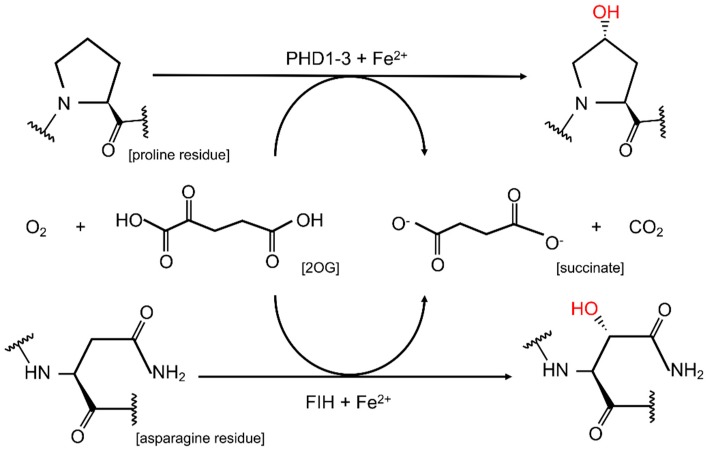
Enzymatic reaction of HIF-α subunits: HIF prolyl hydroxylases (PHD1-3) catalyze the hydroxylation of proline residues (upper panel) and factor inhibiting HIF (FIH) catalyzes the hydroxylation of asparagine residues (lower panel); both using oxygen (O2), iron (Fe2+), α-ketoglutarate (also known as 2-oxaloglutarate; 2-OG) and ascorbic acid (vitamin C; not shown) as co-substrates.
Figure 3
Figure 3
Overview of different techniques and methods to screen, detect and verify alternative targets and substrates of HIF prolyl hydroxylases (PHDs) and factor-inhibiting HIF (FIH).
Figure 4
Figure 4
Schematic overview of alternative targets other than HIF mediated by HIF prolyl hydroxylases (PHD) 1, 3 or factor inhibiting HIF (FIH). PHD1-mediated hydroxylation: Forkhead box O3a (FOXO3a), IκB kinase-β (IKKβ) and centrosomal protein 192 (Cep192). PHD1- and 3-mediated hydroxylation: Tumor suppressor protein 53 (p53). PHD3-mediated hydroxylation: Mitogen-activated protein kinase 6 (MAPK6). FIH-mediated hydroxylation: Ovarian tumor domain containing ubiquitin aldehyde binding protein 1 (OTUB1), NF-κB precursor (NFKB1; p105), IκBα and receptor interacting serine/threonine kinase 4 (RIPK4). PHD-mediated hydroxylation: Zinc fingers and homeoboxes 2 (ZHX2).

References

    1. Semenza G.L. Oxygen sensing, homeostasis, and disease. N. Engl. J. Med. 2011;365:537–547. doi: 10.1056/NEJMra1011165. - DOI - PubMed
    1. Zhang H., Gao P., Fukuda R., Kumar G., Krishnamachary B., Zeller K.I., Dang C.V., Semenza G.L. HIF-1 inhibits mitochondrial biogenesis and cellular respiration in VHL-deficient renal cell carcinoma by repression of C-MYC activity. Cancer Cell. 2007;11:407–420. doi: 10.1016/j.ccr.2007.04.001. - DOI - PubMed
    1. Semenza G.L. Involvement of oxygen-sensing pathways in physiologic and pathologic erythropoiesis. Blood. 2009;114:2015–2019. doi: 10.1182/blood-2009-05-189985. - DOI - PubMed
    1. Kaelin W.G., Ratcliffe P.J. Oxygen sensing by metazoans: The central role of the HIF hydroxylase pathway. Mol. Cell. 2008;30:393–402. doi: 10.1016/j.molcel.2008.04.009. - DOI - PubMed
    1. Cummins E.P., Keogh C.E., Crean D., Taylor C.T. The role of HIF in immunity and inflammation. Mol. Aspects Med. 2016;47–48:24–34. doi: 10.1016/j.mam.2015.12.004. - DOI - PubMed

Publication types

MeSH terms

Substances