. 2019 Apr 27;8(5):577.
doi: 10.3390/jcm8050577.

The IGF1 Receptor Is Involved in Follicle-Stimulating Hormone Signaling in Porcine Neonatal Sertoli Cells

Affiliations

The IGF1 Receptor Is Involved in Follicle-Stimulating Hormone Signaling in Porcine Neonatal Sertoli Cells

Rossella Cannarella et al. J Clin Med. .

Abstract

Experimental evidence has shown that the IGF1 receptor (IGF1R) is involved in testicular development during embryogenesis. More recently, data gathered from mice granulosa cells and zebrafish spermatogonia suggest that IGF1R has a role in Follicle-stimulating hormone (FSH) signaling. No evidence has been reported on this matter in Sertoli cells (SCs) so far. The aim of the study was to evaluate the role, if any, of the IGF1R in FSH signaling in SCs. The effects of FSH exposure on myosin-phosphatase 1 (MYPT1), ERK 1/2, AKT308, AKT473, c-Jun N-terminal kinase (JNK) phosphorylation and on anti-Müllerian hormone (AMH), inhibin B and FSH receptor (FSHR) mRNA levels were assessed with and without the IGF1R inhibitor NVP-AEW541 in purified and functional porcine neonatal SCs. Pre-treatment with NVP-AEW541 inhibited the FSH-induced MYPT1 and ERK 1/2 phosphorylation, decreased the FSH-dependent Protein kinase B (AKT)308 phosphorylation, but did not affect the FSH-induced AKT473 and JNK phosphorylation rate. It also interfered with the FSH-induced AMH and FSHR down-regulation. No influence was observed on the FSH-stimulated Inhibin B gene expression. Conclusion. These findings support the role of theIGF1R in FSH signaling in porcine SCs. The possible influence of IGF1 stimulation on the FSH-mediated effects on SCs should be further explored.

Keywords: Follicle-stimulating hormone; Insulin-like growth factor 1; Insulin-like growth factor 1 receptor; Sertoli cells; infertility.


Conflict of interest statement

The authors declare no conflict of interest.

Figures
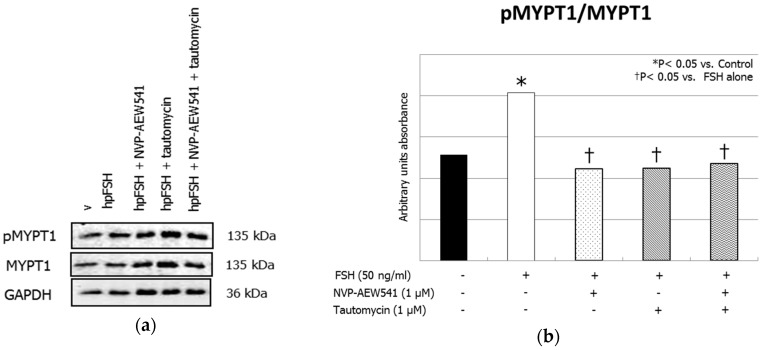
Figure 1
Figure 1
Insulin-like growth factor 1 receptor (IGF1R) is required for the Follicle-stimulating hormone (FSH)-induced myosin-phosphatase 1 (MYPT1) phosphorylation. (a) Immunoblots and (b) densitometric analysis of phosphorilated myosin-phosphatase 1 (pMYPT1), MYPT1 and Glyceraldehyde-3-Phosphate Dehydrogenase (GADPH) from Sertoli cells alone (control), or incubated with hpFSH alone or pre-treated with the IGF1R inhibitor NVP-AEW541 and/or protein phosphatase 1ß (PP1ß) inhibitor tautomycin and then incubated with hpFSH. Data represent the mean ± standard error of the mean (SEM) (* p < 0.05 vs. controls and † p < 0.05 vs. FSH treatment alone) (one-way ANOVA) of three independent experiments, each performed in triplicate.
Figure 2
Figure 2
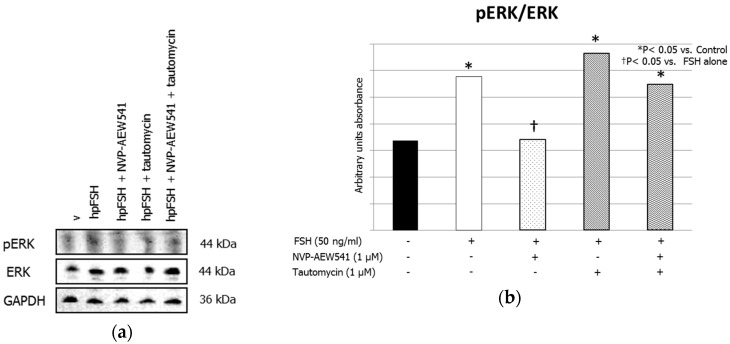
IGF1R is required for the FSH-induced extracellular-signal-regulated kinase (ERK) 1/2 phosphorylation. (a) Immunoblots and (b) densitometric analysis of the protein bands of pERK1/2, ERK1/2 and Glyceraldehyde-3-Phosphate Dehydrogenase (GADPH) from SCs alone (control) or incubated with hpFSH alone or pre-treated with the IGF1R inhibitor NVP-AEW541 and/or PP1ß inhibitor tautomycin and then incubated with hpFSH. Data represent the mean ± SEM (* p < 0.05 vs. controls and † p < 0.05 vs. FSH treatment alone) (one-way ANOVA) of three independent experiments, each performed in triplicate.
Figure 3
Figure 3
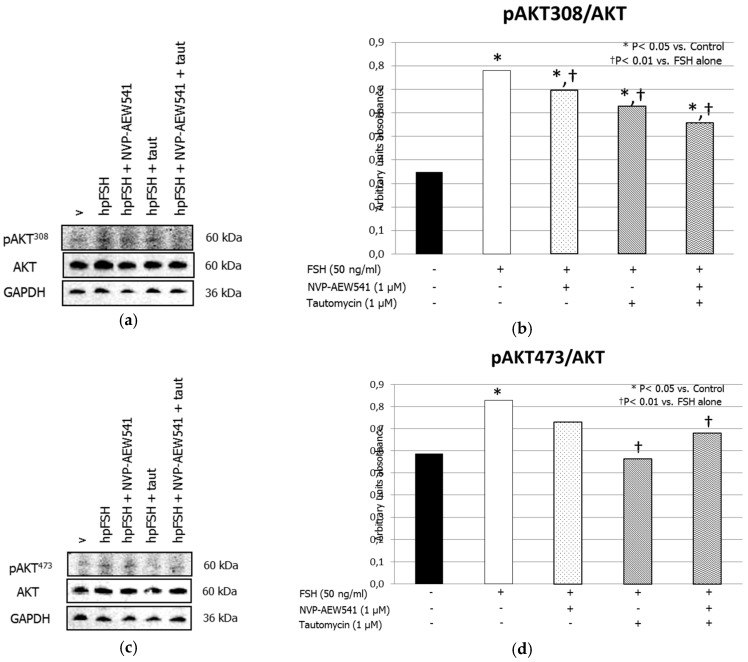
IGF1R is involved in the FSH-induced Protein kinase B (AKT) (Thr308) phosphorylation. (a) Immunoblots and (b) densitometric analysis of the protein bands of pAKT308, AKT and GADPH and (c) Immunoblots and (d) densitometric analysis of the protein bands of pAKT473, AKT and GADPH from SCs alone (control), or incubated with hpFSH alone or pre-treated with the IGF1R inhibitor NVP-AEW541 and/or PP1ß inhibitor tautomycin and then incubated with hpFSH. Data represent the mean ± SEM (* p < 0.05 vs. control and † p < 0.01 vs. FSH treatment alone) (one-way ANOVA) of three independent experiments, each performed in triplicate.
Figure 4
Figure 4
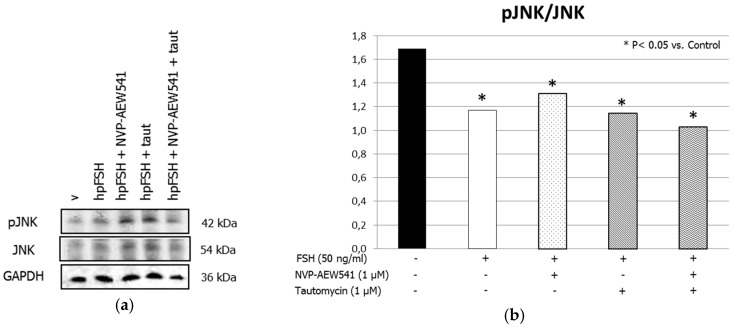
IGF1R does not influence the FSH-induced JNK (Thr18/Tyr185, Thr221/Tyr223) dephosphorylation. (a) Immunoblots and (b) densitometric analysis of the protein bands of pJNK, JNK and GADPH from SCs alone (control), or incubated with hpFSH alone or pre-treated with the IGF1R inhibitor NVP-AEW541 and/or PP1ß inhibitor tautomycin and then incubated with hpFSH. Data represent the mean ± SEM (* p < 0.05 vs. control) (one-way ANOVA) of three independent experiments, each performed in triplicate.
Figure 5
Figure 5
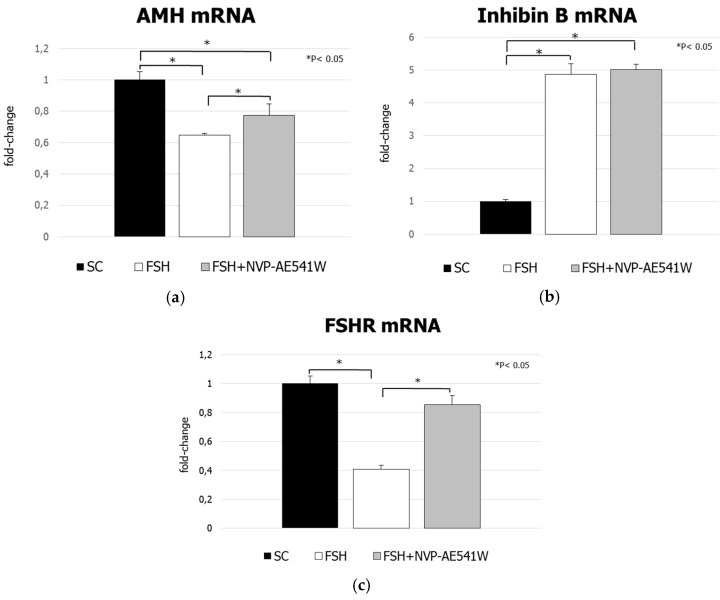
Reverse transcription polymerase chain reaction analysis of (a) anti-Müllerian hormone, (b) inhibin B and (c) FSHR gene expression. Data represent the mean ± SD (* p < 0.05 vs. control or FSH treatment) (one-way ANOVA) of three independent experiments, each performed in triplicate.

References

    1. Themmen A.P.N., Huhtaniemi I.T. Mutations of gonadotropins and gonadotropin receptors: Elucidating the physiology and pathophysiology of pituitary-gonadal function. Endocr. Rev. 2000;21:551–583. doi: 10.1210/edrv.21.5.0409. - DOI - PubMed
    1. Gloaguen P., Crépieux P., Heitzler D., Poupon A., Reiter E. Mapping the follicle-stimulating hormone-induced signaling networks. Front. Endocrinol. 2011;2:45. doi: 10.3389/fendo.2011.00045. - DOI - PMC - PubMed
    1. Cannarella R., Condorelli R.A., La Vignera S., Calogero A.E. Effects of the insulin-like growth factor system on testicular differentiation and function: A review of the literature. Andrology. 2018;6:3–9. doi: 10.1111/andr.12444. - DOI - PubMed
    1. Nef S., Verma-Kurvari S., Merenmies J., Vassalli J.D., Efstratiadis A., Accili D., Parada L.F. Testis determination requires insulin receptor family function in mice. Nature. 2003;426:291–295. doi: 10.1038/nature02059. - DOI - PubMed
    1. Pitetti J.L., Calvel P., Zimmermann C., Conne B., Papaioannou M.D., Aubry F., Cederroth C.R., Urner F., Fumel B., Crausaz M., et al. An essential role for insulin and IGF1 receptors in regulating sertoli cell proliferation, testis size, and FSH action in mice. Mol. Endocrinol. 2013;27:814–827. doi: 10.1210/me.2012-1258. - DOI - PMC - PubMed