


Flavonoids and the Risk of Gastric Cancer: An Exploratory Case-Control Study in the MCC-Spain Study
- PMID: 31035601
- PMCID: PMC6566880
- DOI: 10.3390/nu11050967
Flavonoids and the Risk of Gastric Cancer: An Exploratory Case-Control Study in the MCC-Spain Study
Abstract
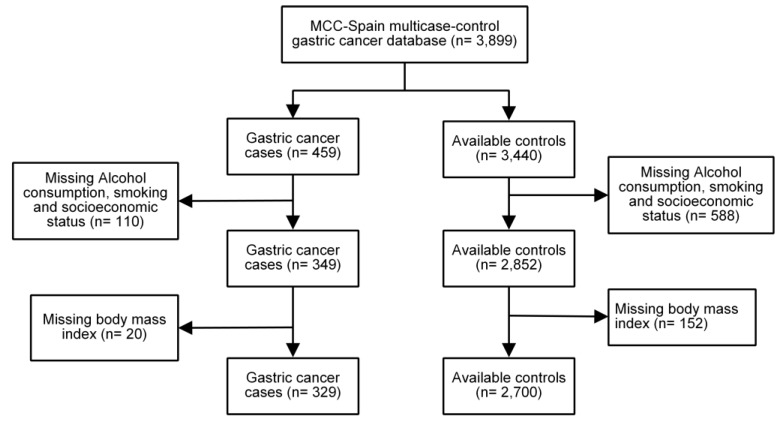
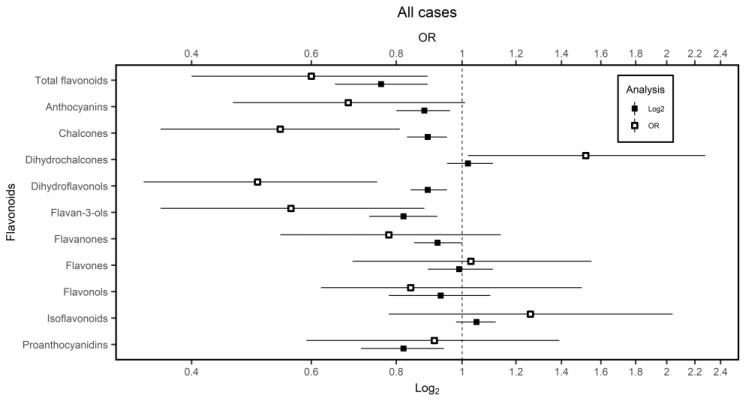
Several epidemiological studies have investigated the association between the dietary flavonoid intake and gastric cancer (GC) risk; however, the results remain inconclusive. Investigating the relationship between the different classes of flavonoids and the histological types and origin of GC can be of interest to the research community. We used data from a population-based multi-case control study (MCC-Spain) obtained from 12 different regions of Spain. 2700 controls and 329 GC cases were included in this study. Odds ratios (ORs) were calculated using the mixed effects logistic regression considering quartiles of flavonoid intakes and log2. Flavonoid intake was associated with a lower GC risk (ORlog2 = 0.76; 95% CI = 0.65-0.89; ORq4vsq1 = 0.60; 95%CI = 0.40-0.89; ptrend = 0.007). Inverse and statistically significant associations were observed with anthocyanidins, chalcones, dihydroflavonols and flavan-3-ols. The isoflavanoid intake was positively associated with higher cancer risk, but without reaching a statistical significance. In general, no differences were observed in the GC risk according to the location and histological type. The flavonoid intake seems to be a protective factor against GC within the MCC-study. This effect may vary depending on the flavonoid class but not by the histological type and location of the tumor. Broader studies with larger sample size and greater geographical variability are necessary.
Keywords: MCC-Spain; case-control study; flavonoids; gastric cancer; intake.
Conflict of interest statement
The authors declare no conflict of interest.
Figures
References
-
- Diet, Nutrition, Physical Activity and Cancer: A Global Perspective. [(accessed on 24 December 2018)]; Available online: https://www.wcrf.org/sites/default/files/Summary-third-expert-report.pdf.
-
- Allemani C., Matsuda T., Di Carlo V., Harewood R., Matz M., Niksic M., Bonaventure A., Valkov M., Johnson C.J., Esteve J., et al. Global surveillance of trends in cancer survival 2000-14 (concord-3): Analysis of individual records for 37 513 025 patients diagnosed with one of 18 cancers from 322 population-based registries in 71 countries. Lancet. 2018;391:1023–1075. doi: 10.1016/S0140-6736(17)33326-3. - DOI - PMC - PubMed
-
- van Duijnhoven F.J., Bueno-De-Mesquita H.B., Ferrari P., Jenab M., Boshuizen H.C., Ros M.M., Casagrande C., Tjonneland A., Olsen A., Overvad K., et al. Fruit, vegetables, and colorectal cancer risk: The european prospective investigation into cancer and nutrition. Am. J. Clin. Nutr. 2009;89:1441–1452. doi: 10.3945/ajcn.2008.27120. - DOI - PubMed
