


Reducing Inequities in Early Childhood Mental Health: How Might the Neighborhood Built Environment Help Close the Gap? A Systematic Search and Critical Review
- PMID: 31035699
- PMCID: PMC6540328
- DOI: 10.3390/ijerph16091516
Reducing Inequities in Early Childhood Mental Health: How Might the Neighborhood Built Environment Help Close the Gap? A Systematic Search and Critical Review
Abstract
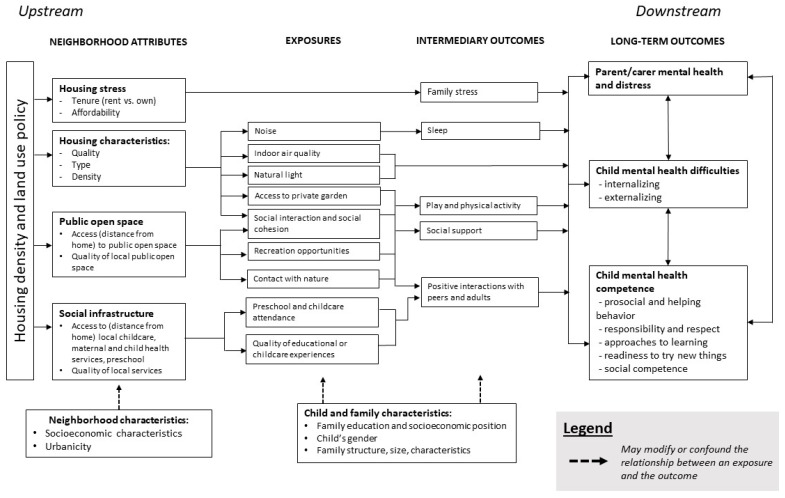
Background: Optimal mental health in early childhood is key to later mental health, physical health, education, and social outcomes; yet, children facing disadvantage tend to have worse mental health and fewer opportunities to develop this foundation. An emerging body of research shows that neighborhoods provide important opportunities for the development of children's mental health. Synthesizing this evidence can advance understandings of the features of the neighborhood built environment (e.g., housing, parks) that (1) promote optimal mental health in childhood and (2) reduce mental health inequities.
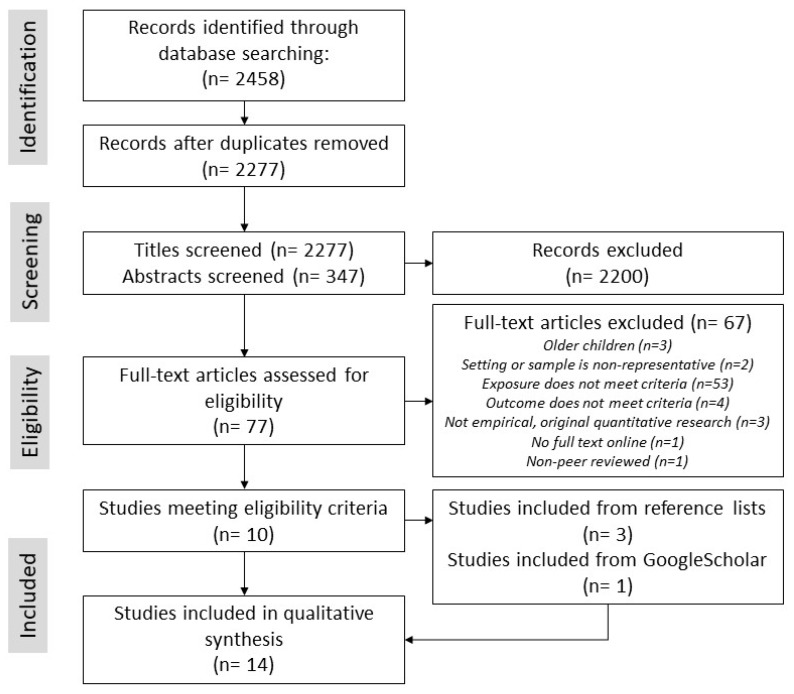
Methods: We systematically searched and critically reviewed the international quantitative literature investigating associations between the neighborhood built environment and young children's mental health.
Results: 14 articles met inclusion criteria; most examined nature or public open space. Studies tended to find greater access to or quantity of neighborhood nature or public open space were associated with better mental health. Significant gaps included a lack of studies investigating social infrastructure, and few studies examined how the built environment related to positive mental health (i.e., functioning, rather than problems).
Conclusions: Current evidence suggests there is some relationship, but additional research is needed that addresses these gaps and examines differences in associations between child subgroups (e.g., diverse socioeconomic backgrounds).
Keywords: children; health inequalities; mental health; neighborhood effects; social determinants; socio-ecological model; urban planning.
Conflict of interest statement
HB is a Guest Co-Editor of this IJERPH Special Issue.
Figures
References
-
- WHO Fact File: 10 Facts on Mental Health. [(accessed on 28 April 2019)]; Available online: https://www.who.int/features/factfiles/mental_health/mental_health_facts...
-
- Social Determinants of Health (CSDH) Closing the Gap in a Generation. World Health Organization (WHO); Geneva, Switzerland: 2008.
Publication types
MeSH terms
LinkOut - more resources
Full Text Sources
Medical
Miscellaneous
