


Selecting, refining and identifying priority Cochrane Reviews in health communication and participation in partnership with consumers and other stakeholders
- PMID: 31036016
- PMCID: PMC6489310
- DOI: 10.1186/s12961-019-0444-z
Selecting, refining and identifying priority Cochrane Reviews in health communication and participation in partnership with consumers and other stakeholders
Abstract
Background: Priority-setting partnerships between researchers and stakeholders (meaning consumers, health professionals and health decision-makers) may improve research relevance and value. The Cochrane Consumers and Communication Group (CCCG) publishes systematic reviews in 'health communication and participation', which includes concepts such as shared decision-making, patient-centred care and health literacy. We aimed to select and refine priority topics for systematic reviews in health communication and participation, and use these to identify five priority CCCG Cochrane Reviews.
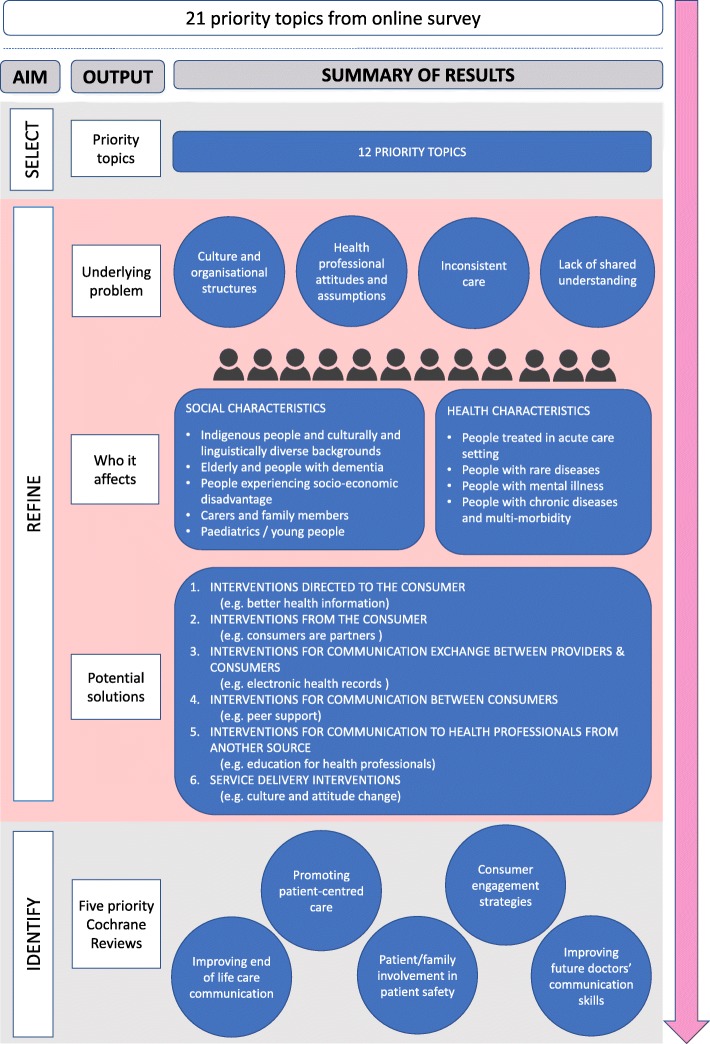
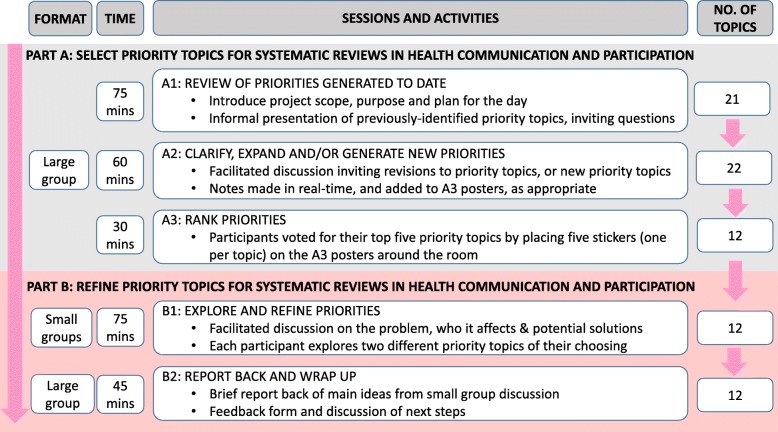
Methods: Twenty-eight participants (14 consumers, 14 health professionals/decision-makers) attended a 1-day workshop in Australia. Using large-group activities and voting, participants discussed, revised and then selected 12 priority topics from a list of 21 previously identified topics. In mixed small groups, participants refined these topics, exploring underlying problems, who they affect and potential solutions. Thematic analysis identified cross-cutting themes, in addition to key populations and potential interventions for future Cochrane Reviews. We mapped these against CCCG's existing review portfolio to identify five priority reviews.
Results: Priority topics included poor understanding and implementation of patient-centred care by health services, the fact that health information can be a low priority for health professionals, communication and coordination breakdowns in health services, and inadequate consumer involvement in health service design. The four themes underpinning the topics were culture and organisational structures, health professional attitudes and assumptions, inconsistent experiences of care, and lack of shared understanding in the sector. Key populations for future reviews were described in terms of social health characteristics (e.g. people from indigenous or culturally and linguistically diverse backgrounds, elderly people, and people experiencing socioeconomic disadvantage) more than individual health characteristics. Potential interventions included health professional education, interventions to change health service/health professional culture and attitudes, and health service policies and standards. The resulting five priority Cochrane Reviews identified were improving end-of-life care communication, patient/family involvement in patient safety, improving future doctors' communication skills, consumer engagement strategies, and promoting patient-centred care.
Conclusions: Stakeholders identified priority topics for systematic reviews associated with structural and cultural challenges underlying health communication and participation, and were concerned that issues of equity be addressed. Priority-setting with stakeholders presents opportunities and challenges for review producers.
Keywords: Health communication; community participation; decision-making; health priorities; patient participation; patient-centred care.
Conflict of interest statement
Ethics approval and consent to participate
We received approval from La Trobe University Science, Health and Engineering College Human Ethics Sub-Committee (S15–52) and all participants provided written consent.
Consent for publication
Participants provided consent for the information they shared as part of this study, including anonymised direct quotes, to be included in publications.
Competing interests
The authors declare that they have no competing interests. PB is an Associate Editor of
Publisher’s Note
Springer Nature remains neutral with regard to jurisdictional claims in published maps and institutional affiliations.
Figures
References
-
- National Health and Medical Research Council and Consumers Health Forum of Australia. Statement on Consumer and Community Involvement in Health and Medical Research. Canberra: NHMRC; 2016.
MeSH terms
Grants and funding
LinkOut - more resources
Full Text Sources
