


Hyperkinetic Movement Disorders in Children: A Brief Review
- PMID: 31037073
- PMCID: PMC6451853
Hyperkinetic Movement Disorders in Children: A Brief Review
Abstract
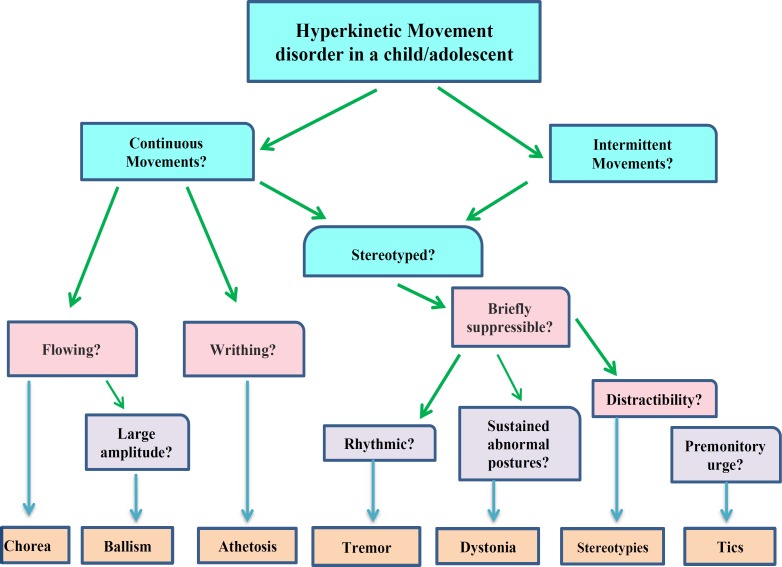
Movement disorders are common neurologic disturbances in childhood. There are two major types of movement disorders. Hypokinetic disorders are with paucity of voluntary movements and are very uncommon in pediatric age group. Hyperkinetic movement abnormalities are very common in children and defined as abnormal repetitive involuntary movements. Movement disorders in childhood and even in adolescents are different in etiology, timing, treatment and prognosis versus adulthood movement abnormalities. In this brief article, we reviewed common types of hyperkinetic abnormal movements in children and adolescents with emphasis on etiologies, new classifications and recent treatment strategies.
Keywords: Children; Hyperkinetic; Movement disorders; Pediatrics.
Conflict of interest statement
The authors declare that there is no conflict of interest.
Figures
References
-
- Saunders-Pullman R, Braun I, Bressman S. Pediatric movement disorders. Child Adolesc Psychiatr Clin North Am. 1999;8:747–65. - PubMed
-
- Singer HS, Mink JW, Gilbert DL, et al. Movement Disorders in Childhood, second ed. London: Academic Press; 2016.
-
- Dale RC, Singh H, Troedson C, Pillai S, Gaikiwari S, Kozlowska K. A prospective study of acute movement disorders in children. Dev Med Child Neurol. 2010;52(8):739–748. - PubMed
-
- Cardoso F, Seppi K, Mair KJ, Wenning GK, Poewe W. Seminar on choreas. Lancet Neurol. 2006:5:589–602. - PubMed
Publication types
LinkOut - more resources
Full Text Sources