One-Time Fecal Immunochemical Screening for Advanced Colorectal Neoplasia in Patients with CKD (DETECT Study)
- PMID: 31040191
- PMCID: PMC6551781
- DOI: 10.1681/ASN.2018121232
One-Time Fecal Immunochemical Screening for Advanced Colorectal Neoplasia in Patients with CKD (DETECT Study)
Abstract
Background: In patients with CKD, the risk of developing colorectal cancer is high and outcomes are poor. Screening using fecal immunochemical testing (FIT) is effective in reducing mortality from colorectal cancer, but performance characteristics of FIT in CKD are unknown.
Methods: To determine the detection rates and performance characteristics of FIT for advanced colorectal neoplasia (ACN) in patients with CKD, we used FIT to prospectively screen patients aged 35-74 years with CKD (stages 3-5 CKD, dialysis, and renal transplant) from 11 sites in Australia, New Zealand, Canada, and Spain. All participants received clinical follow-up at 2 years. We used a two-step reference standard approach to estimate disease status.
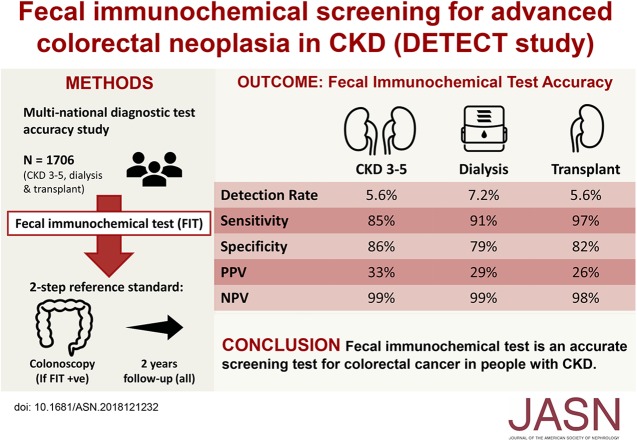
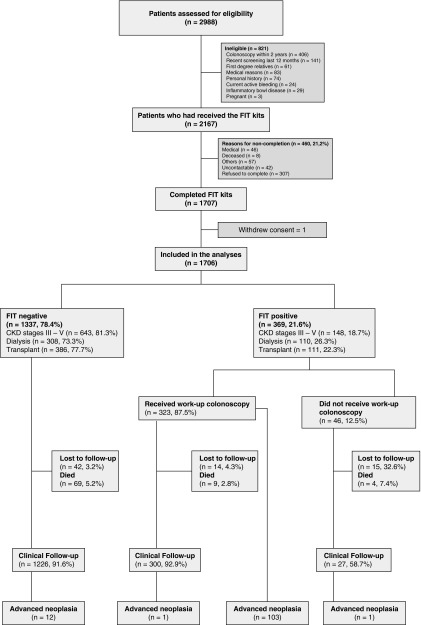
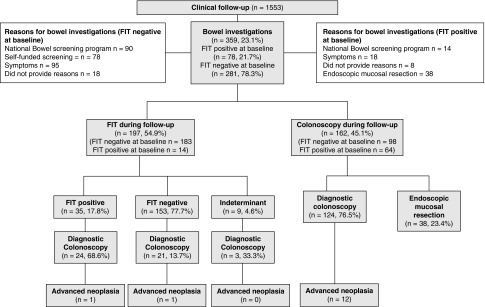
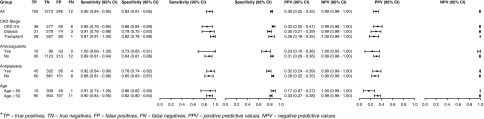
Results: Overall, 369 out of 1706 patients who completed FIT (21.6%) tested positive; 323 (87.5%) underwent colonoscopies. A total of 1553 (91.0%) completed follow-up; 82 (4.8%) had died and 71 (4.2%) were lost. The detection rate of ACN using FIT was 6.0% (5.6%, 7.4%, and 5.6% for stages 3-5 CKD, dialysis, and transplant). Sensitivity, specificity, and positive and negative predictive values of FIT for ACN were 0.90, 0.83, 0.30, and 0.99, respectively. Of participants who underwent colonoscopy, five (1.5%) experienced major colonoscopy-related complications, including bowel perforation and major bleeding.
Conclusions: FIT appears to be an accurate screening test for patients with CKD, such that a negative test may rule out the diagnosis of colorectal cancer within 2 years. However, the risk of major complications from work-up colonoscopy are at least ten-fold higher than in the general population.
Keywords: cancer; chronic kidney disease; screening; test performance.
Copyright © 2019 by the American Society of Nephrology.
Figures
Comment in
-
Fecal Immunochemical Screening for Advanced Colorectal Neoplasia in Patients with CKD: Accurate or Not?J Am Soc Nephrol. 2019 Nov;30(11):2275. doi: 10.1681/ASN.2019070710. Epub 2019 Oct 9. J Am Soc Nephrol. 2019. PMID: 31597716 Free PMC article. No abstract available.
References
-
- Vajdic CM, McDonald SP, McCredie MR, van Leeuwen MT, Stewart JH, Law M, et al.: Cancer incidence before and after kidney transplantation. JAMA 296: 2823–2831, 2006 - PubMed
-
- Webster AC, Craig JC, Simpson JM, Jones MP, Chapman JR: Identifying high risk groups and quantifying absolute risk of cancer after kidney transplantation: A cohort study of 15,183 recipients. Am J Transplant 7: 2140–2151, 2007 - PubMed
-
- Iff S, Craig JC, Turner R, Chapman JR, Wang JJ, Mitchell P, et al.: Reduced estimated GFR and cancer mortality. Am J Kidney Dis 63: 23–30, 2014 - PubMed
Publication types
MeSH terms
LinkOut - more resources
Full Text Sources
Medical