. 2019 Apr 30;10(2):e00388-19.
doi: 10.1128/mBio.00388-19.

Isolation and Characterization of Live Yeast Cells from Ancient Vessels as a Tool in Bio-Archaeology

Affiliations

Isolation and Characterization of Live Yeast Cells from Ancient Vessels as a Tool in Bio-Archaeology

Tzemach Aouizerat et al. mBio. .

Abstract

Ancient fermented food has been studied based on recipes, residue analysis, and ancient-DNA techniques and reconstructed using modern domesticated yeast. Here, we present a novel approach based on our hypothesis that enriched yeast populations in fermented beverages could have become the dominant species in storage vessels and their descendants could be isolated and studied today. We developed a pipeline of yeast isolation from clay vessels and screened for yeast cells in beverage-related and non-beverage-related ancient vessels and sediments from several archaeological sites. We found that yeast cells could be successfully isolated specifically from clay containers of fermented beverages. The findings that genotypically the isolated yeasts are similar to those found in traditional African beverages and phenotypically they grow similar to modern beer-producing yeast strongly suggest that they are descendants of the original fermenting yeast. These results demonstrate that modern microorganisms can serve as a new tool in bio-archaeology research.IMPORTANCE So far, most of the study of ancient organisms has been based mainly on the analysis of ancient DNA. Here we show that it is possible to isolate and study microorganisms-yeast in this case-from ancient pottery vessels used for fermentation. We demonstrate that it is highly likely that these cells are descendants of the original yeast strains that participated in the fermentation process and were absorbed into the clay matrix of the pottery vessels. Moreover, we characterized the isolated yeast strains, their genomes, and the beer they produced. These results open new and exciting avenues in the study of domesticated microorganisms and contribute significantly to the fields of bio- and experimental archaeology that aim to reconstruct ancient artifacts and products.

Keywords: ancient fermented food and beverages; ancient pottery vessels; beer; bio-archaeology; experimental archaeology; yeasts.


Figures

FIG 1
FIG 1
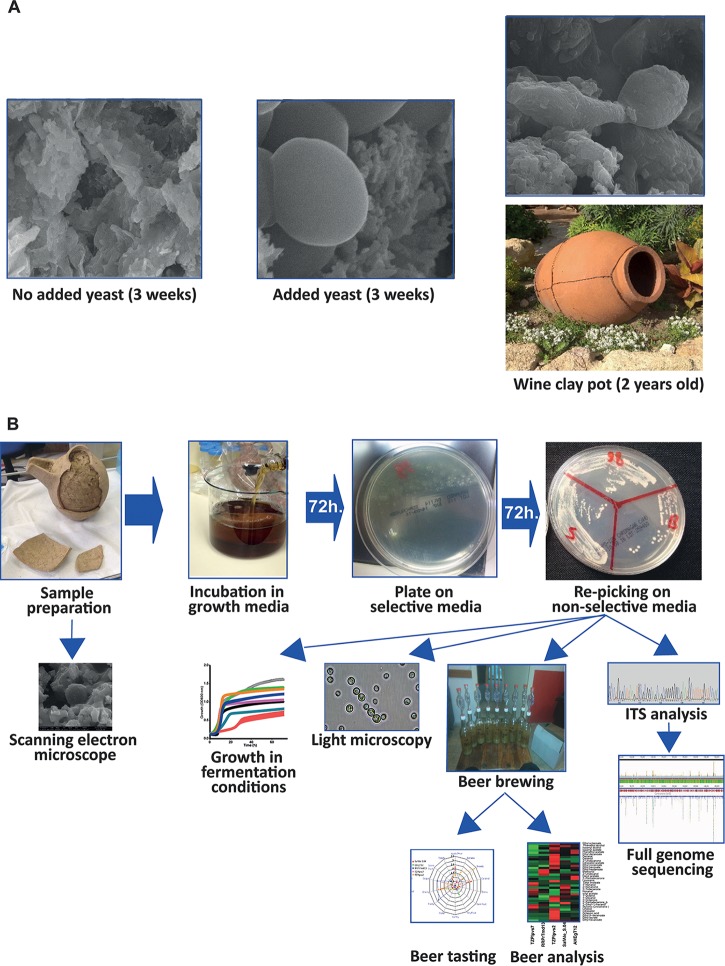
Isolation of yeast from clay vessels. (A) Yeast strains in clay vessels. Scanning electron microscope (SEM) pictures of the inside of a modern clay vessel buried in the ground for 3 weeks without beer (left panel) and presoaked with unfiltered beer (middle panel) prior to burial. On the right panel is a 2-year out-of-use wine clay vessel (bottom) that yielded live yeast cells, observed as colonies and by electron microscopy (EM [upper panel]). Yeast cells were only successfully isolated from the last two vessels. (B) The pipeline of yeast isolation and characterization from vessels. Putative fermented beverage-containing vessels were carefully dismantled. Small pieces were sent for scanning electron microscopy (SEM), and the rest were incubated in growth medium (YPD) for 72 h at room temperature. Samples were plated on selective plates with antibiotics to eliminate bacteria. After 72 h, yeast colonies appeared and were regrown on new plates. The yeast strains were taken for various analyses, including full-genome sequencing and comparison of growth under fermentation-related conditions in beer wort. In addition, beer was brewed according to a standard recipe using the isolated yeast strains. The presence of aromatic and flavor compounds in the beers was analyzed quantitatively, and their flavor was qualitatively evaluated by specialized beer tasters.
FIG 2
FIG 2
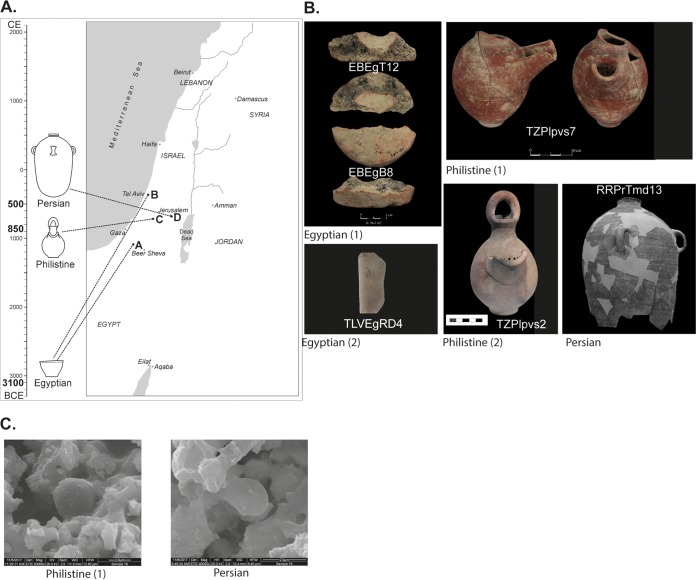
Ancient vessels that putatively contained fermented beverage and were used for yeast isolation. (A) A map and timeline of the archaeological sites from which the vessels yielding fermenting yeast strains were excavated. (B) Photographs of the vessels. The white text indicates the name of the yeast strain isolated, and the text below the photographs denotes the archaeological culture with which the vessels are associated. (C) Representative SEM image of vessels with “yeast-like” structures (compared to Fig. 1A).
FIG 3
FIG 3
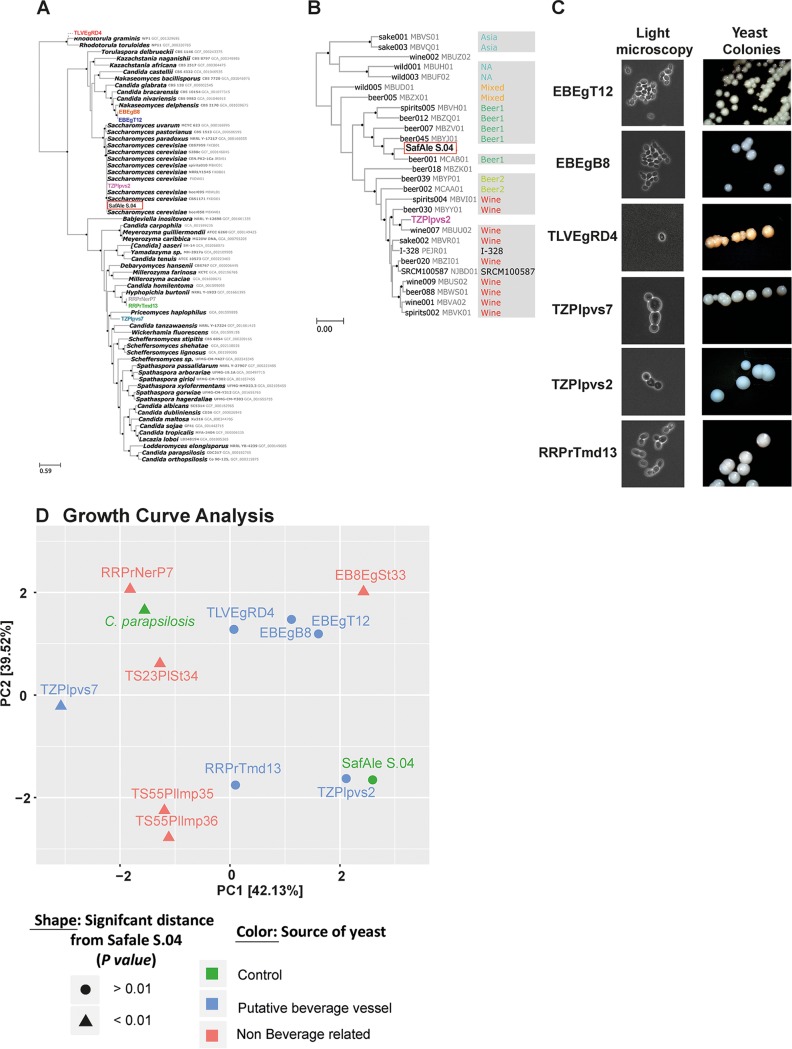
Genotypic and phenotypic characterization of yeast strains isolated from ancient vessels. (A and B) Phylogenetic trees based on full-genome sequencing of the isolated yeast strains. Black bullets at nodes represent maximal bootstrap percentage of node support. The newly isolated strains are in color. The modern beer yeast species Saccharomyces cerevisiae (SafAle S.04), which served as a control, is surrounded by a red box. (A) A list of 118 gene partitions and a representation of the combination Saccharomycetaceae plus Debaryomycetaceae. (B) Comparison of TZPlpvs2 (in purple) to modern wine and beer strains, based on 465 gene representatives and partitioning of Saccharomyces cerevisiae. Reference strains are denoted by NCBI strain name and accession number followed by clade affiliation (41). (C) The shape of the isolated yeast cells under light microscopy (left panel) and colonies on YPD agar plates (right panel). (D) Growth curve analysis. The yeast strain isolated from putative beverage vessels grows in beer wort with similar kinetics to a modern beer yeast. Principal-component analysis (PCA) of the distances of the growth curves of yeast grown in beer wort under fermentation-related conditions was performed (Fig. S3). The modern domesticated beer yeast strain SafAle S.04 served as a positive control, and the pathogenic yeast C. parapsilosis served as a negative control. The marker’s shape denotes the statistical significance of the distance from SafAle S.04 growth curve kinetics, and the color denotes the source of the yeast: control, putative beverage container, or non-beverage-related vessel.
FIG 4
FIG 4
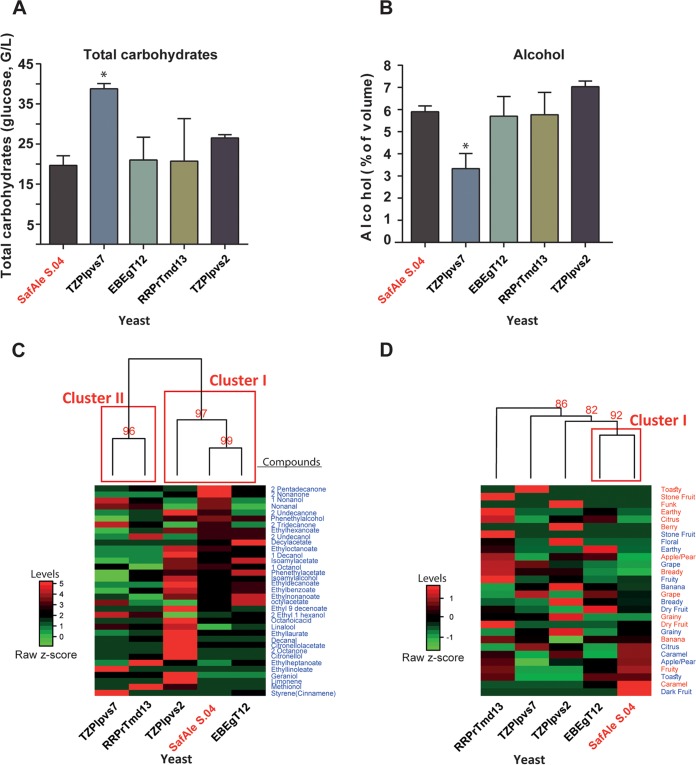
Characterization of reconstructed beer produced by yeast strains isolated from ancient vessels. Beer was brewed with the yeast strains isolated according to a standard brewing recipe. The modern beer yeast strain S. cerevisiae (SafAle S.04) served as a positive control. (A) Levels of total carbohydrates in the beers (as glucose). (B) Amount of alcohol produced. (C) Heat map of clustered levels of aromatic and flavor compounds found in the beer. The levels of various compounds were normalized as a percentage of the highest value for each compound. (D) Heat map of clustered samples based on parameters of beer tasting of aromas (red text) and flavors (blue text) (see also Fig. S4 in the supplemental material). In both panels C and D, the clustering was performed using Ward’s method with Euclidean distances. In the red text are the approximated unbiased (AU) P values in percentages of the nodes. The red squares denote clusters with P values of >95%.

Comment in

References

    1. Callahan E. 1999. What is experimental archaeology?, p 4–6. In Westcott D. (ed), Primitive technology: a book of earth skills. Gibbs Smith, Layton, UT.
    1. Ingersoll D, Yellen JE, Macdonald W, Yellen J. 1977. Experimental archeology. Columbia University Press, New York, NY.
    1. Legras JL, Merdinoglu D, Cornuet J, Karst F. 2007. Bread, beer and wine: Saccharomyces cerevisiae diversity reflects human history. Mol Ecol 16:2091–2102. doi:10.1111/j.1365-294X.2007.03266.x. - DOI - PubMed
    1. McGovern PE. 2009. Uncorking the past: the quest for wine, beer, and other alcoholic beverages. University of California Press, Berkeley, CA.
    1. Dietler M. 2006. Alcohol: anthropological/archaeological perspectives. Annu Rev Anthropol 35:229–249. doi:10.1146/annurev.anthro.35.081705.123120. - DOI

MeSH terms

LinkOut - more resources