. 2019 Apr 30;10(1):1982.
doi: 10.1038/s41467-019-09841-3.

Reversed size-dependent stabilization of ordered nanophases

Affiliations

Reversed size-dependent stabilization of ordered nanophases

J Pirart et al. Nat Commun. .

Abstract

The size increase of a nanoscale material is commonly associated with the increased stability of its ordered phases. Here we give a counterexample to this trend by considering the formation of the defect-free L11 ordered phase in AgPt nanoparticles, and showing that it is better stabilized in small nanoparticles (up to 2.5 nm) than in larger ones, in which the ordered phase breaks in multiple domains or is interrupted by faults. The driving force for the L11 phase formation in small nanoparticles is the segregation of a monolayer silver shell (an Ag-skin) which prevents the element with higher surface energy (Pt) from occupying surface sites. With increasing particle size, the Ag-skin causes internal stress in the L11 domains which cannot thus exceed the critical size of ~2.5 nm. A multiscale modelling approach using full-DFT global optimization calculations and atomistic modelling is used to interpret the findings.


Conflict of interest statement

The authors declare no competing interests.

Figures
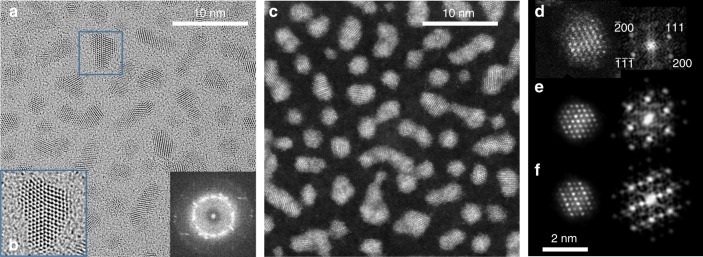
Fig. 1
Fig. 1
As-grown room temperature AgPt sample (flux 3.2 × 1015 at cm−2). a HRTEM images and in the inset, the total Fourier transform. b Zoom (×2) showing crystal twinning. c STEM-HAADF image with homogeneous contrast. High-resolution STEM-HAADF image and the corresponding FFT for d experimental NP along the [011¯] zone axis and the corresponding simulated images e for a random solid solution and f for an L11 ordered structure. HRTEM high resolution in TEM, STEM-HAADF high angle annular dark field in scanning transmission electron microscope, NP nanoparticle
Fig. 2
Fig. 2
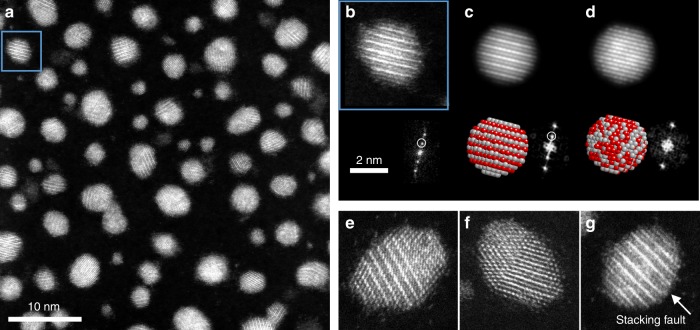
AgPt NPs after annealing at 400 °C. a STEM-HAADF image; b a zoom on one NP oriented along the [011¯] zone axis showing the L11 phase with alternating planes of Ag and Pt and its corresponding FFT showing the superstructure reflections. c, d Simulated STEM-HAADF images along the [011¯] zone axis for an L11 structure and a random solid solution respectively. eg show multidomains, twin and a stacking fault for L11 NPs (Pt atoms are in red and Ag atoms in grey). The scale is the same for bg. NP nanoparticle, FFT fast Fourier Ttransform, STEM-HAADF high angle annular dark field in scanning transmission electron microscope
Fig. 3
Fig. 3
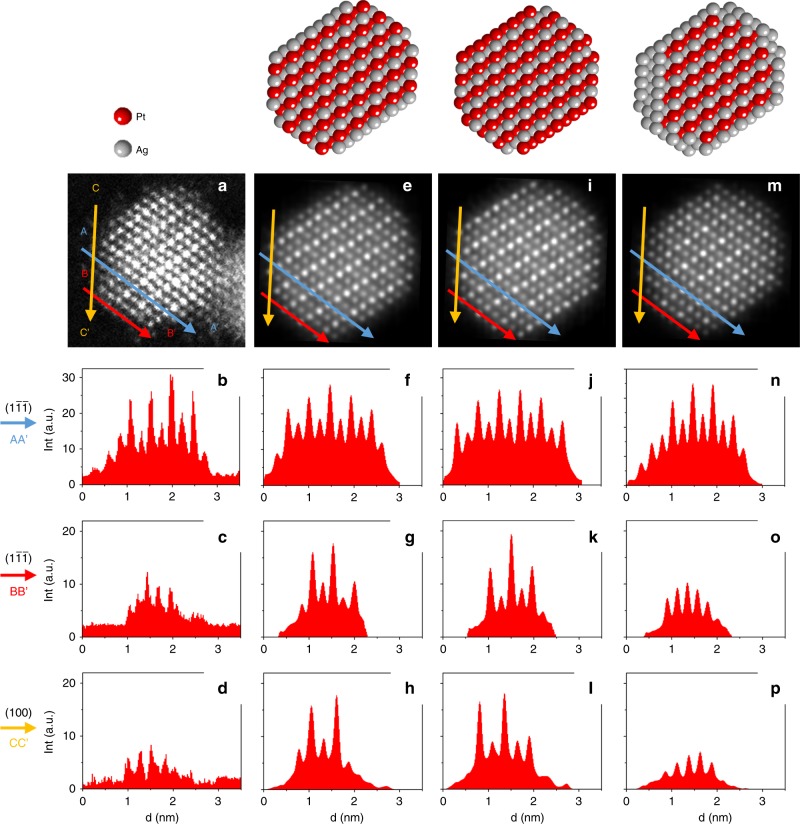
L11@Ag-skin nanoparticle. ad High-resolution STEM-HAADF image of a 2.8 nm NP in the [011¯] zone axis with its corresponding intensity profile lines. eh, il and mp show the model 1, 2, and 3 in the [011¯] zone axis, respectively, with their corresponding intensity profile lines. The intensity profiles were done for three different locations: along the (11¯1¯) plane close to the centre of the NP (AA′), along the (11¯1¯) plane at the NP surface (BB′) and along the (100) plane at the NP surface (CC′). STEM-HAADF high angle annular dark field in scanning transmission electron microscope, NP nanoparticle
Fig. 4
Fig. 4
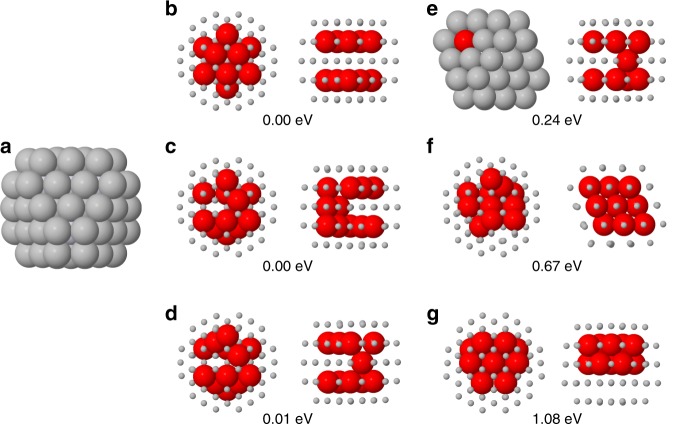
DFT results. a The truncated octahedron of 79 atoms. This structure has 19 internal sites, i.e. 18 subsurface sites plus the central site. bg Structures of Ag67Pt12. Each cluster is shown in two views. Pt atoms are in red and Ag atoms in grey. Pt and Ag atoms are shown as large and small spheres, respectively, with the exception of the left view of (e), in which all atoms are shown as large spheres. In (b), the perfect L11@Ag-skin phase is shown. The numbers give the DFT energy differences from the lowest-energy homotops, which are the perfect L11@Ag-skin structure shown in (b) and the structure in (c). DFT density functional theory
Fig. 5
Fig. 5
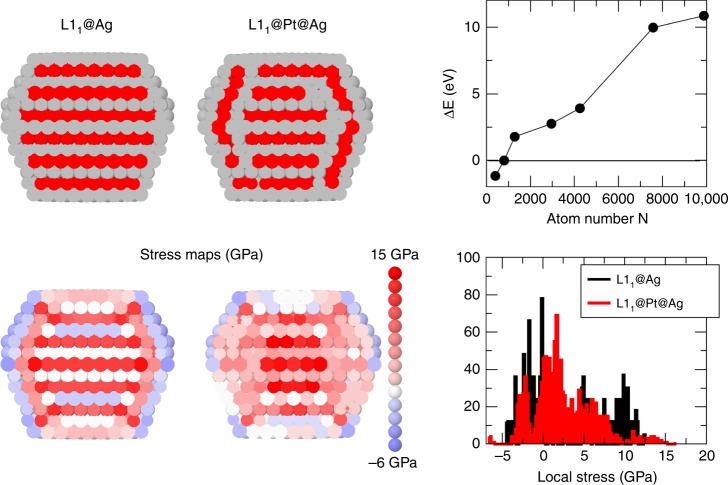
Theoretical predictions of L11 nanophases. L11@Ag core/shell and L11@Pt@Ag core/subshell/shell structures for the TOh1289 (Pt atoms in red, Ag atoms in grey) and their associated stress map in colour code from −6 GPa for tensile stress to 15 GPa for compressive stress. The graph on the bottom right illustrates the stress distribution inside the TOh1289 with the two structures and the graph on top shows the energy difference between the L11@Ag and the L11@Pt@Ag structures: positive sign means the L11@Pt@Ag is the stable structure

References

    1. Hill, T. L. Thermodynamics of Small Systems (Dover Publications, New York, 1994).
    1. Borel P, Buffat JP. Size effect on the melting temperature of gold partlcles. Phys. Rev. A. 1976;13:2287–2298. doi: 10.1103/PhysRevA.13.2287. - DOI
    1. Alloyeau D, et al. Size and shape effects on the order/disorder phase transition in cobalt-platinum nanoparticles. Nat. Mater. 2009;8:940. doi: 10.1038/nmat2574. - DOI - PubMed
    1. Andreazza P, Pierron-Bohnes V, Tournus F, Andreazza-Vignolle C, Dupuis V. Structure and order in cobalt/platinum-type nanoalloys: from thin films to supported clusters. Surf. Sci. Rep. 2015;70:188–258. doi: 10.1016/j.surfrep.2015.02.002. - DOI
    1. Okamoto H. Ag-Pt (silver-platinum) J. Phase Equilibria. 1997;18:485–485. doi: 10.1007/BF02647706. - DOI

Publication types